Clear Sky Science · en
Robotaxis reduce taxi drivers’ income
Driverless cars meet everyday work
Self driving taxis are no longer science fiction in some Chinese cities, and their arrival raises a simple but important question for anyone who depends on a paycheck: when machines start doing the driving, what happens to the people who used to sit behind the wheel? This study looks at Wuhan, China, where Baidu’s Apollo Go robotaxis now share the streets with traditional taxis, to see how this new service is already changing drivers’ earnings, working lives, and future plans.
A new kind of taxi on city streets
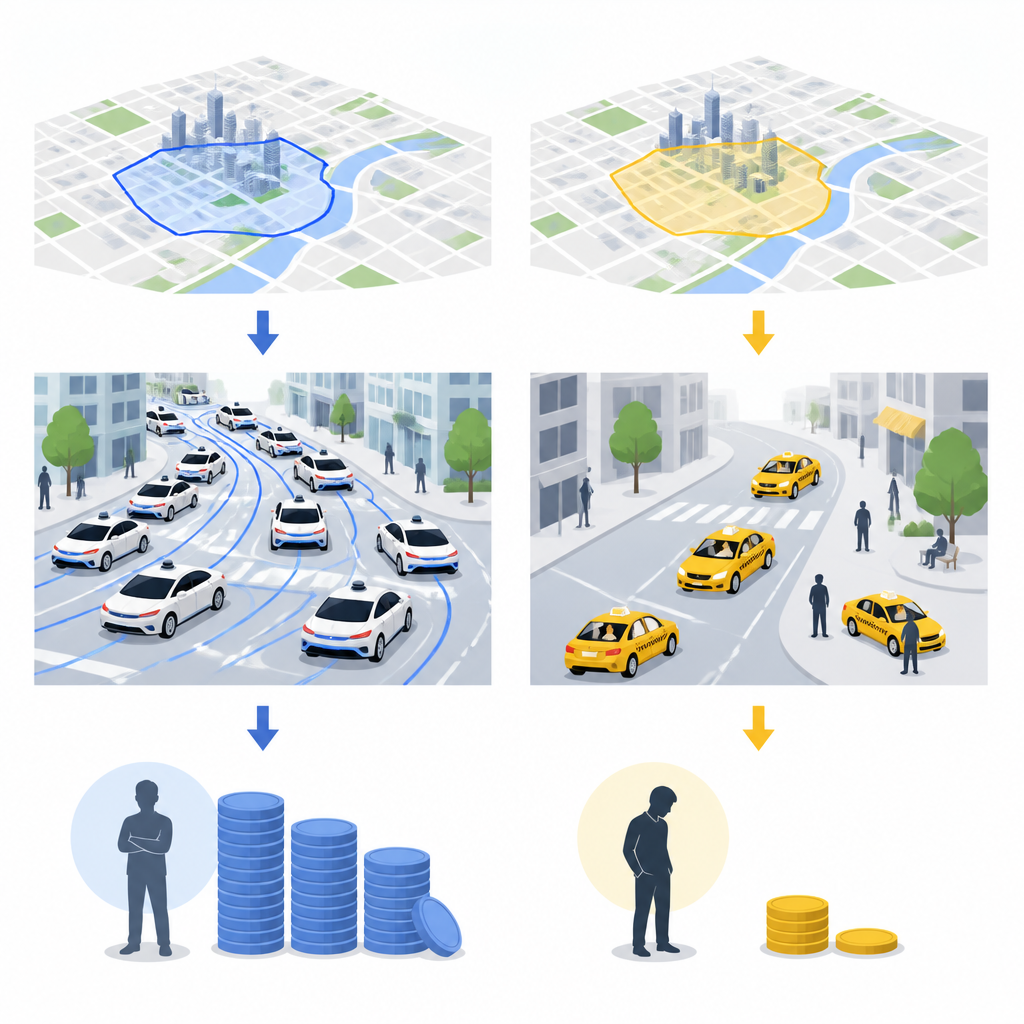
Baidu’s Apollo Go is a driverless taxi service that picks up and drops off passengers inside selected zones of Wuhan. Riders hail these vehicles through a phone app, much like a regular ride hailing service, but the cars operate without a human driver. The company has rolled out service district by district instead of all at once, which creates a clear contrast between neighborhoods where robotaxis are allowed to run and those where they are not. This patchwork rollout offered researchers a rare chance to measure how human taxi drivers fare when robotaxis suddenly appear in their home territory.
A natural test between two districts
The authors focused on two districts that differ in how tightly taxis are tied to local streets. In Jiangxia, where Apollo Go operates, many taxis are legally confined to that district and face fines if they cross into other areas to look for passengers. In Wuchang, where robotaxis do not yet run, taxis can roam freely throughout the city. By tracking more than 200,000 daily income records from January to August 2024, the researchers compared how driver earnings changed before and after Apollo Go’s June launch, using Wuchang as a benchmark for what would have happened without robotaxis. Before June, incomes in the two districts moved in step, but once Apollo Go arrived, earnings in Jiangxia began to fall while those in Wuchang rose.
What the numbers reveal
Using a standard statistical tool that isolates the effect of a policy change over time, the team estimates that the introduction of robotaxis cut the average daily income of Jiangxia’s traditional taxi drivers by about 10.9 percent in the short run. This drop appears to reflect a loss of riders to Apollo Go. The authors tested their results in several ways, including checks that compare different starting dates and “placebo” scenarios with fake launch dates, and the negative impact persisted. This suggests that the income decline is closely linked to the spread of robotaxis rather than to unrelated shifts in weather, holidays, or citywide demand.
Voices from behind the wheel
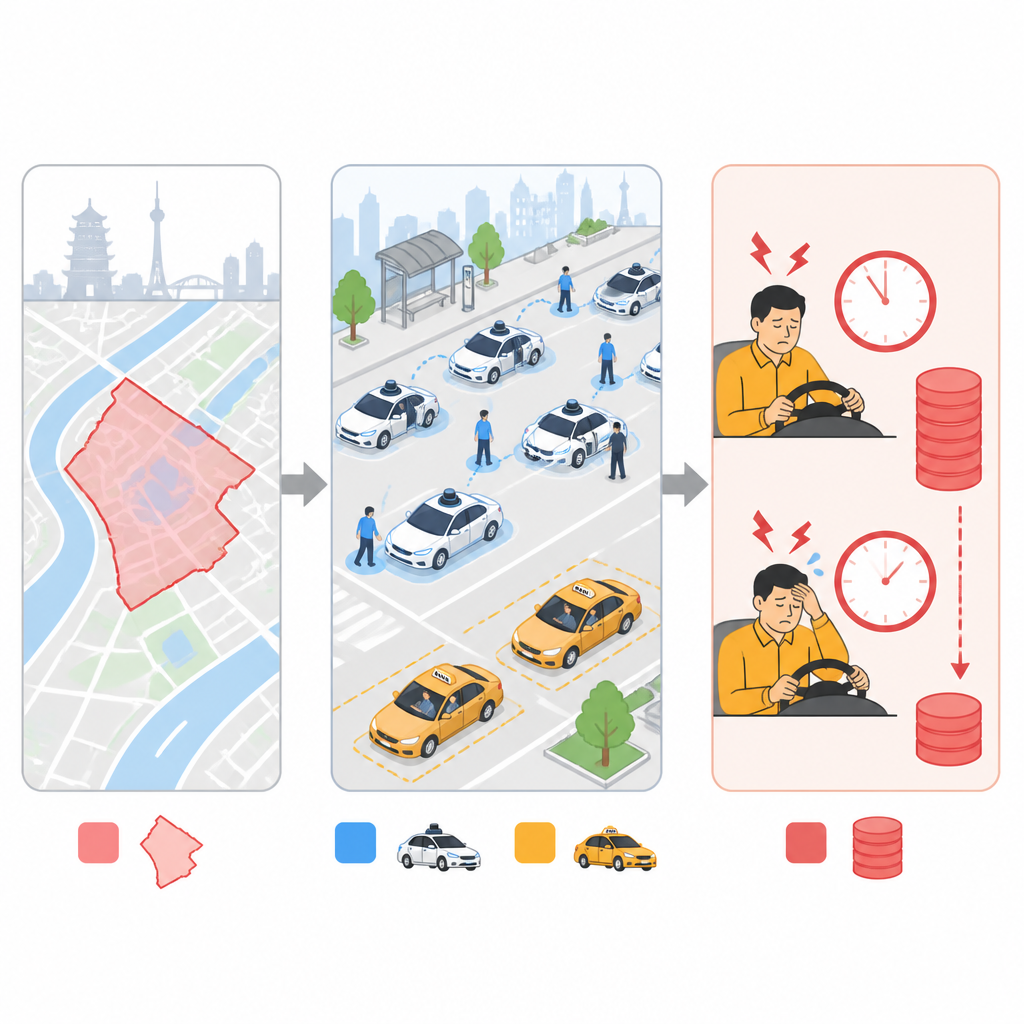
To see beyond the raw income figures, the researchers surveyed 180 taxi drivers across Wuhan. A majority in high coverage areas reported seeing several Apollo Go vehicles on a typical day and believed that the new service hurt their earnings. Many said it had become harder to find passengers, so they stayed on the road longer just to bring home similar pay, effectively lowering their hourly wage. In districts with dense robotaxi activity, more drivers reported longer working hours, greater job stress, trouble sleeping, and a loss of satisfaction with their work compared with drivers in low coverage areas. Most drivers in high coverage zones were considering leaving the industry, and a substantial share were already looking for other jobs.
What this means for workers and cities
The study offers early evidence that driverless taxis can quickly reduce the income and well being of human taxi drivers, at least in the first months after they arrive. When drivers are locked into a small area, as in Jiangxia, they have few ways to escape the new competition. The authors argue that cities should prepare for such shocks by easing rigid rules that trap drivers in shrinking markets, and by investing in training so workers can move into new roles as technology advances. In simple terms, the findings show that while robotaxis may bring convenience to riders, they also create real financial and emotional strain for the people whose jobs they partly replace.
Citation: Yu, Z., Wang, J., Zuo, T. et al. Robotaxis reduce taxi drivers’ income. Humanit Soc Sci Commun 13, 629 (2026). https://doi.org/10.1057/s41599-026-07366-x
Keywords: robotaxis, taxi drivers, artificial intelligence, autonomous vehicles, labor markets