Clear Sky Science · en
Linguistic dynamics of online scam conversations: a multi-stage analysis based on the COLD framework
Why Online Scam Chats Matter
Online scams are no longer just clumsy emails from strangers. Many now unfold as long, carefully crafted conversations in messaging apps, where scammers play the role of caring partner or savvy investor. This study looks inside nearly 277,000 real messages from successful Chinese romance and investment scams to ask a simple question: how does the way people talk help scams work, step by step?
Five Steps From “Hello” to Harm
Researchers found that scams generally move through five stages: building trust, inventing risk, pitching a fake solution, pushing for action, and then squeezing the victim again and again. In the first stage, scammers share personal stories and warm greetings to create a sense of closeness while staying away from money talk. Next, they introduce a crisis or urgent problem, such as fake hospital bills, to stir fear and urgency. That sets the stage for a supposedly helpful opportunity, like a special investment, followed by strong pressure to transfer money or share sensitive information. Finally, when victims are already committed, scammers fabricate new setbacks and fees, keeping the scheme going as long as possible. 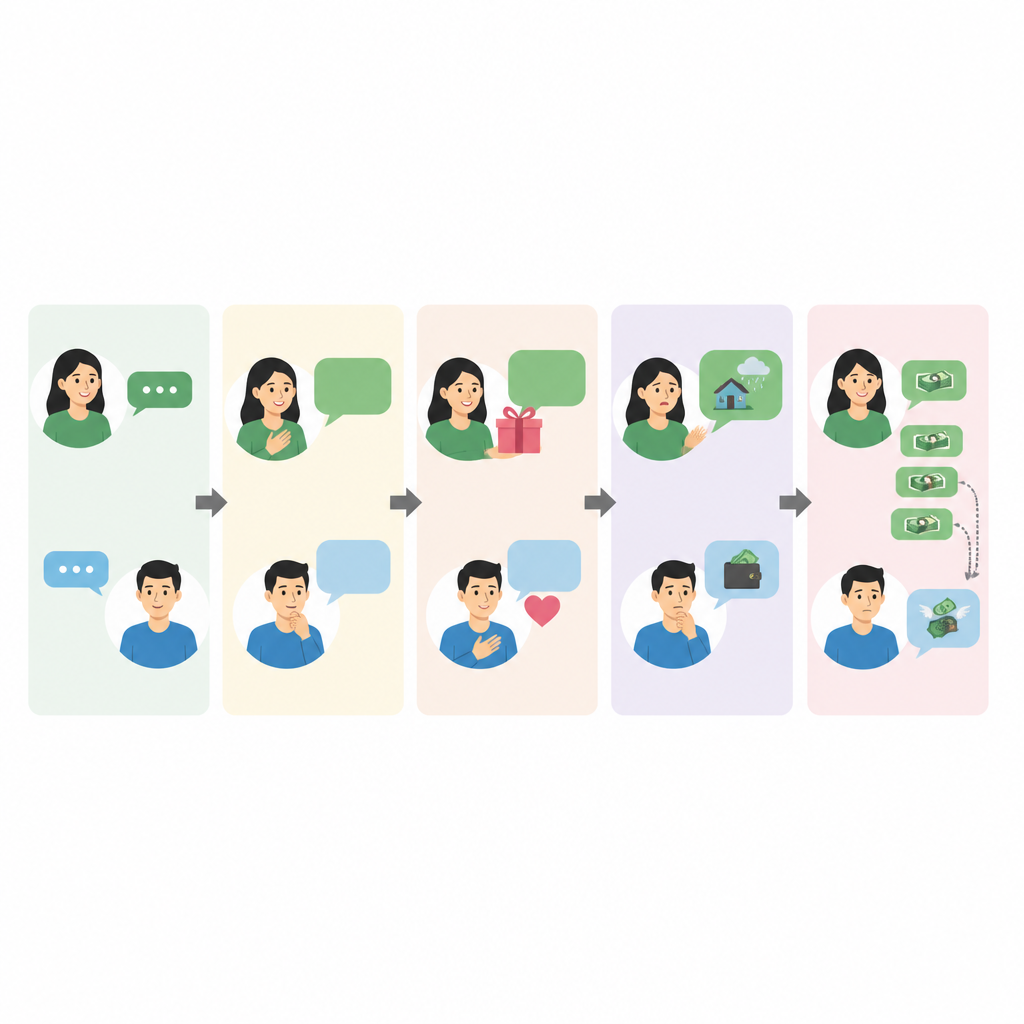
Different Voices for Scammers and Victims
Across all these stages, scammers and victims use language in strikingly different ways. Scammers lean on words that signal thinking, control, and connection. They use more terms linked to reasoning and mental effort, and they often talk in ways that stress achievement, power, and money while playing down words about danger or risk. They also use more social and affiliation words, such as those that suggest friendship or togetherness, and they favor phrases that include the other person or a shared “we.” Victims, by contrast, use more emotional language overall, including both positive and negative feelings, more anxiety-related words, and even more swearing. They also talk more about themselves, using “I” language that reflects self-focus and distress.
Emotional Ups and Downs Over Time
The emotional landscape of these chats is far from flat. Scammers keep a relatively steady tone, with only small rises in signs of anxiety as exploitation deepens. Victims, however, ride a roller coaster. Their negative emotions and anxious wording spike during the persuasive pitch, when the big opportunity is laid out and doubts naturally surface. They also show bursts of words that suggest thinking hard, uncertainty, and trying to make sense of the situation. Surprisingly, victims use more positive emotion words than scammers, especially in romance scams. This suggests that victims might be trying to regulate their feelings, using hopeful or affectionate language to calm themselves, maintain the relationship, or avoid admitting that something is wrong.
How Words Push People Toward Compliance
The study also tracks how persuasive themes rise and fall at different stages. As scammers move from trust-building to risk and then to the pitch, they sharply increase money-related and reward-focused terms, especially when describing the supposed benefits of an investment. These patterns stay high through the compliance and repeated exploitation stages, matching their push for continued transfers. Victims, meanwhile, begin to echo some of this language, talking more about rewards and gains themselves. This echoing shows how they gradually join in the scammer’s story, reinforcing the idea that big benefits are just one more payment away. 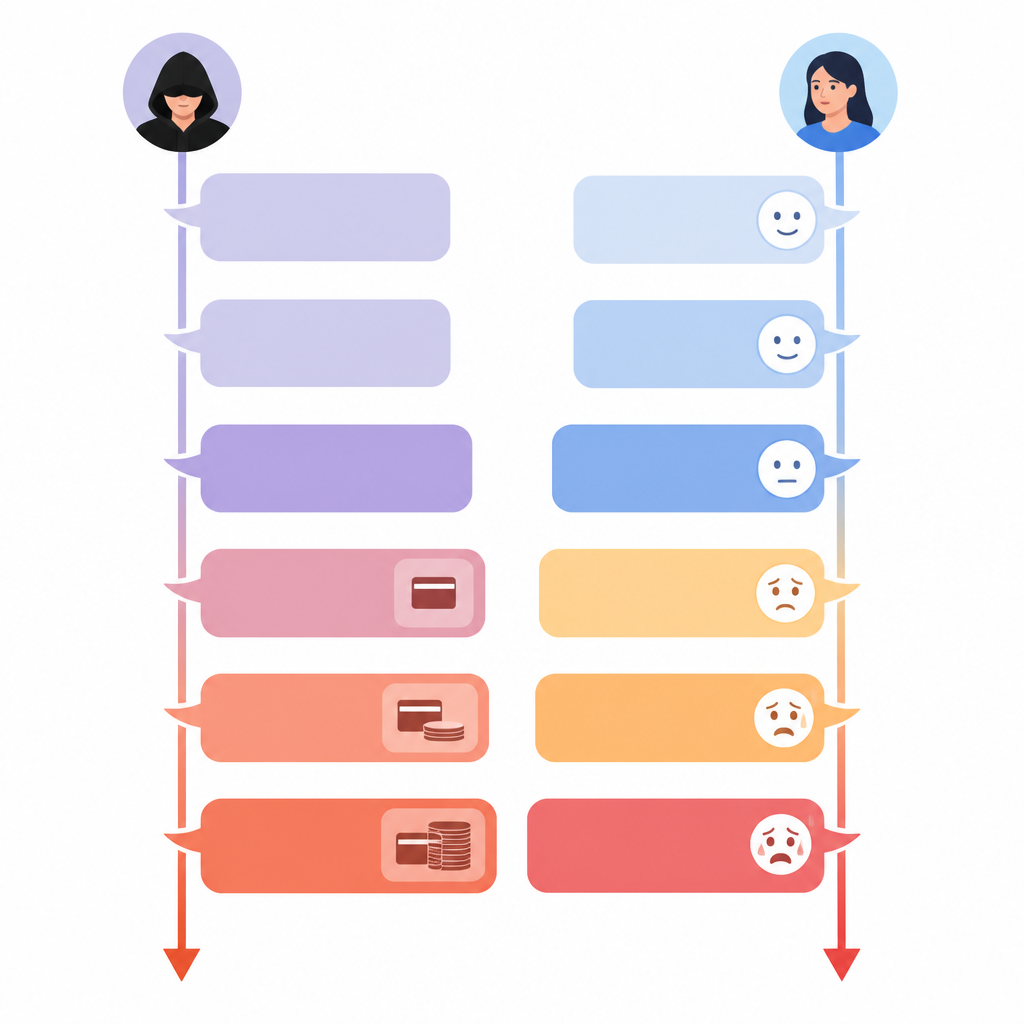
What This Means for Everyday Defenses
By mapping how language shifts across stages, the study shows that scams are not single moments of trickery but long, interactive performances. Scammers manage their words to appear steady, caring, and in control, while victims’ language reveals growing hope, fear, and inner conflict. These insights can help design tools that flag risky conversations based on patterns of words and can guide public education that teaches people to recognize the telltale mix of warmth, urgency, and money talk. In simple terms, the research shows that the way we write in chats can either protect us or make us vulnerable, and learning to read those signals may be one of our best defenses against online scams.
Citation: Li, D., Zheng, R., Liu, X.F. et al. Linguistic dynamics of online scam conversations: a multi-stage analysis based on the COLD framework. Humanit Soc Sci Commun 13, 698 (2026). https://doi.org/10.1057/s41599-026-07052-y
Keywords: online scams, deceptive language, romance fraud, psycholinguistics, cybercrime