Clear Sky Science · en
COVID-19 school closures, learning losses and intergenerational mobility
Why this matters for families everywhere
When schools closed during the COVID-19 pandemic, many parents worried about their children falling behind. This study looks beyond short test score drops to ask a deeper question: how might those months and years of disrupted learning shape children’s futures compared with their parents, especially for families with fewer resources? Using global data, the authors explore whether the pandemic could slow or even reverse the long-running trend of children getting more education than the generation before them.
School shutdowns and uneven chances to keep learning
Across the world, school closures hit at the same time as job losses and health worries, but not all children were affected in the same way. In richer countries, and in better-off households, many students shifted to online classes or stayed in touch with their teachers. In poorer countries, and in families with less educated parents, large numbers of children had no access to any learning during closures. Phone surveys from 30 developing countries show that children whose parents have more education were far more likely to continue learning, while those from less educated households were often left idle.
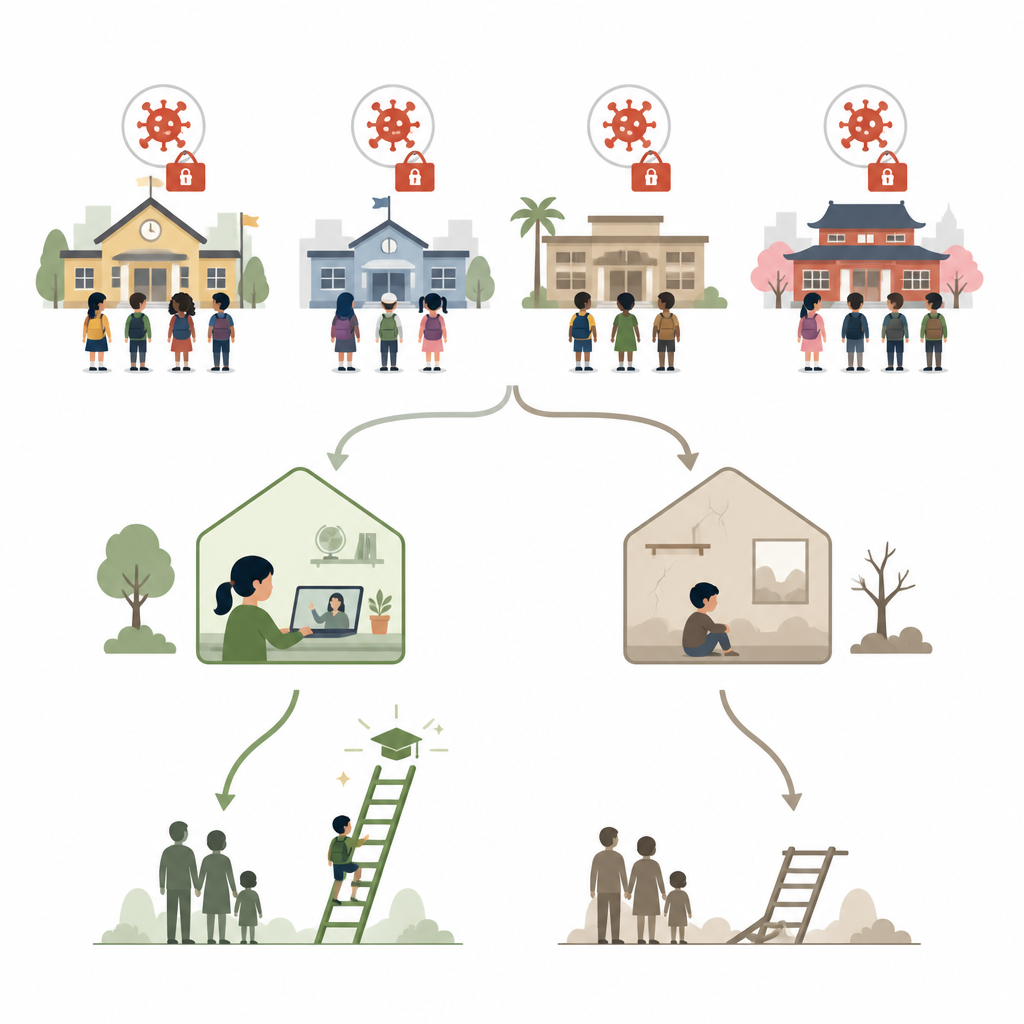
From lost lessons to fewer years in school
The researchers translate missed learning into something simple to compare across countries: years of effective schooling. They start with existing data on how many years of education people typically complete, and how that compares between parents and children. They then use models of learning loss, built from worldwide information on how long schools stayed shut and how effective different types of remote learning were, to estimate how much schooling the current generation of students may effectively lose. A key idea is that a year in school with poor or no learning does not count the same as a normal year in the classroom.
Who is most likely to fall behind their parents
Using these tools, the study simulates two kinds of movement across generations. Absolute mobility asks whether children end up with more schooling than their parents. Relative mobility asks how strongly a child’s education depends on their parents’ education level. The results suggest that, without strong remedial action, the share of children who surpass their parents’ education may fall by about eight to nine percentage points in high and upper middle income countries. In low and lower middle income countries, the drop is smaller but still worrying, and in many places it erases years of gradual progress made before the pandemic.
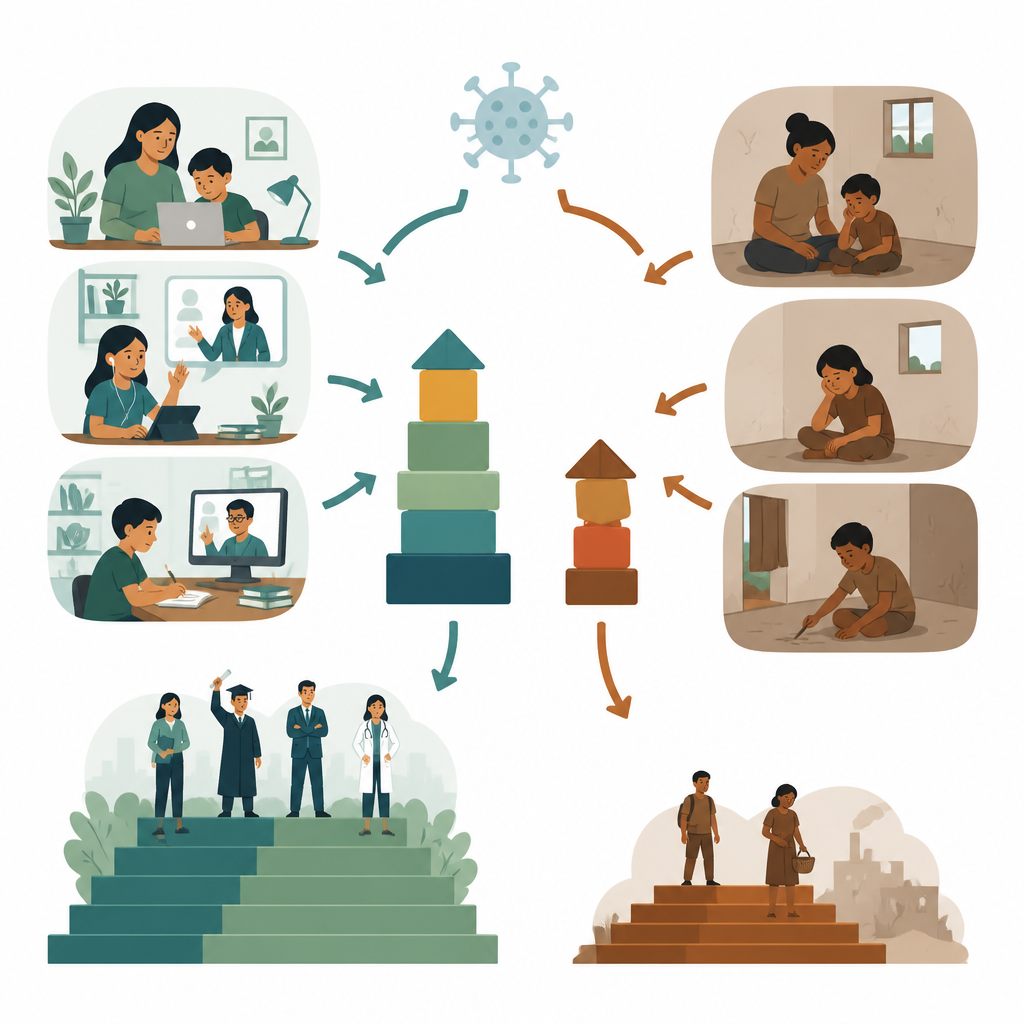
Unequal remote learning and growing gaps
The most striking effects appear when looking at relative mobility, which reflects fairness of opportunity. Because children from better-off households were more likely to have some form of learning during closures, while poorer children were often completely cut off, the link between parents’ and children’s education tightens. In the sample of countries studied, the correlation between the two rises by almost four percent on average, with even larger jumps in some countries. Surprisingly, assuming that remote learning worked better overall actually makes the simulated inequality worse, since those benefits mainly reach children who were already more advantaged.
What this could mean for the next generation
The authors stress that their simulations are not precise forecasts but informed scenarios based on current data and reasonable assumptions. Even so, the message is clear for a lay reader: if nothing more is done, COVID-19 school closures risk locking many children, especially those from poorer families, into lower levels of education than they might otherwise have achieved. That in turn could slow progress in reducing poverty and inequality. The good news is that these outcomes are not fixed. Well designed efforts to bring students back to school, measure what they have missed, focus on core skills, and support both learning and well-being can still prevent temporary school shutdowns from becoming permanent barriers to a better life.
Citation: Cojocaru, A., Azevedo, J.P., Narayan, A. et al. COVID-19 school closures, learning losses and intergenerational mobility. Humanit Soc Sci Commun 13, 646 (2026). https://doi.org/10.1057/s41599-026-06967-w
Keywords: COVID-19 school closures, learning loss, educational mobility, remote learning, inequality