Clear Sky Science · en
Predicting unethical intentions among accounting students in Vietnam: an exploratory study applying the extended theory of planned behavior
Why this matters beyond the numbers
When we read about corporate scandals or collapsing companies, it is easy to blame a few bad actors at the top. But long before someone signs a fraudulent report, that person was a student learning how to handle money, pressure, and professional duty. This study looks at Vietnamese accounting and auditing students and asks a simple, unsettling question: under what conditions are tomorrow’s professionals more likely to do the wrong thing?
Looking at future accountants in real-life dilemmas
To explore this, the researchers surveyed 214 accounting and auditing students at leading universities in Hanoi. Instead of asking abstract questions about honesty, they presented two concrete situations that often arise in practice: breaking client confidentiality, and slipping personal expenses into a company’s accounts. Students rated how likely they would be to act in these ways, and how they felt about such behavior, using a detailed questionnaire adapted from earlier international studies.

The four forces that steer ethical choices
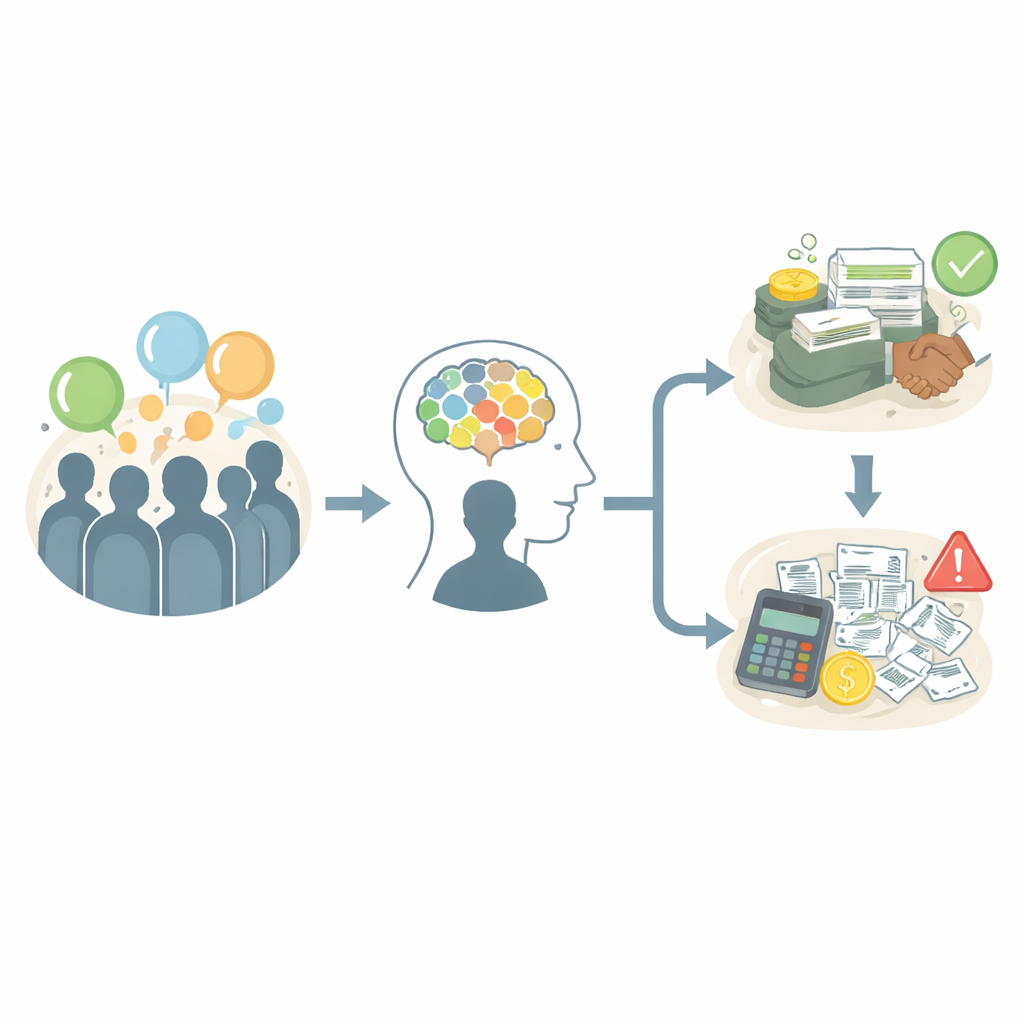
The team relied on a well-known psychological framework called the extended theory of planned behavior. In plain terms, it says that a person’s intentions grow out of four main forces. First is attitude: whether someone sees a questionable act as acceptable or harmful. Second are social pressures, such as the expectations of friends, family, and teachers. Third is perceived control, or how easy a person thinks it would be to carry out the act. Finally, the extended model adds moral obligation, which captures a person’s inner sense of right and wrong and how guilty they would feel if they crossed a line.
What the numbers reveal about temptation
Using statistical analyses, the authors found that all four forces meaningfully shaped students’ willingness to behave unethically in the scenarios. Students who had a more favorable attitude toward the dubious actions, who felt that people around them would not strongly disapprove, or who believed it would be easy to get away with them, were more inclined to say they might do them. By contrast, those who felt a strong inner duty not to harm clients or misuse company funds reported lower intentions to act unethically. Together, these four factors explained just over half of the differences in students’ responses, suggesting that they capture a large share, but not all, of what drives ethical intentions.
Culture, conscience, and the weight of guilt
One of the most striking findings is that moral obligation was the single strongest influence: students who anticipated feeling guilty or believed the act clashed with their principles were much less likely to go along with it, even when social or practical conditions made it seem easy. The authors argue that this may reflect Vietnam’s cultural background, where collectivist values shaped by Confucianism and Buddhism anchor ideas of duty, harmony, and responsibility to others. In such a setting, conscience is not only personal; it is tied to family honor and community expectations, which may give moral considerations extra weight.
Teaching ethics as a pillar of sustainable growth
Because these students will soon handle real companies’ books, the study’s implications reach far beyond the classroom. The authors conclude that strengthening ethics education—through realistic case studies, discussion of gray areas, and exposure to strong role models—can reinforce the attitudes, social expectations, and inner obligations that prevent wrongdoing. Doing so not only helps prevent the next financial scandal; it also supports broader sustainable development goals by building a workforce that values transparency, fair play, and public trust at the heart of economic life.
Citation: Binh, V.T.T., My, T.T., Rickards, R.C. et al. Predicting unethical intentions among accounting students in Vietnam: an exploratory study applying the extended theory of planned behavior. Humanit Soc Sci Commun 13, 544 (2026). https://doi.org/10.1057/s41599-026-06944-3
Keywords: accounting ethics, student behavior, Vietnam, unethical intentions, theory of planned behavior