Clear Sky Science · en
Does distance influence international collaboration among scientists? Evidence from library and information science
Why working together across borders matters
Most of today’s big scientific questions are too complex for any one country to tackle alone. This study looks at how researchers in library and information science—a field that underpins how we organize and share knowledge—have joined forces across national borders over the past three decades. It asks a deceptively simple question: does the distance between countries still matter when scientists decide whom to work with, now that digital tools seem to connect everyone instantly?
How global teamwork has grown
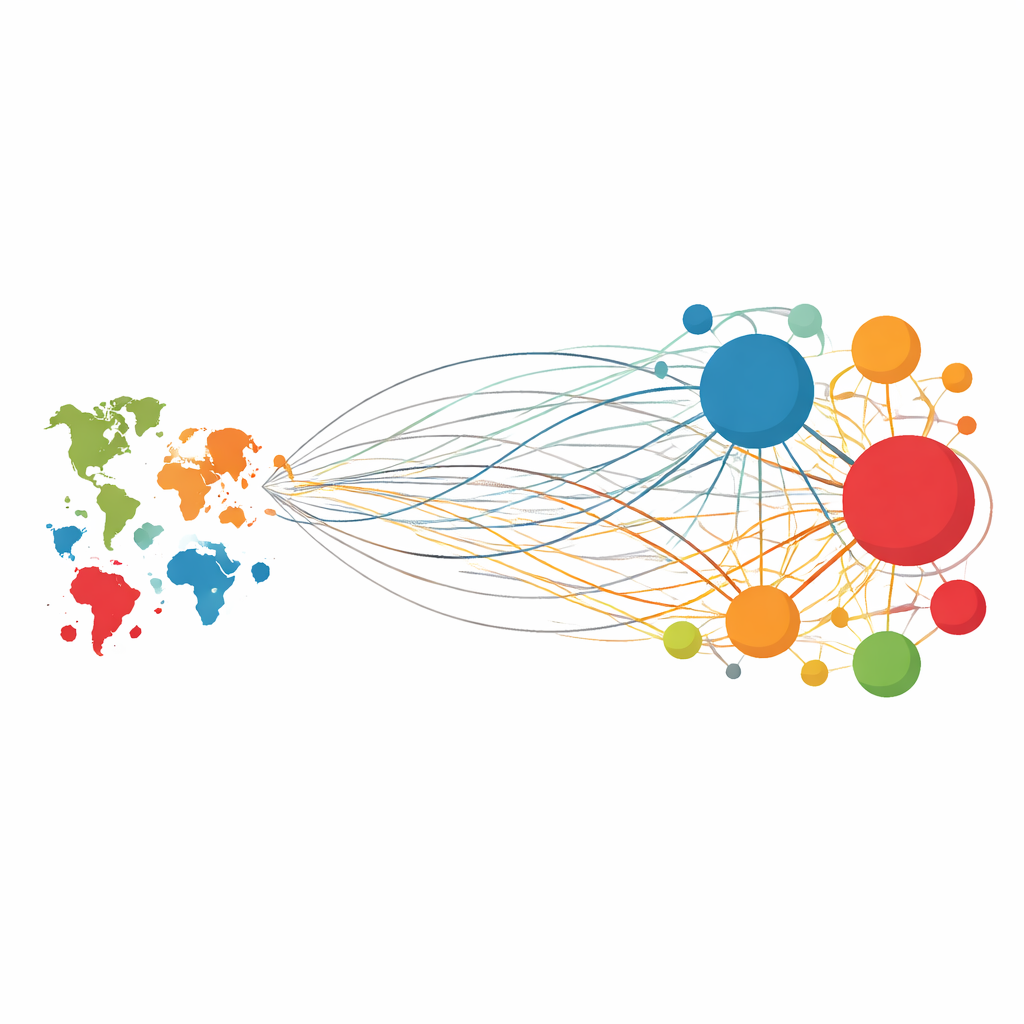
From 1990 to 2019, research in library and information science shifted from being mostly solo work to being dominated by teams. Co‑authored papers rose from about one quarter to roughly three quarters of all articles in the field. The fastest growth came from international co‑authorships, which expanded far more quickly than collaborations within the same country and now account for more than one in five papers. Even so, most work still happens in small teams of two to six authors, suggesting that intimate, focused groups remain the norm while giant global consortia are relatively rare.
From one main hub to a shared lead
Looking at who collaborates with whom, the global network has changed shape dramatically. In the early 1990s, the United States sat at the center of a hub‑and‑spoke system, connecting to many other countries that were less connected to each other. By the 2010s, the picture had shifted to a more balanced pattern with two major hubs—the United States and China—surrounded by several strong regional players in Europe and the Asia‑Pacific. The number of participating countries nearly doubled, and the number of collaborative ties increased more than sixfold, showing that library and information science has become a genuinely worldwide enterprise.
When distance still makes a difference
To uncover what drives these patterns, the study used a "gravity" model, a statistical approach borrowed from economics that compares how often each pair of countries works together. It focused on four kinds of distance: geographic (how far apart countries are and whether they share a border), cultural (whether they share a language or colonial history, and how their values differ), political (differences in governance quality), and economic (gaps in income levels). After carefully adjusting for countries’ overall research activity and testing many variations of the model, the results are clear: traditional ties such as a common language, a shared land border, and past colonial links strongly and consistently boost collaboration. Physical distance between capitals still acts as a mild brake—the farther apart two countries are, the less often they publish together—but this effect is smaller than the pull of shared language and history.
What matters less than expected
Surprisingly, differences in national wealth or political systems did not show a lasting, direct effect on how often countries collaborated. Whether countries were rich or poor, or had similar or different governance profiles, did not by itself predict more or fewer joint papers once other factors were taken into account. Even detailed measures of cultural values showed only weak or inconsistent influence compared with the simple fact of speaking the same language or sharing historical connections. Robustness checks—using different ways of counting papers, alternative economic and political indicators, and stricter samples—confirmed that these conclusions were not artifacts of one particular method.
What this means for the future of shared knowledge
For a lay reader, the main message is that science is becoming more global, but old ties still matter. Library and information scientists increasingly work across borders, and the global network has opened up from a single dominant center to a more plural, yet still unequal, structure. Shared language, neighboring geography, and historical relationships continue to make collaboration easier, even in an age of email and video calls. By contrast, economic and political gaps are less decisive than many might assume. For policymakers and institutions hoping to foster international research, this suggests that investing in language skills, mobility across borders, and long‑term relationships may do more to encourage fruitful collaboration than economic incentives alone.
Citation: Zhao, Y. Does distance influence international collaboration among scientists? Evidence from library and information science. Humanit Soc Sci Commun 13, 462 (2026). https://doi.org/10.1057/s41599-026-06767-2
Keywords: international scientific collaboration, library and information science, geographic and cultural distance, research networks, science globalization