Clear Sky Science · en
Collectivism or individualism: the challenge to predict green hotel selection in a developing country
Why your hotel choice matters
When we book a place to stay, we rarely think about how our culture and personal values shape that choice. Yet hotels consume large amounts of water and energy, and "green" hotels are promoted as a way to reduce this impact. This study looks at young adults in China and asks a simple but important question: are people driven more by group-minded values or by self-focused ones when deciding whether to choose and pay extra for an environmentally friendly hotel?

Different ways of caring about the planet
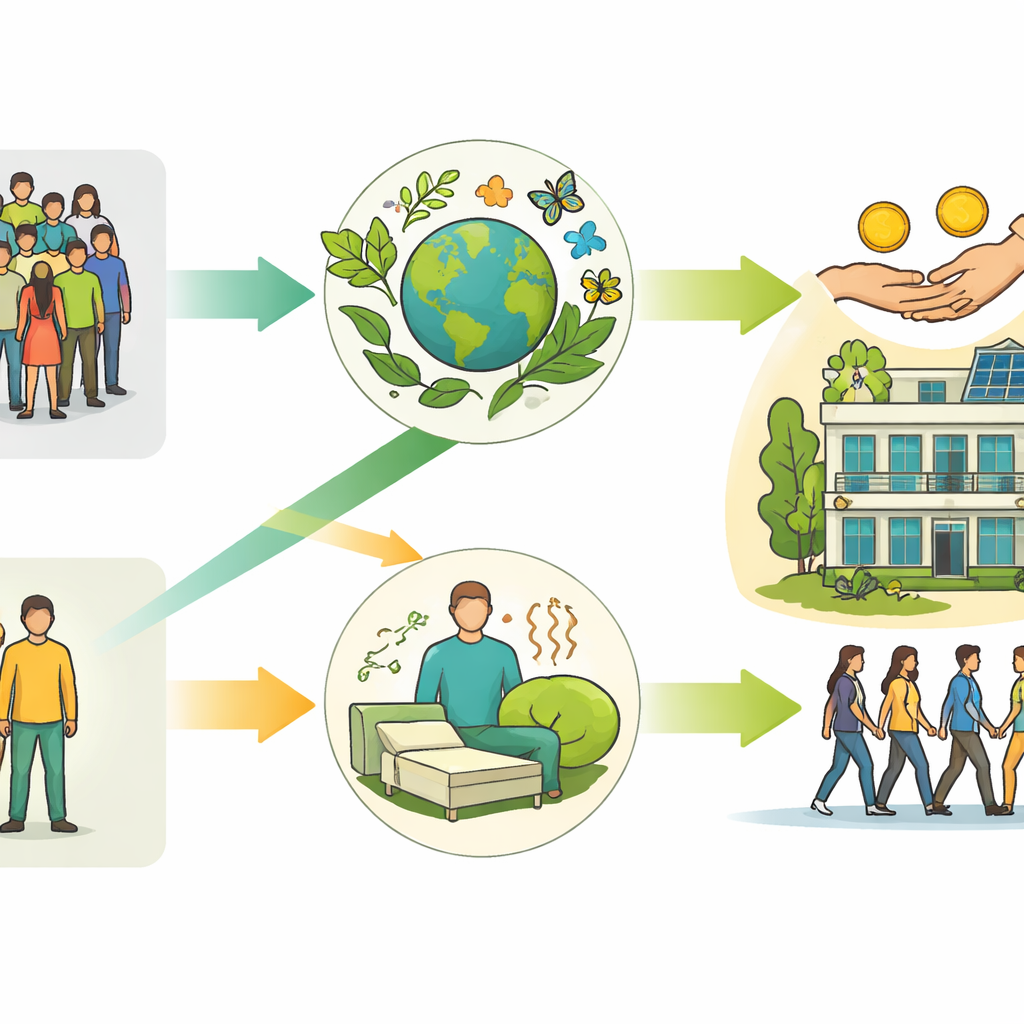
The researchers distinguish between two broad value systems and two kinds of environmental attitudes. On the value side, collectivism reflects seeing oneself as part of a group, valuing harmony and shared goals, while individualism reflects independence, competition, and self-reliance. On the attitude side, an ecocentric view reflects caring about nature for its own sake, whereas an anthropocentric view reflects caring about the environment mainly because it affects human comfort, health, and quality of life. Earlier studies, mostly in Western settings, left open how these four pieces fit together in countries where group values are traditionally strong, such as China.
How the study was carried out
The authors surveyed 296 university students in three Chinese cities using established psychological questionnaires. Students rated how strongly they agreed with statements that captured collectivist or individualist values, their feelings about protecting nature, their evaluations of green hotels, their intention to stay in such hotels, and how much extra they would be willing to pay. The answers were analysed with structural equation modelling, a statistical technique that maps how multiple factors influence one another at the same time rather than one by one.
What the researchers discovered
The results paint a nuanced picture. Students with stronger collectivist values were more likely to have a favourable view of green hotels and were more willing both to stay in them and to pay a premium. Surprisingly, however, collectivism did not significantly strengthen a deep, nature-centered (ecocentric) outlook. In contrast, individualism reduced both types of environmental attitudes: highly self-focused students tended to care less about nature and evaluated green hotels less positively. Yet those same individualistic students still showed higher intentions to choose green hotels and to spend extra on them. The authors suggest that, for these youths, green hotels may be attractive for self-oriented reasons such as health, comfort, status, or novelty, even when they are less emotionally invested in environmental protection.
Two kinds of attitude work together
Both ecocentric and anthropocentric attitudes independently boosted students’ intention to choose a green hotel and their willingness to pay more, with the human-centered attitude having the strongest link to planned visits. Importantly, a stronger ecocentric outlook also led to a more positive, benefit-focused view of green hotels themselves. This suggests a chain: caring about nature in general makes students more open to seeing green hotels as desirable for their own experience, which in turn encourages them to book and pay more. Additional analyses showed that these attitudes partly explain how individualism and collectivism translate into actual intentions, underscoring that values work through what people feel and believe about both nature and specific products.
What this means for travelers and hotels
For a layperson, the takeaway is that both group-minded concern and self-interest can nudge people toward greener stays, but they do so in different ways. In a highly collectivist society like China, appeals that stress shared benefits and group responsibility align well with guests’ intentions and their readiness to pay more. At the same time, even individualistic guests may opt for green hotels if these properties clearly deliver personal advantages such as better health, comfort, or prestige. The study concludes that promoting green hotels effectively in developing countries requires speaking to both hearts: the part that cares about nature and society, and the part that looks for personal value in every trip.
Citation: Wang, L., Zhang, Q. & Wang, ZX. Collectivism or individualism: the challenge to predict green hotel selection in a developing country. Humanit Soc Sci Commun 13, 377 (2026). https://doi.org/10.1057/s41599-026-06742-x
Keywords: green hotels, collectivism and individualism, environmental attitudes, willingness to pay, sustainable tourism