Clear Sky Science · en
Grounding ontologies: considering diversity and practice in conceptions of non-humans in an Amazonian society
Why this story from the Amazon matters
How people imagine the world around them shapes how they treat forests, animals, and even the night sky. This article takes us inside a Matsigenka community living deep within Peru’s Manu National Park to explore how they think about animals, plants, and other beings. Rather than assuming that a whole culture shares one fixed worldview, the study shows that ideas about non‑humans are diverse, shaped by daily practice, and sometimes even contradictory. Understanding this richer picture helps us rethink broad claims about “other worlds” and offers a more grounded way to listen to Indigenous voices in debates over nature and conservation. 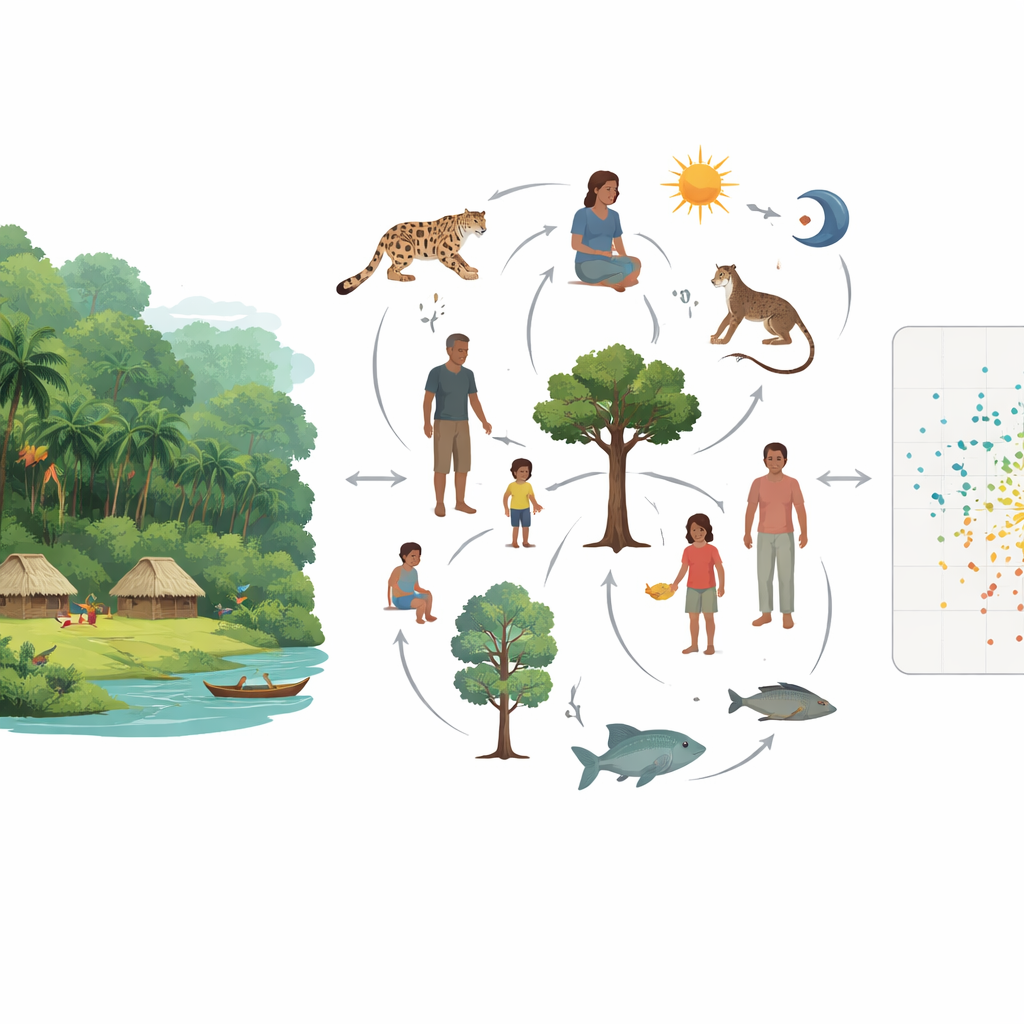
Many worlds, or one complicated one?
Over the past two decades, a set of ideas known as the “ontological turn” has argued that different societies don’t just hold different beliefs about a single reality; they may inhabit entirely different realities. Inspired by Amazonian ethnography, some scholars claim that animals and spirits are treated as persons with humanlike souls, yielding radically different worlds that cannot be easily compared. Critics counter that this picture is too neat: it smooths over disagreement within communities, ignores change over time, and often takes every statement as literally true without asking how people actually act. The author enters this debate by proposing a more modest and empirical way to talk about “ontologies”: instead of sealed-off worlds, they are shared ways of imagining and acting that can be multiple, unevenly distributed, and constantly in motion.
Living with many kinds of beings
Among the Matsigenka of Tayakome, people regularly interact with an array of beings—game animals, trees, crops, rivers, and celestial bodies—with whom they maintain close, practical relationships. Key to these relationships is a concept that the author translates as “soul,” linked to thinking, vitality, and moral behavior. Yet not all souls are alike. Some beings, such as the giant armadillo kinteroni, are remembered as humans transformed long ago, and their souls are seen as powerful and protective but also potentially dangerous. Others, like the spider monkey, may have a remote and threatening master spirit, while everyday monkeys are treated simply as game. Certain trees and fish can harm infants by “stealing” their souls, whereas staple foods like the palm tsigaro are viewed as entirely safe and even essential to a person’s healthy development—and are said to have no soul at all. These examples already show a tangle of relationships that does not fit a single animistic template.
From stories to patterns in numbers
To understand how widely these ideas are shared, the author combined long-term participant observation with a structured interview given to 51 adults. Community members were asked, for 77 different beings, whether each has a soul and whether it is, or once was, human. Using a Bayesian item response model, the study mapped both people and beings into a two‑dimensional space: one axis captured the likelihood of being seen as having a soul, the other the likelihood of being seen as human or formerly human. The resulting picture showed clusters. Some beings were widely agreed to be humanlike persons with powerful souls (such as certain healing plants and protective figures). Others—especially domesticates and everyday food plants—were consistently judged to be neither human nor ensouled. In between lay large groups, like common game animals and dangerous trees or fish, about which there was marked disagreement, reflecting different experiences and roles in the community. 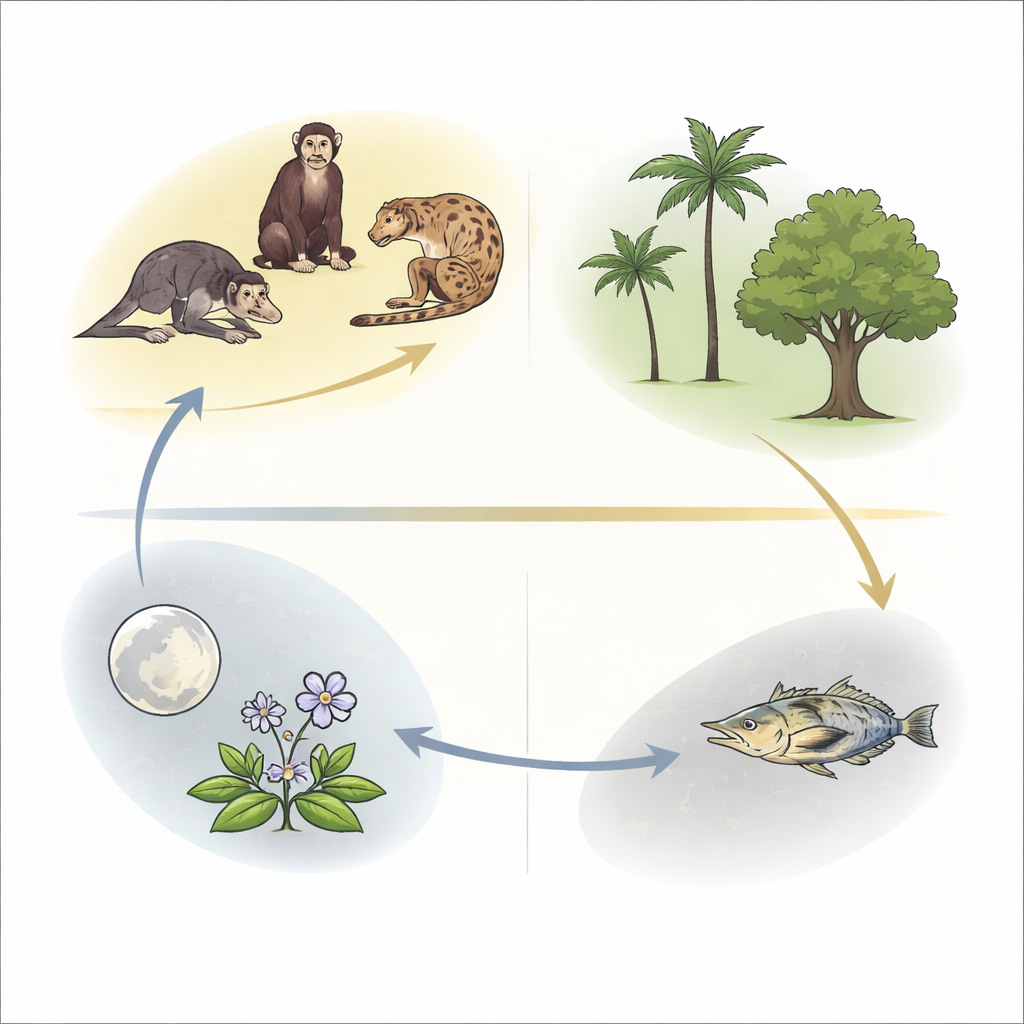
Specialists, stories, and shifting views
Variation did not fall neatly along lines of age or gender alone. Instead, the strongest differences appeared among people with particular specializations, such as expert hunters, healers, or women currently caring for infants. Skilled hunters and their close relatives were more likely to describe game animals in terms of master spirits, while healers and mothers of young children more often emphasized beings that could steal a child’s soul. At the same time, ideas about which beings were once human seemed more uniform, passed on through shared origin stories. This suggests that narratives circulate widely and anchor certain classifications, while lived experience with specific plants and animals makes views of their souls more fluid and contested.
What this means for understanding other lifeways
Seen together, the ethnographic stories and statistical patterns challenge the image of Indigenous ontologies as single, stable worlds. In Tayakome, ideas about non‑humans are layered, context‑dependent, and tied to what people actually do—hunt, heal, farm, and care for children. Some relations resemble familiar descriptions of animism, where animals or plants are treated as persons, but others give key foods or protective plants no inner life at all. The study argues that to take people seriously is not simply to declare that “everything they say is literally true,” but to watch how different statements are enacted in practice. Doing so reveals ontologies as shared yet uneven, emerging at the intersection of stories, skills, and everyday encounters. Rather than dividing humanity into incommensurable worlds, this grounded approach invites a more careful, comparative, and politically attentive way of engaging with Indigenous understandings of the more‑than‑human world.
Citation: Revilla-Minaya, C. Grounding ontologies: considering diversity and practice in conceptions of non-humans in an Amazonian society. Humanit Soc Sci Commun 13, 404 (2026). https://doi.org/10.1057/s41599-026-06494-8
Keywords: Amazonian anthropology, Indigenous ontologies, human–nonhuman relations, Matsigenka, animism