Clear Sky Science · en
COVID-19 and urban exodus: diverging population redistribution patterns across countries from 2020 to 2022
Why People Moved Away from Big Cities
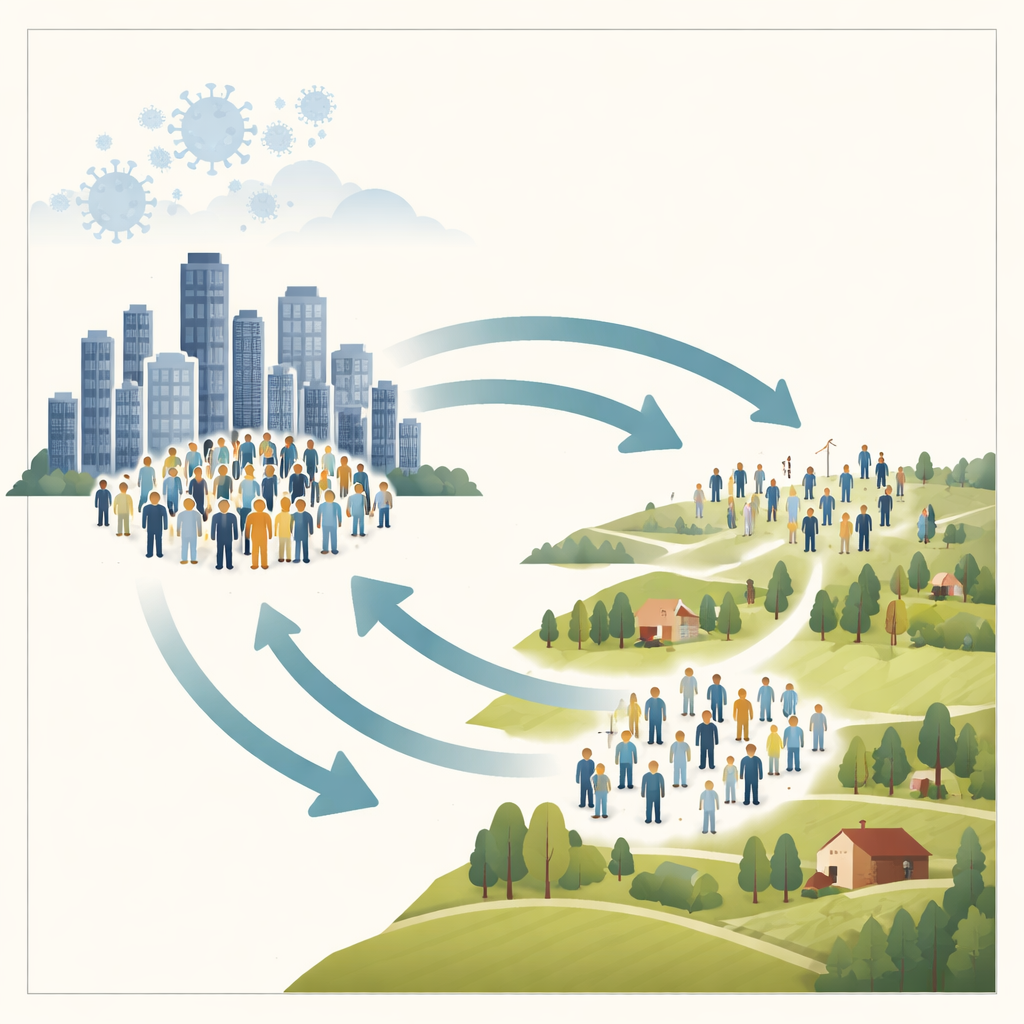
The COVID-19 pandemic did not only change how we work and travel; it also quietly reshaped where many people chose to live. This study looks at whether there really was an "urban exodus" from big cities to smaller towns and countryside, and how lasting those changes might be. By tracking how millions of social media users shifted locations in 35 countries between 2020 and 2022, the researchers reveal that the pandemic nudged people away from the most crowded areas—but not in the same way everywhere, and not always for good.
Following Digital Footprints to See Who Moved
Instead of waiting years for new census data, the team used anonymized, aggregated location information from Facebook users who shared their position via smartphones. They focused on where people were at night on workdays, which is a good stand-in for home location. Each country was divided into small map tiles, and for every tile the researchers knew both how many users were there and how much of the ground was physically built up with buildings, roads, and other hard surfaces. Tiles with more than a quarter of their area covered by built structures counted as "urban," while less built-up tiles were treated as more rural.
Two Ways to Measure Shifts in Where People Live
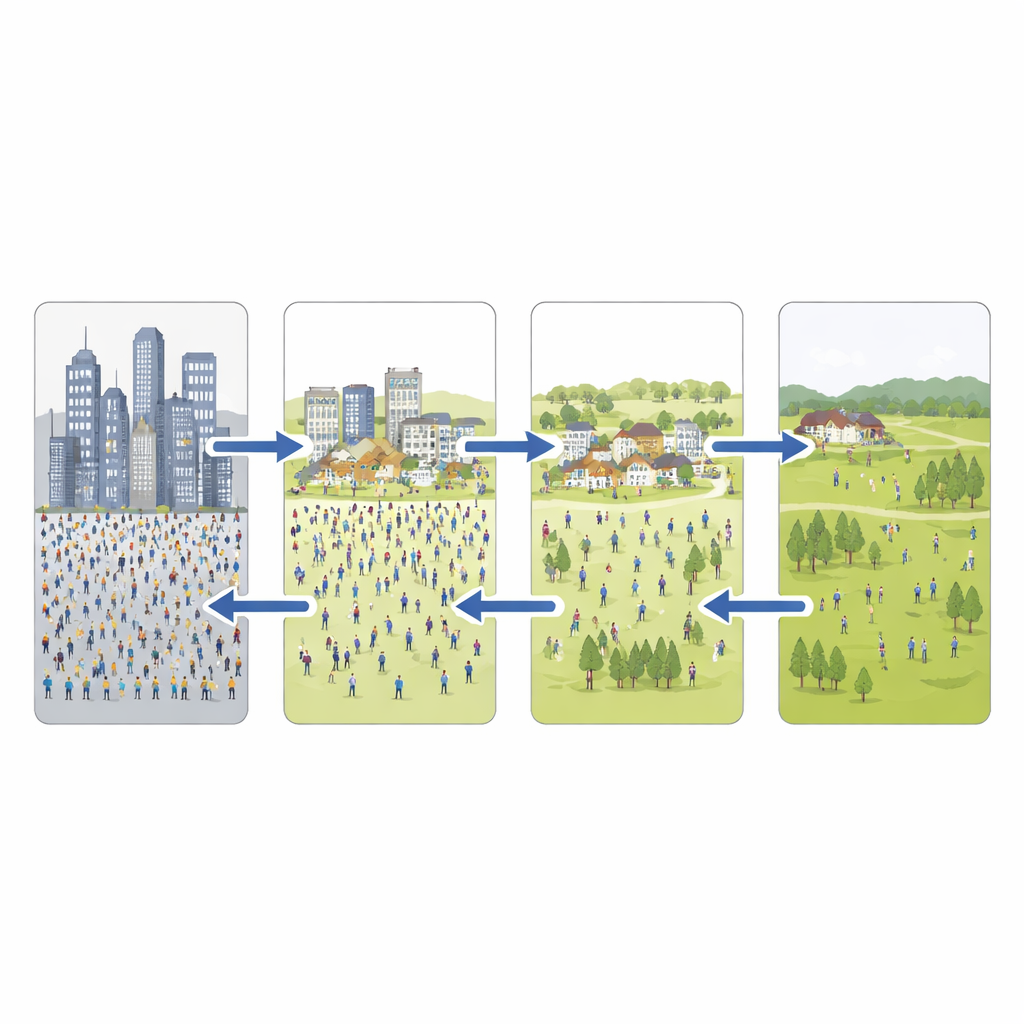
The authors tracked population changes in two complementary ways. First, they measured how the overall share of people living in urban versus less urban areas changed over time in each country. Second, they looked within cities themselves, along a gradient from dense cores to looser edges, asking whether people were clustering more tightly in central districts or spreading out toward the fringes and nearby countryside. To do this, they examined how changes in local population were related to how built-up each tile already was. Together, these two measures reveal not just whether cities gained or lost people, but also how those gains and losses were arranged in space.
What Happened During and After the Pandemic Shock
During the early phase of the pandemic, many countries showed signs of people moving away from the densest urban areas. Across the 35 countries, more than a third saw their share of urban residents fall, and in many places population growth shifted from city centers to suburbs, small towns, or rural surroundings. The pattern was especially strong in highly developed countries, where dense cores tended to lose people while lower-density areas gained them. In some middle- and upper-middle-income countries, by contrast, cities often continued to grow, with people still drawn toward job-rich centers despite the health crisis.
Different Countries, Different Long-Term Directions
When the researchers extended their view into the later pandemic phase, they found that the story was more complex. About one fifth of the early shifts from urban to rural areas reversed: in some countries, people began moving back toward cities or at least stopped leaving. Countries with very high scores on the Human Development Index—an indicator that blends health, education, and income—were more likely to see continued thinning out of dense cores and growth in lower-density zones. In less developed but still middle- and high-income countries, city centers often remained magnets. Factors like overall development level and industrialization showed clearer links to these patterns than short-term policies such as lockdown strictness or unemployment rates.
Why These Moves Matter for the Future
These changing settlement patterns have direct consequences for how we plan infrastructure, protect the environment, and prepare for future crises. In rich countries where dense urban cores are losing residents, empty apartments, underused roads, and oversized water or power systems raise questions about how best to maintain, shrink, or repurpose what is already built—potentially turning vacant land into parks or green spaces. At the same time, fast-growing suburbs and rural communities may need better broadband, schools, healthcare, and public transport to support newcomers without creating traffic, sprawl, and higher emissions. In countries where cities continue to swell, the challenge is to manage urban growth while keeping rural areas viable and safeguarding food production.
What This Means for Everyday Life
To a non-specialist, the study’s main message is that the pandemic briefly pushed many people to rethink where they want to live, and in some places that rethink may be the beginning of a longer shift away from the very densest city neighborhoods. The moves were strongest in wealthier countries, where smaller towns and rural areas can still offer good jobs, services, and quality of life. While not every change will last, and the global march toward urban living has certainly not stopped, city planners and governments can no longer assume that big cities will always grow. Instead, they need flexible plans that can respond to people spreading out, moving back, or doing both at once—and that balance comfortable living with environmental sustainability.
Citation: Duan, Q., Lai, S., Sorichetta, A. et al. COVID-19 and urban exodus: diverging population redistribution patterns across countries from 2020 to 2022. npj Urban Sustain 6, 59 (2026). https://doi.org/10.1038/s42949-026-00351-y
Keywords: urban exodus, COVID-19 migration, population redistribution, remote work and cities, urban rural dynamics