Clear Sky Science · en
Near work affects ocular higher order aberrations in children—a longitudinal study before and after COVID-19: The Tokyo Myopia Study
Why screen time and study habits matter for kids’ eyes
Across the world, more and more children are becoming nearsighted, especially in East Asia. Parents often hear advice about sending kids outside and limiting screen time, but what exactly is happening inside a child’s eye as their daily routines change? This study followed Japanese schoolchildren before, during, and after the COVID-19 pandemic to see how shifts in outdoor play, digital device use, and studying were linked to subtle changes in how clearly their eyes focus light, offering clues to how modern lifestyles may be reshaping young vision.
Following one group of children through a time of change
Researchers tracked 6- to 12-year-old students at a single elementary school in Tokyo from 2018 to 2021. Each summer, they measured how the children’s vision changed over one year, including how long their eyes had grown front-to-back and how well each eye focused light. They also asked families how much time children spent outdoors, watching television, using smartphones or computers, and reading or studying. The study naturally divided into three phases: the year before COVID-19 disruptions, the year dominated by pandemic restrictions, and the year after schools and activities began adapting to a new normal. This allowed the team to compare eye changes against three distinct patterns of daily life.
Shifts in outdoor play and close-up work
Outdoor time steadily shrank across the study, from about one hour and forty minutes a day before the pandemic to just over an hour afterward. Close-up activities, known as near work, showed a more complex pattern: they dipped when the pandemic first disrupted schooling and then rebounded. Smartphone use fell slightly during the pandemic year and then jumped afterward, while computer time, though still modest, grew sharply in the post-pandemic period. Reading and studying time dropped during the pandemic and then only partially recovered. These changing habits created a moving backdrop against which the researchers could examine how the children’s eyes responded over time. 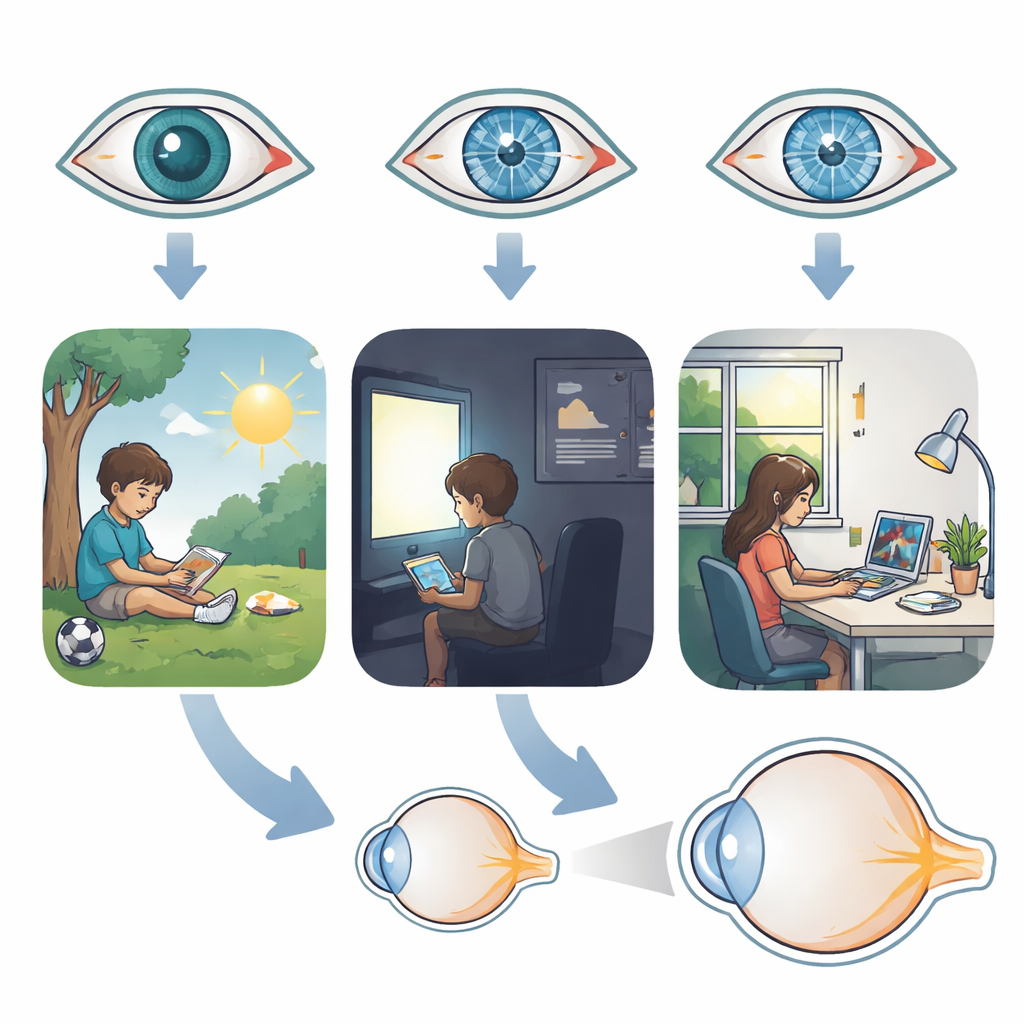
Fine details of focus inside the eye
Beyond simple nearsightedness, the team looked at fine imperfections in the way the eye bends light, called higher-order aberrations. These are tiny distortions that can affect how crisp an image looks on the retina but are not corrected by ordinary glasses. During the pandemic year, these distortions increased on average, while in the years before and after, they tended to decrease. At the same time, the eyes’ length grew fastest during the pandemic, when children’s routines were most disrupted. Although time outdoors is often linked to slower worsening of nearsightedness, in this study it was not clearly tied to these fine focusing errors in any of the three periods.
Different close-up tasks have different eye effects
The type of near work appeared to matter. Before the pandemic, more smartphone use was linked to slightly smaller changes in several of the eye’s fine distortions. During the pandemic, however, longer computer use was associated with larger changes in all of these distortions. Afterward, time spent reading and studying showed a similar positive link with overall distortion levels. These relationships held even after accounting for age, sex, sleep, and whether parents were nearsighted. The results suggest that not all close-up tasks affect the eye in the same way; screen size, viewing distance, gaze direction, and how long a task is sustained may each influence how sharply the eye focuses. 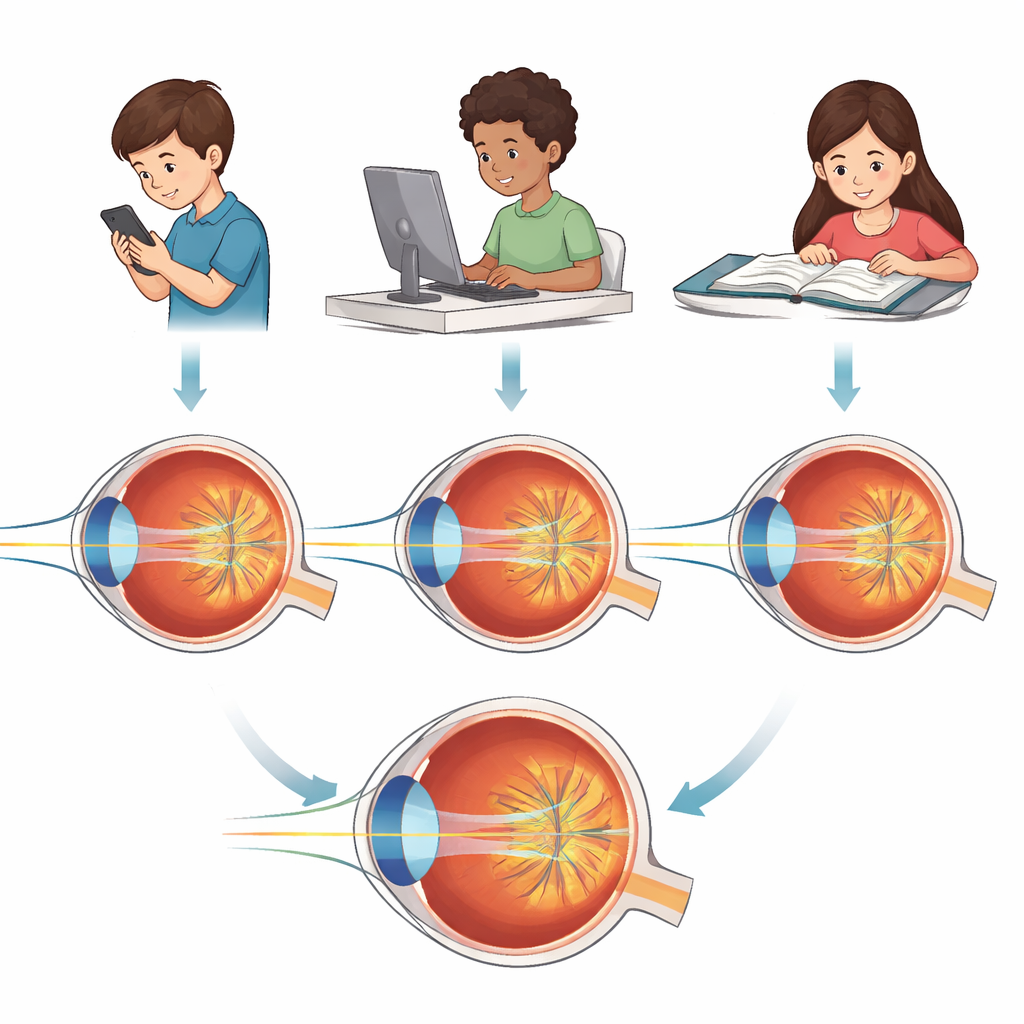
What this means for families and future research
The study does not prove that specific activities cause long-term damage, but it shows that children’s everyday habits, especially the ways they use screens and books up close, are linked to measurable changes in how their eyes handle light. Outdoor time, while still important for overall eye health and myopia risk, did not strongly relate to these finer focusing patterns. For parents and educators, the message is balanced: encourage regular breaks from close-up work, support outdoor play, and be mindful of how and how long children use smartphones and computers. For scientists, these findings highlight that the inner optics of the eye respond to lifestyle shifts and may help explain why nearsightedness is rising so rapidly in the digital age.
Citation: Shimizu, Y., Yotsukura, E., Ogawa, M. et al. Near work affects ocular higher order aberrations in children—a longitudinal study before and after COVID-19: The Tokyo Myopia Study. Sci Rep 16, 14288 (2026). https://doi.org/10.1038/s41598-026-44635-w
Keywords: childhood myopia, screen time, near work, COVID-19 lifestyle, eye development