Clear Sky Science · en
Threat and blame frames in political rhetoric about societal issues lead to neural and political polarization
Why this matters for everyday voters
From climate change to immigration and health care, much of what we see online about politics is wrapped in stories of looming danger or pointed fingers. This study asks a simple but crucial question: when political messages focus on threat or on blaming a group or institution, how does that change what we feel, how we vote, and even how our brains process information alongside other people?

Online videos that stir up emotions
The researchers created short video clips about three real-world issues: climate change, immigration, and health care. Each clip existed in three versions with the same images and voice, but different wording. One version was neutral and matter-of-fact. A second version used threat language, stressing serious negative consequences for viewers or society. A third version used blame language, pinning responsibility on a person, group, or institution. More than 1,800 Dutch adults, broadly similar to the national population, watched one of these clips online and then reported how they felt and how important they found the issue, whether they would share the clip, and how they viewed major political parties.
Emotions rise, but sharing falls
Threat and blame versions of the videos reliably triggered stronger negative feelings than neutral versions, especially anger. People also tended to see the issues as more important when they felt more stirred up. Yet the story takes a twist: despite raising arousal, both threat and blame clips actually made people less likely to say they would share the content, compared with neutral clips. This pattern was most striking for blame framing, which produced the strongest anger but the weakest willingness to pass the video along. The result suggests that emotional rhetoric can pull apart two things that usually go together—feeling worked up about an issue and wanting to talk about it publicly.
Shifting attitudes toward political parties
The team also looked at how these emotional reactions connected to attitudes toward specific parties seen as “owning” particular issues, such as a right-wing party associated with immigration and a green party linked to climate policy. In general, stronger negative feelings about a topic predicted warmer feelings toward the party that was widely linked to that issue. But when issues were framed in terms of blame, these usual links between strong issue positions, emotions, and party support were weakened or distorted. In other words, blame-heavy rhetoric did not simply boost support for like-minded parties; it also disrupted the normal, more issue-based way people connect their views to their political choices.
Inside the brain: from shared stories to divided views
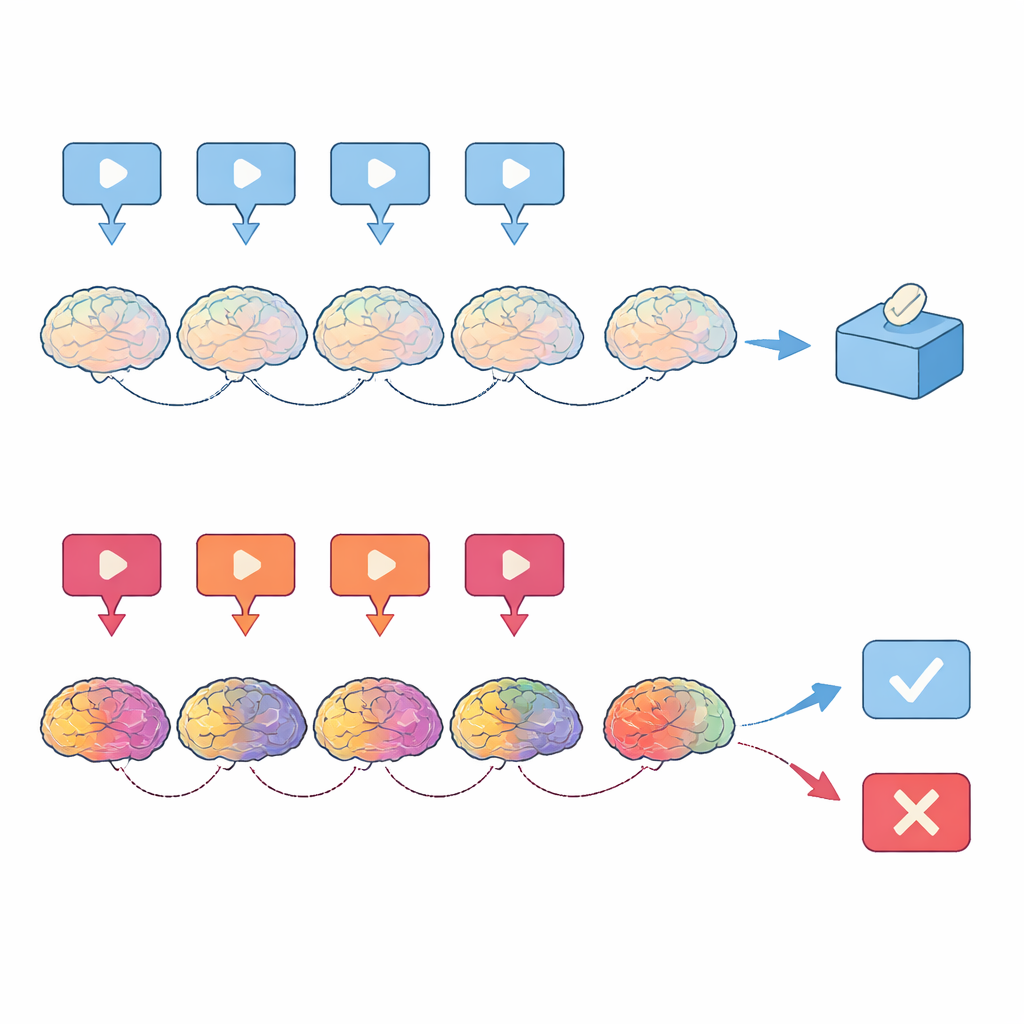
To probe what happens in the brain, a second, smaller study placed 27 participants in an MRI scanner while they watched all 36 video clips. The researchers examined how synchronized brain activity was across people seeing the same clip—a sign that they are processing the story in a similar way. Neutral clips produced more similar patterns of activity, especially in the dorsolateral prefrontal cortex, a region involved in understanding narratives and making sense of social situations. When the same issues were framed in terms of threat or blame, this shared response dropped: people’s brains processed the videos in more divergent ways. Blame framing, in particular, caused the greatest “desynchronization,” especially among participants who already held different political attitudes, suggesting that this style of rhetoric can amplify existing divides.
What this means for democracy
Taken together, the findings paint a sobering picture. Framing political issues as threats or as someone’s fault grabs attention and heightens emotions, but it also makes people less willing to share content and less likely to process information in a common way with others. In the brain, these frames push viewers away from a shared understanding of the same message, especially when they already disagree politically. That combination—strong feelings, lower willingness to engage publicly, and more fragmented mental processing—can feed political polarization. In a world where recommendation algorithms may favor emotionally charged content, the study suggests that frequent exposure to threat and blame rhetoric risks making it harder for citizens to reach common ground on problems that require collective solutions.
Citation: van der Plas, E., Todorova, L., Heidlmayr, K. et al. Threat and blame frames in political rhetoric about societal issues lead to neural and political polarization. Sci Rep 16, 14304 (2026). https://doi.org/10.1038/s41598-026-43389-9
Keywords: political polarization, social media, framing effects, emotion and politics, brain imaging