Clear Sky Science · en
Real-time decentralized model predictive control for cooperative multi-robot object transport: experimental validation
Robots Teaming Up to Carry the Load
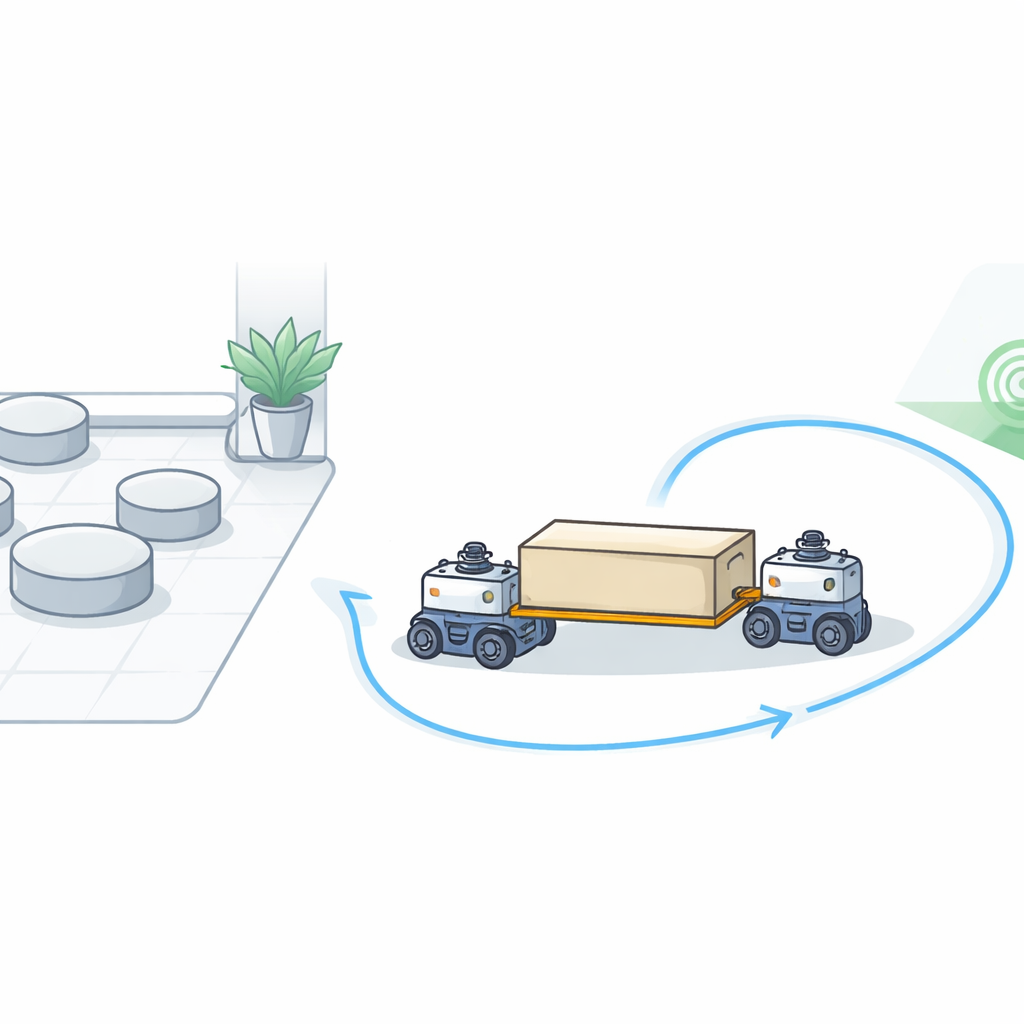
Imagine a warehouse where small mobile robots, not people, team up to carry boxes around tight corners and between shelves—without crashing into each other or nearby obstacles. This paper shows how two such robots can share a heavy object and move it smoothly and safely in real time, even when their sensors are noisy and their view of the world is imperfect.
Why Sharing the Load Is Hard
Getting multiple robots to carry the same object is far tougher than telling a single robot where to go. The machines must agree on where the shared load should be, keep a safe distance from each other, and avoid bumping into walls or obstacles, all while reacting quickly to changes. Traditional approaches often rely on a single central computer that sees everything and tells each robot what to do. That setup can be fragile: if the central brain or the communication link fails, the whole team can break down. The authors instead explore a "decentralized" approach in which each robot makes its own decisions but still behaves as part of a coordinated team.
A Real-World Robot Pair
To test their ideas, the researchers built a physical setup using two small off‑the‑shelf robots known as TurtleBot3. Each robot has two driven wheels and carries a portion of a lightweight acrylic platform. The two robots are connected to this shared platform through specially designed joints that can both pivot and stretch, mimicking how a real object might flex or shift when carried by a team. The robots move in a modest indoor area about the size of a living room, marked with visual tags that help a camera overhead determine where everything is located.
Seeing and Deciding on the Move
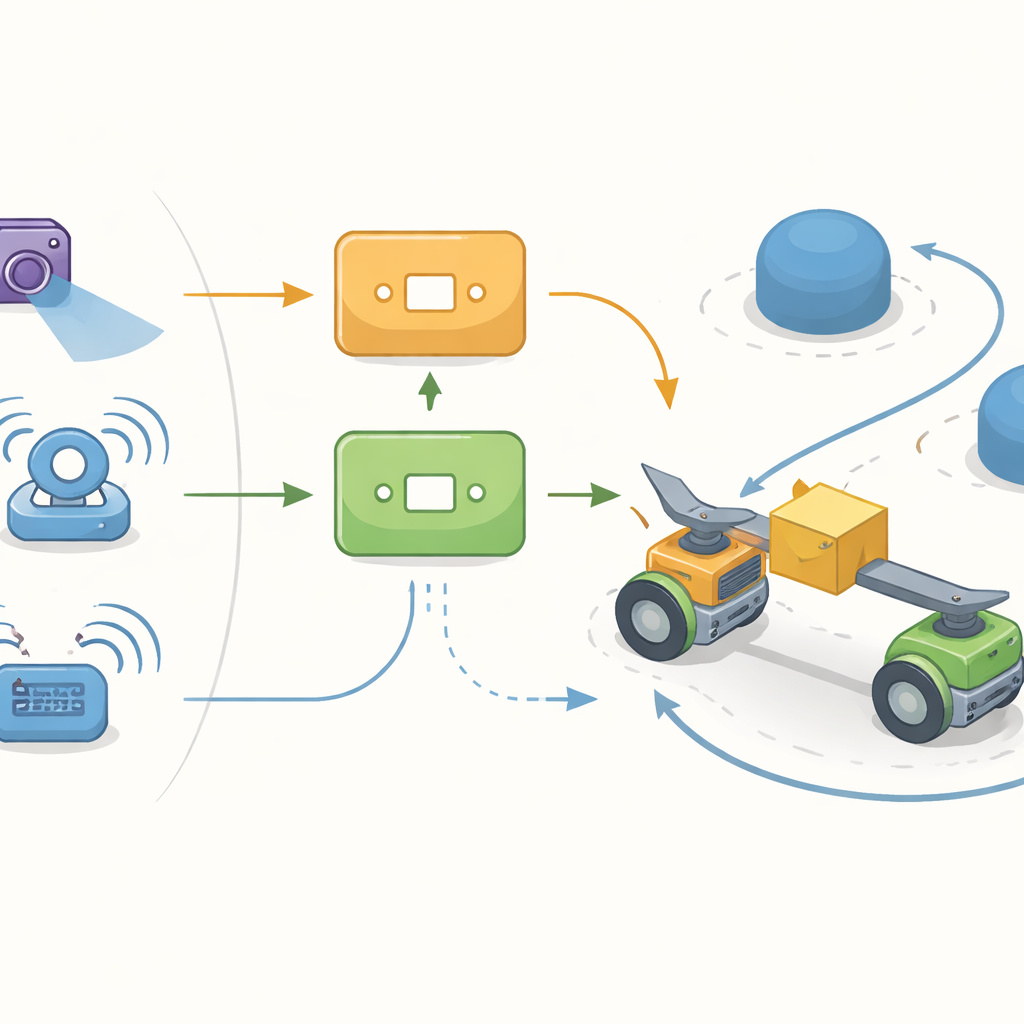
Vision alone is not perfect: the overhead camera can briefly lose sight of a robot, and its measurements are delayed. To keep track of the shared load in real time, the system blends information from the camera with readings from wheel encoders and tiny motion sensors on each robot. A mathematical filtering method smooths these signals into a single, reliable estimate of where the carried object is and how it is moving. On top of this sensing layer, each robot runs its own predictive controller. Instead of reacting only to the present moment, the controller looks a short time into the future, checking possible motion choices against safety limits such as speed bounds, spacing between robots, and how close they are allowed to get to obstacles.
Cooperation Without a Constant Conversation
Although the robots must cooperate, they do not chat continuously. They share information only when their relative spacing or orientation drifts too far from what is expected. Between these communication bursts, each robot uses its last view of its partner and builds in safety margins to stay clear of collisions. The controller also adjusts its own priorities on the fly: when the desired path bends sharply or obstacles are nearby, it automatically focuses more on staying close to the planned route and keeping the formation tight, and a bit less on making the motion as gentle as possible. When the path straightens out, it relaxes those priorities to reduce strain on the motors and keep motion smooth.
Putting the Method to the Test
The team put the robots through a range of trials: moving from one point to another, tracing straight lines and circles, and following an infinity‑shaped path both with and without obstacles in the way. In each case, they compared a basic version of the controller to the adaptive one that can retune its own priorities as it goes. The adaptive strategy kept the carried platform much closer to the intended path—improving accuracy by roughly one‑fifth to one‑third—while still honoring all safety limits on spacing, joint extension, and how fast the wheels could spin or change speed. Even on a modest computer, each robot could complete its calculations fast enough to update its motion decisions ten times per second, leaving enough slack for real‑time operation.
What This Means for Future Robot Teams
For non‑specialists, the take‑home message is that it is now feasible for teams of small, inexpensive robots to carry shared loads safely and precisely without depending on a single central controller. By blending camera and onboard sensor data and letting each robot predict and optimize its own motion while talking to its partner only when needed, the system achieves smooth, accurate transport even in cluttered spaces. This kind of decentralized, real‑time teamwork could help future robots handle tasks such as moving inventory, assisting in disaster zones, or reconfiguring factory floors with less human oversight and greater resilience to failures.
Citation: Muhammed, I., Nada, A.A. & El-Hussieny, H. Real-time decentralized model predictive control for cooperative multi-robot object transport: experimental validation. Sci Rep 16, 9824 (2026). https://doi.org/10.1038/s41598-026-41881-w
Keywords: multi-robot cooperation, object transport, model predictive control, decentralized control, mobile robots