Clear Sky Science · en
Physical fitness changes among school-aged children during the COVID-19 lockdown evaluated within the Hungarian National Student Fitness Test cohort
Why this story about kids and movement matters
The COVID-19 pandemic did not just close classrooms; it also quietly reshaped how children move, play, and use their bodies. This study followed more than a quarter of a million Hungarian students in grades 5 to 8 to see how their physical fitness changed from before the pandemic to a year after the first long wave of school closures. Because every school in the country runs the same annual fitness tests, the researchers could track real, measured changes across an entire nation—and ask how different school environments might protect, or harm, children’s health.

How the study watched children’s fitness over time
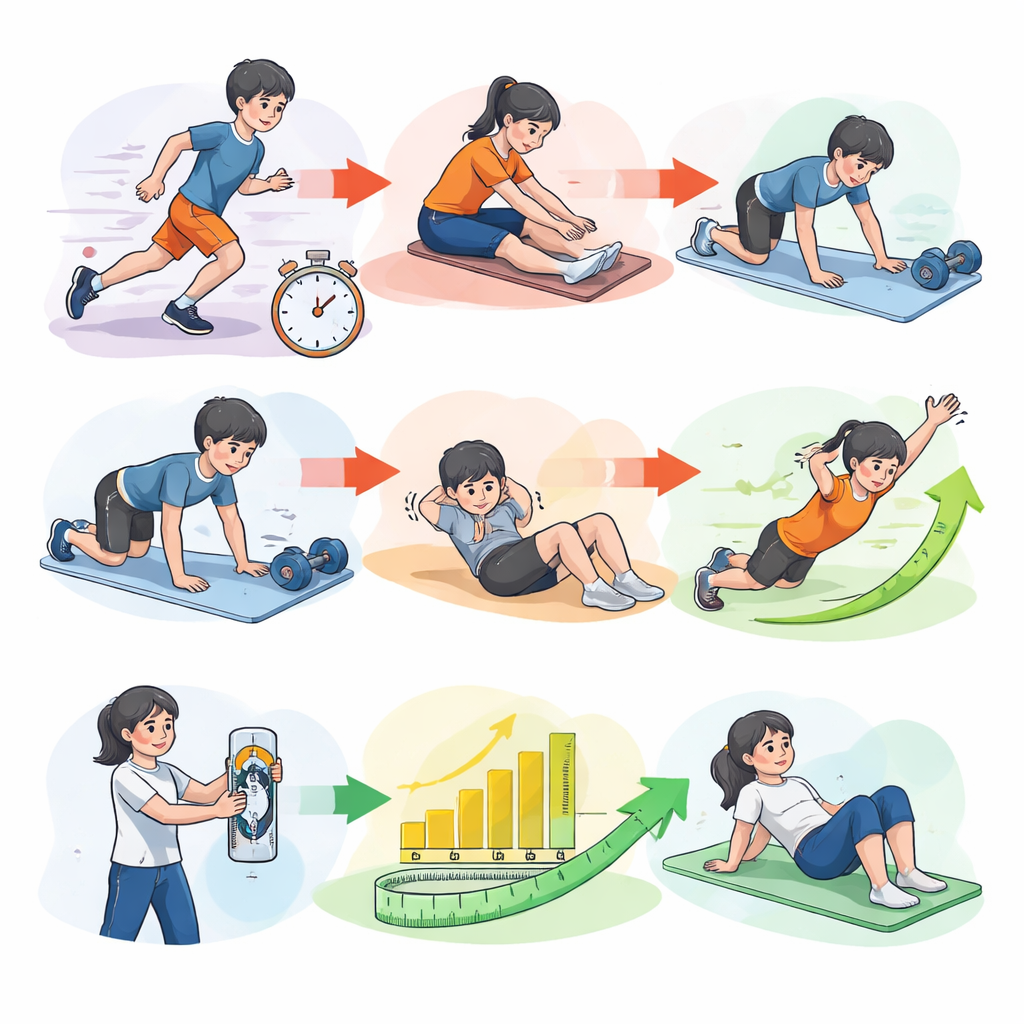
Hungary has a national program called the National Student Fitness Test, where all students from fifth grade up complete a set of standardized fitness checks each year. These include body measurements such as weight, height, and estimated body fat, as well as several performance tasks: a shuttle run for heart and lung fitness, push-ups and curl-ups for muscle endurance, a standing long jump and handgrip squeeze for strength and power, a trunk-lift for back strength, and a simple sit-and-reach test for flexibility. The researchers compared results from the school year just before the pandemic (2018–2019) with results from the first full year after major lockdowns (2021–2022), linking the same children’s scores across time so they could see who improved and who fell behind.
What changed in children’s bodies and stamina
The picture that emerged was uneven but worrying. Measures linked to body composition and heart health tended to move in the wrong direction. The share of students whose body fat fell outside the healthy range rose by about three percentage points, and children were more likely to be in the “not healthy” category for overall weight as well. The most dramatic shift was in the shuttle run, which reflects how well the heart and lungs can keep up during activity. Before the pandemic, about one in three students failed to hit the healthy zone; afterward, that figure climbed to more than one in two. Flexibility also slipped, and more students struggled to do enough push-ups and curl-ups, signs that their muscles tired more easily than before.
Strength that held steady and even grew
Not every part of fitness declined. Tests that capture short bursts of force told a different story. On average, children squeezed harder in the handgrip test, jumped farther in the standing long jump, and lifted their upper bodies higher in the trunk-lift assessment. These gains in strength and power were modest, and they were outweighed by the larger setbacks in body composition, endurance, and muscle stamina. Still, they suggest that while long periods of activity—like running or doing repeated movements—became harder, some children may have continued to practice brief, intense movements at home, such as jumping or playing short, active games.
Why where you go to school made a difference
The study also revealed that schools themselves matter a great deal. Children in smaller towns and villages were more likely than those in the capital city to fall outside the healthy range for weight, body fat, heart and lung fitness, and several muscle tests. Students in larger, central school campuses with better facilities tended to perform better than those in small branch schools. Schools run by foundations or churches often had more favorable fitness results than those run by local governments, hinting at differences in resources, sports programs, or how strongly physical activity is valued. Even after taking age and sex into account, some schools consistently had much better outcomes than others, while a sizable group lagged in multiple tests.
What this means for children’s health going forward
To a lay reader, the message is clear: pandemic restrictions left many adolescents less fit, especially in areas most closely tied to everyday health, such as healthy weight and the ability to stay active without quickly running out of breath. At the same time, the changes were not uniform. Some aspects of strength improved, and some schools clearly did a better job of shielding their students from the worst effects. The authors argue that future efforts should focus first on improving body weight, body fat, heart and lung fitness, and muscle endurance, while also learning from schools that performed well. Their conclusion is that schools are not just places for lessons; they are powerful environments that can either support or undermine children’s physical resilience—during a crisis and in ordinary times—and that policies must use this leverage to help the next generation move more and sit less.
Citation: Vincze, F., Csányi, T., Kaj, M. et al. Physical fitness changes among school-aged children during the COVID-19 lockdown evaluated within the Hungarian National Student Fitness Test cohort. Sci Rep 16, 10254 (2026). https://doi.org/10.1038/s41598-026-41055-8
Keywords: COVID-19 lockdown, adolescent physical fitness, school physical education, sedentary behavior, cardiorespiratory fitness