Clear Sky Science · en
Assessing the technological capabilities and efficiency of inland ports in Vietnam’s Mekong Delta: a hybrid DEA approach post-COVID-19
Why River Ports Matter to Everyday Life
For many people, the Mekong Delta in Vietnam is known for rice fields and floating markets, not for the quiet work of its river ports. Yet these inland ports act like valves in the region’s trade bloodstream, moving more than half of the country’s rice and fruit toward global markets. When COVID-19 hit, that flow was disrupted, raising transport costs and threatening local jobs and export income. This study looks under the hood of ten key river ports from 2019 to 2023 to see how well they coped, which ones bounced back fastest, and what that means for how countries should invest in transport infrastructure after a crisis.

How the Researchers Took the Pulse of the Ports
Instead of judging ports by simple statistics such as total cargo moved, the authors used a set of tools that compare how well each port turns its physical assets into real work. They examined four basic ingredients: how much land a port has, how long its berths are, how many berths there are, and how much loading equipment is installed. They then compared those inputs with a single, clear output: the volume of cargo handled. By repeating this comparison across five years and slicing the data into overlapping time windows, the team could see not just who was efficient at one moment, but how performance rose or fell during the pandemic shock and the recovery that followed.
What Happened During and After the COVID Shock
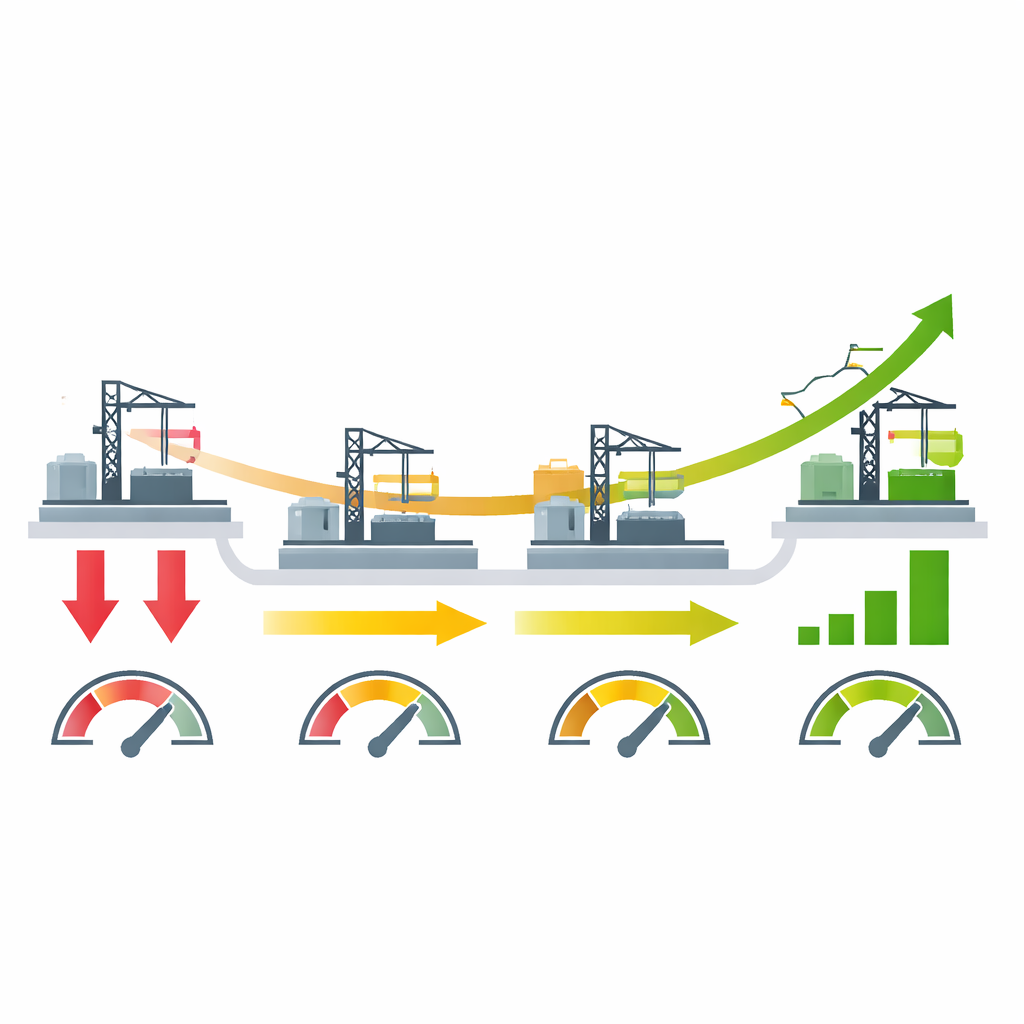
The picture that emerges is a distinct U-shaped curve. On average, the ports used their resources effectively less than half the time at the depth of the crisis, with efficiency bottoming out around 46 percent as demand collapsed, workers were constrained by health rules, and infrastructure sat idle. After Vietnam adopted a “safe and flexible” COVID policy in late 2021, activity picked up and average efficiency recovered to about 51 percent by 2023. But the rebound was uneven. A few ports near major river channels, able to handle larger ships and a mix of cargoes, held up relatively well. Others, especially small ports in areas with weak industrial bases, found themselves with expensive berths and land that were barely used.
Winners, Strugglers, and the Role of Management
By digging deeper into the numbers, the study sorted the ports into three broad groups. “Resilient leaders” such as Hau Giang, My Tho, and Tra Noc remained relatively efficient throughout, thanks to favorable locations and more diverse cargo flows. A middle tier of ports improved but never fully closed the gap. A final group, including Nam Can and several small facilities, stayed stuck below 50 percent efficiency because local demand was too thin to keep their infrastructure busy. Interestingly, the biggest improvements were not due to cutting-edge technology. Across the system, most gains came from managers squeezing more out of what they already had—better scheduling, smarter use of equipment, and tactical responses to shocks—rather than from new cranes, software, or major construction.
Investment Freeze and the Surprising Star Performer
The authors also tracked whether the entire port system’s “best-practice frontier” moved forward over time. Here, the news was sobering: on average, technological progress slightly slipped backward during the study period, pointing to an investment freeze as operators delayed big upgrades in the face of uncertainty. One standout exception was Hau Giang Port, which managed to combine sharper day-to-day operations with targeted spending on modern handling gear. That mix allowed it to capture cargo that spilled over from congested hubs and to lift its efficiency by about 19 percent, making it a benchmark for the region. In contrast, a busy hub like My Tho showed signs of congestion, where heavy use of existing assets without corresponding upgrades led to bottlenecks and lost efficiency.
What This Means for the Future of River Trade
For non-specialists, the main takeaway is that building bigger ports is not enough—especially in places like the Mekong Delta, where many facilities mainly feed into larger seaports. The study shows that during and after a crisis, smart management and flexible operations often matter more than pouring concrete. Policymakers are advised to prioritize digital tools, such as better terminal operating systems, and to encourage ports to diversify the types of cargo they handle so they are less exposed to border closures or demand swings. In short, resilience comes from learning to use existing infrastructure more intelligently, while making carefully chosen upgrades, rather than assuming technology alone will lift all boats.
Citation: Wang, CN., Truong, TT. Assessing the technological capabilities and efficiency of inland ports in Vietnam’s Mekong Delta: a hybrid DEA approach post-COVID-19. Sci Rep 16, 10157 (2026). https://doi.org/10.1038/s41598-026-41041-0
Keywords: Mekong Delta logistics, inland ports, COVID-19 disruption, port efficiency, transport resilience