Clear Sky Science · en
A new late Cretaceous squamate from Patagonia sheds light on Gondwanan diversity
Ancient Lizards at the End of the Dinosaur Age
Long before modern geckos and skinks scurried across warm rocks, their distant relatives shared the world with the last dinosaurs. Yet our picture of these ancient lizards is badly lopsided: most known fossils come from the Northern Hemisphere. This paper reports a remarkably complete fossil lizard from Patagonia, in southern Argentina, that helps redress that imbalance. The new find, named Paleoteius lakui, offers a rare, detailed glimpse of the small reptiles that lived in South America just before the mass extinction that ended the age of dinosaurs.
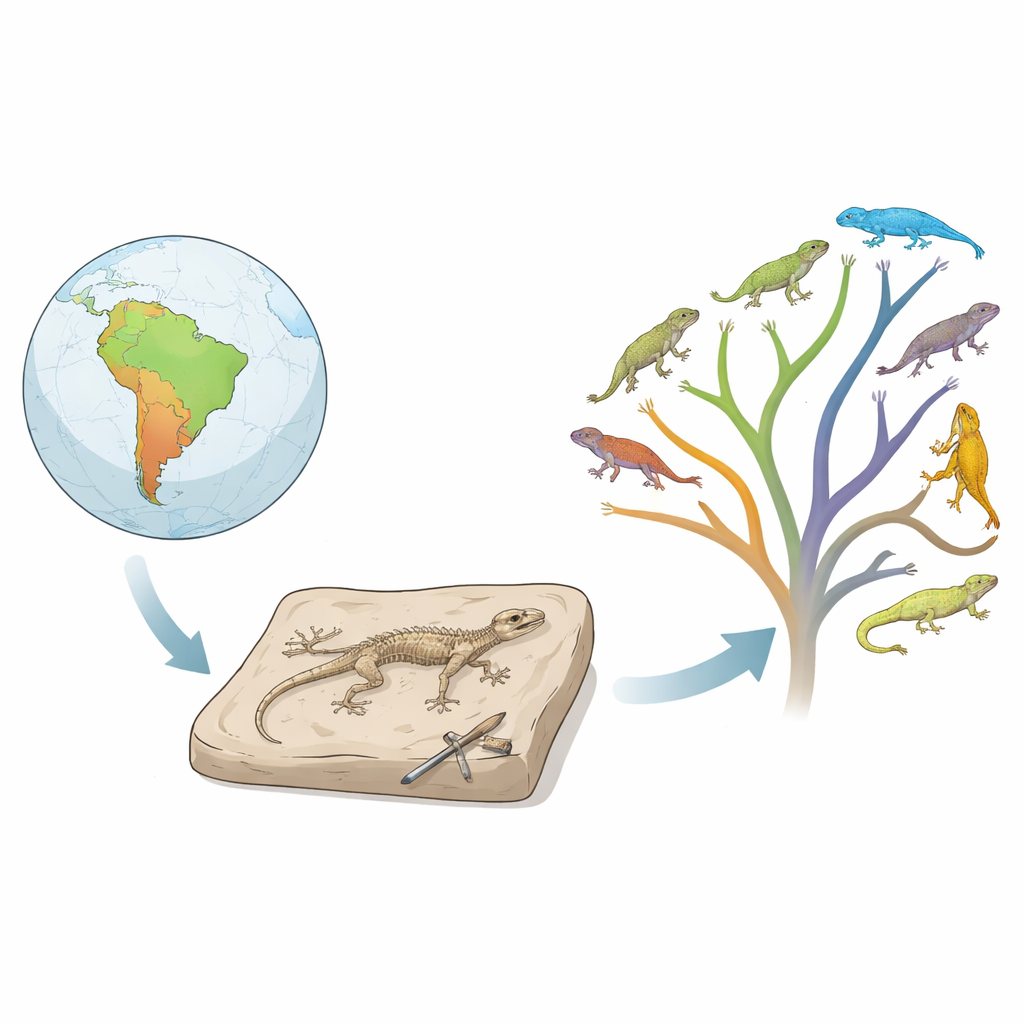
A Rare Find in Southern Patagonia
The fossil was discovered in rocks of the Allen Formation in northern Patagonia, laid down about 70 million years ago during the final stage of the Cretaceous Period. These rocks record shallow water channels and nearby low-lying landscapes that supported a rich community of freshwater and coastal animals. From this setting, the researchers recovered a small block of rock containing bones from a single lizard: parts of the skull, several vertebrae, and portions of the limbs. For South America, where Cretaceous lizard remains are usually just isolated fragments or flattened impressions, this degree of preservation is exceptional and makes Paleoteius lakui the most complete land-dwelling lizard known from the continent at that time.
The Shape of a Small, Specialized Lizard
Careful preparation, microscopy, and high-resolution CT scanning allowed the team to reconstruct the animal’s head and parts of its body in three dimensions. The skull roof bones are covered with distinct, raised bumps, giving the top of the head a rough, sculptured texture. The lower jaw is long and low, with an unusually high number of small, closely packed teeth—at least 37 in the lower jaw alone. These teeth are slender, simple cones without extra cusps or ornamentation, and are fused on the inner side of the jaw, a common pattern in many modern lizards. The internal surfaces of the jaw bones, including a deep groove that carried soft tissues and nerves, show a unique arrangement of openings and ridges that help distinguish this species from all others known.
Placing the Fossil on the Lizard Family Tree
To understand where Paleoteius lakui fits in lizard evolution, the authors compared hundreds of skeletal features with those of both living and extinct species, using computer-based family tree analyses. When they relied only on anatomical traits, the new species grouped with a major lizard assemblage often called scincomorphs, which includes modern families such as skinks and night lizards. In that scenario, Paleoteius fell close to night lizards, based on details of the skull roof, the way certain skull bones locked together, and the structure of canals in the face and lower jaw. However, when the same anatomical data were analyzed while forcing the overall tree to match results from DNA studies of living lizards, Paleoteius shifted slightly: it landed just outside the core scincomorph group, among a collection of Jurassic to Paleogene fossils that appear to be early offshoots of skink-like lineages.
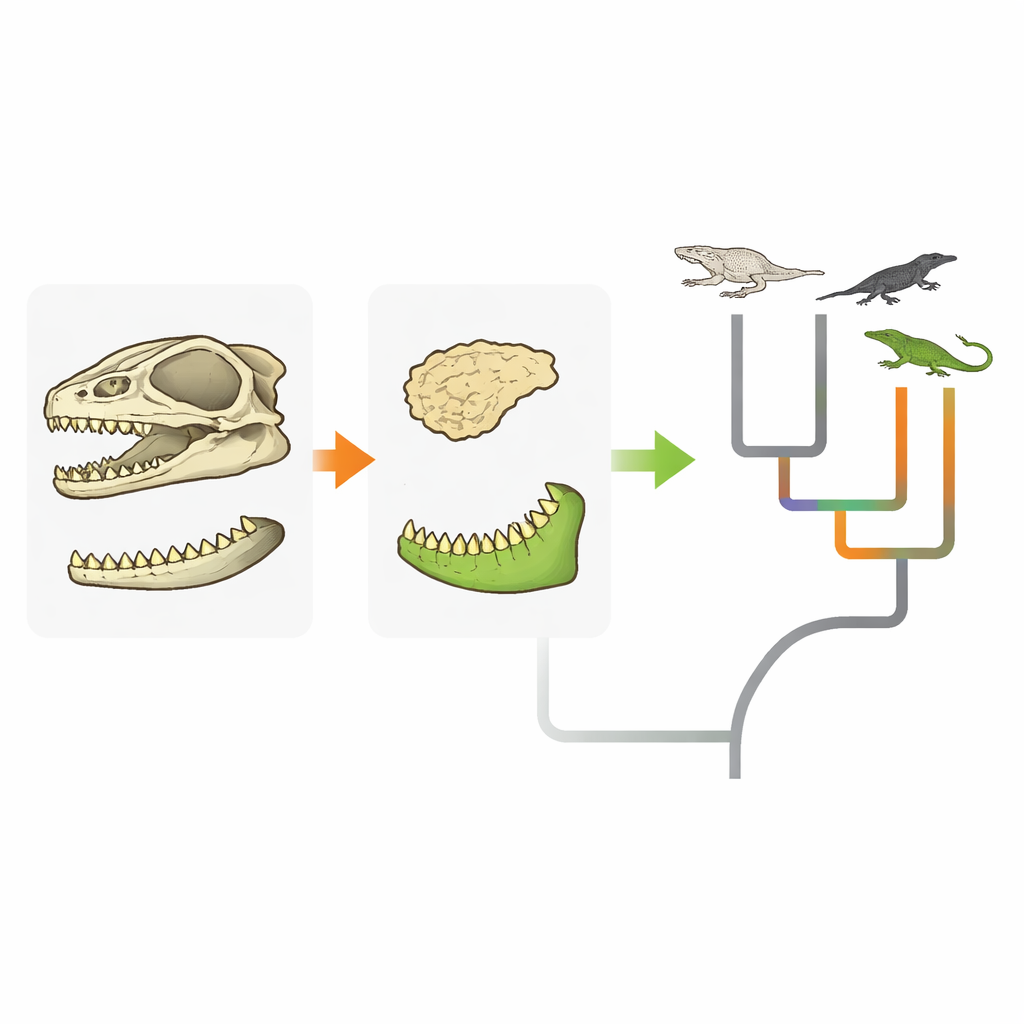
A Hidden Southern Lineage with Northern Ties
Either placement tells a similar story. Paleoteius lakui seems to represent a long-lived branch of lizards that is closely related to, but not part of, modern skinks and their kin. It shares features with Northern Hemisphere fossils from the Jurassic and later, suggesting that its ancestors were once widespread, possibly ranging across both the northern and southern landmasses. Yet by the latest Cretaceous in Patagonia, this lineage had developed a highly specialized body plan, different from other known South American lizards of the time, which often had broader, more complex teeth and smoother skulls. The authors infer that this unique form likely evolved over tens of millions of years, leaving a “ghost lineage” of unsampled ancestors in the fossil record.
What This Means for Ancient Southern Ecosystems
The discovery of Paleoteius lakui strengthens the case that Cretaceous lizard communities in the Southern Hemisphere were both diverse and distinct from their northern counterparts. While certain lizard groups dominated late Cretaceous sites in North America, Patagonia hosted a different mix that included iguana-like forms, heavily armored lineages, and now this specialized skink-like species. Because no close relatives of Paleoteius are known from younger South American rocks, the fossil also supports the idea that many ancient lizard groups vanished during or soon after the mass extinction 66 million years ago, to be replaced by new radiations in the early Cenozoic. For paleontologists, this small skull from Patagonia is thus a key piece of evidence that ancient lizards in the southern continents had rich, independent histories that we are only beginning to uncover.
Citation: Agnolín, F.L., Aranciaga-Rolando, M., Álvarez-Herrera, G. et al. A new late Cretaceous squamate from Patagonia sheds light on Gondwanan diversity. Sci Rep 16, 13005 (2026). https://doi.org/10.1038/s41598-026-40914-8
Keywords: Cretaceous lizards, Patagonia fossils, squamate evolution, Gondwana, skink-like reptiles