Clear Sky Science · en
Optimizing multi-level shuttle-based puzzle storage systems with horizontal and vertical dynamics using integer programming and ALNS-IP
Why smarter storage matters to everyday life
Behind every same‑day delivery and click‑and‑collect order lies a warehouse racing to find, pick, and ship items in minutes. As cities grow denser and online shopping soars, companies must squeeze more goods into less space without slowing down. This article explores a new kind of high‑density warehouse that works like a 3D sliding puzzle, along with a planning method that decides how its robots should move. The payoff is faster retrieval, fewer robot moves, and systems that can realistically handle the crush of modern e‑commerce.
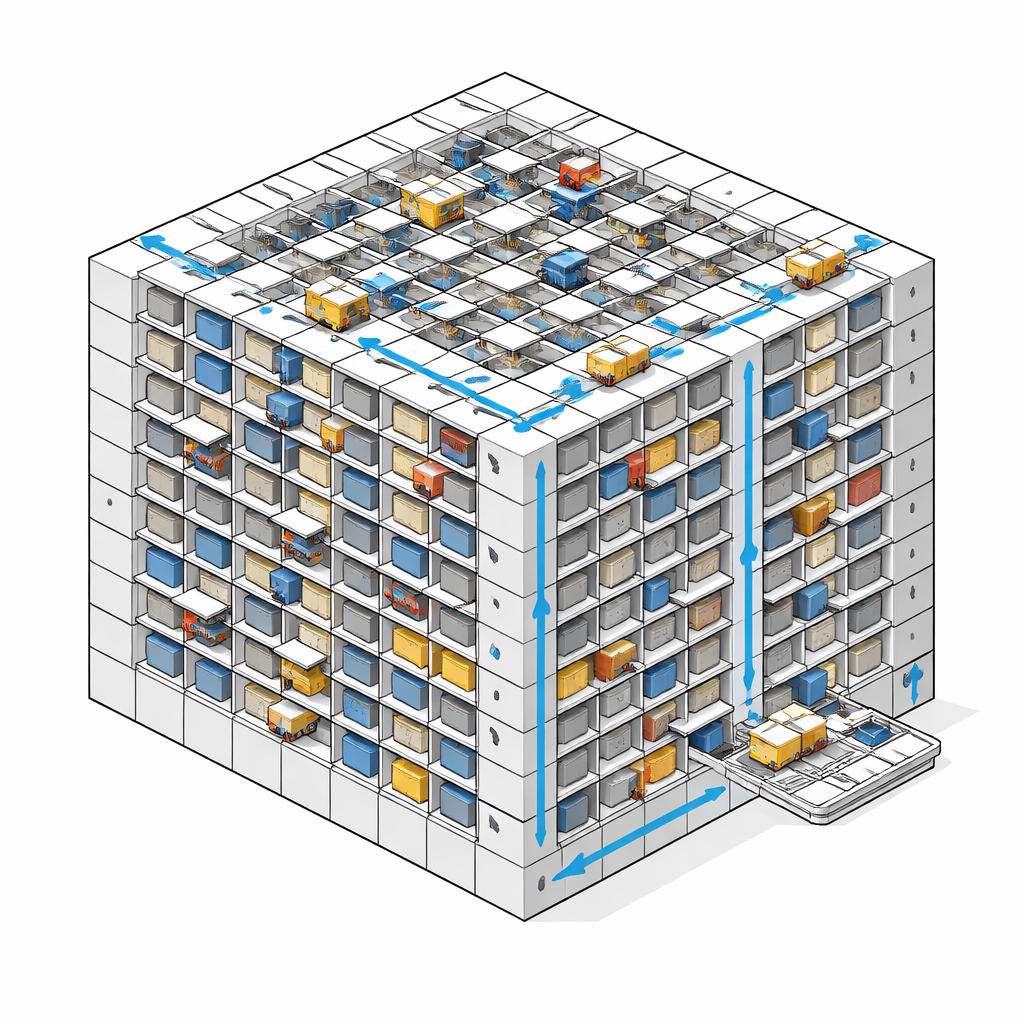
From aisles and forklifts to sliding puzzles
Conventional warehouses devote up to 40% of their floor to fixed aisles so trucks or forklifts can drive between shelves. Puzzle‑based storage systems rethink this layout. Goods sit in a tight grid, and instead of people or vehicles traveling long distances, shelves themselves shift around an empty "escort" space, much like tiles in the classic 15‑piece sliding puzzle. This aisle‑free design can pack 30–50% more items into the same footprint. The study builds on this idea and imagines such a puzzle extended into a cube: racks stacked in multiple levels, with autonomous shuttle robots moving loads both sideways and up or down.
Adding the missing third dimension
Most earlier research treated these puzzle‑style systems as flat. Items slid north, south, east, or west, while any vertical motion—like a lift—was handled separately or ignored in the optimization. Real warehouses, however, increasingly look like three‑dimensional mazes, and their robots must coordinate in all directions. The authors identify this as a critical gap: no existing mathematical model optimizes retrieval in a fully 3D puzzle grid where shuttles can move in six directions and must avoid blocking or colliding with each other across multiple levels. Their work introduces the first such integrated model, aiming to minimize how many individual movements are needed to bring all requested items to a single input/output point.
Turning a complex warehouse into equations
To capture the warehouse’s behavior, the researchers describe it as a grid of positions in space and a series of time steps. Binary decision variables record whether a particular shuttle or item moves from one cell to a neighboring cell—horizontally or vertically—at a given time. Constraints enforce commonsense rules: no two shuttles or items can occupy the same cell at once; items can move only when carried by shuttles; flows must be continuous from start to finish; and requested items must eventually reach the pickup point in the corner of the cube. The overall objective is simple to state but hard to compute: minimize the total number of moves for all shuttles and items combined. Because this problem generalizes several notorious hard problems in operations research, solving it exactly becomes impossible once the warehouse is more than modest in size.
Hybrid search: mixing smart guesses with exact checks
To tame this complexity, the authors design a hybrid heuristic called ALNS‑IP. It starts with a greedy plan that assigns each desired item to a nearby shuttle and then routes both toward the pickup point. An adaptive large neighborhood search (ALNS) procedure then repeatedly "destroys" small parts of this plan—by removing one or more moves from selected item paths—and "repairs" them using an integer‑programming submodel that enforces all physical rules. Over time, the algorithm learns which types of local changes tend to produce better results and favors them. Extensive tests on simulated cube‑shaped warehouses of different sizes, storage densities, demand levels, and shuttle counts show that this approach finds solutions very close to the optimal ones in small and medium cases, and high‑quality feasible plans even when exact solvers run out of memory or time on larger cases.
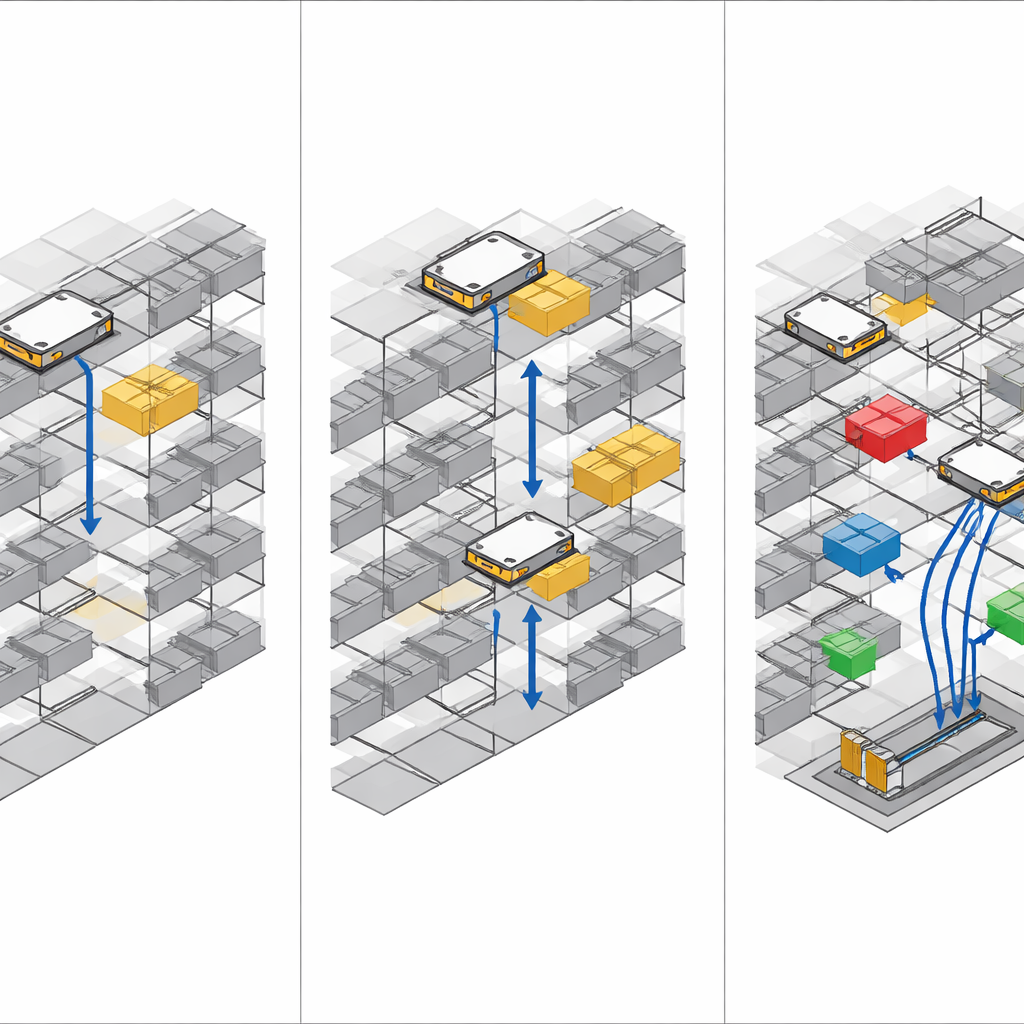
What vertical motion really buys you
A key question is whether letting shuttles move vertically as well as horizontally is actually worth the added engineering. By comparing their full 3D model with a restricted version that mimics older, mostly horizontal designs, the authors show that integrated vertical motion can cut the number of required moves by more than 10% on average in small test cases, and by as much as 40% in some layouts. That means items reach workers or packing stations faster, with less robot traffic and fewer opportunities for congestion. Sensitivity analyses also reveal that simply adding more shuttles does not always help—coordination becomes harder—while higher demand naturally increases the number of moves but remains manageable within the proposed framework.
Big picture: towards practical 3D robot warehouses
In plain terms, this work shows how to choreograph fleets of small robots in a three‑dimensional sliding‑puzzle warehouse so that they do just enough moving, and no more, to fetch what customers order. The combination of a detailed mathematical description and a smart search algorithm turns an intractable planning problem into something that can be solved quickly enough for real design and operations decisions. As urban warehouses grow taller and more automated, such tools could help companies decide how many robots to buy, how to lay out their storage grids, and how to exploit vertical space without bogging down retrieval speed.
Citation: Al jneid, R., Yiğit, V. & Keskin, M.E. Optimizing multi-level shuttle-based puzzle storage systems with horizontal and vertical dynamics using integer programming and ALNS-IP. Sci Rep 16, 13117 (2026). https://doi.org/10.1038/s41598-026-40383-z
Keywords: automated warehouse, puzzle-based storage, shuttle robots, integer programming, heuristic optimization