Clear Sky Science · en
Aversive responses to stereotypic science and math-based (STEM) images predict women’s long–term STEM memories and underperformance in math
Why some science pictures can quietly push women away
Walk into many science and math spaces and you still mostly see men in the spotlight: men at the chalkboard, men in lab coats, men clustered around high‑tech equipment. This paper asks a deceptively simple question with big consequences: do these ordinary, male‑dominated science images quietly teach many women’s brains to fear and avoid STEM—and does that fear hurt their performance and shape what they remember about past experiences?
When a picture says “you don’t belong”
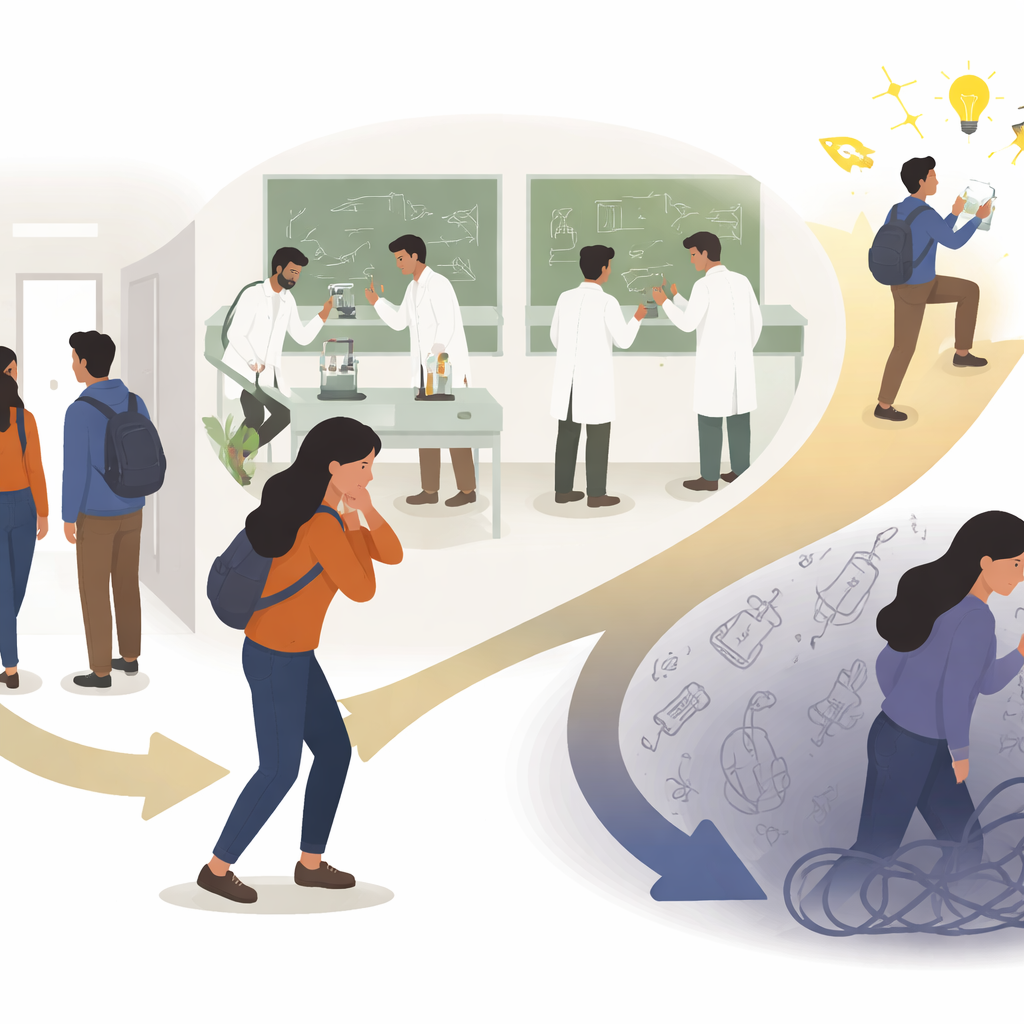
Across four studies, the researchers focused on “stereotypic STEM images”: photos of all‑male labs, lecture halls, and technical workspaces. They compared these with non‑STEM images that showed only women in more typical academic or professional roles. Women and men completed difficult math tasks under either neutral conditions or situations designed to feel like high‑stakes tests of “math intelligence,” a setup known to make negative gender stereotypes feel very real. The key question was whether women would react to these male‑heavy STEM pictures as if they were a kind of threat—drawing attention, raising emotional arousal, and ultimately undermining performance.
Threat in a split second of attention
In the first two studies, participants performed a classic attention task in which a small dot appears where one of two pictures had just been shown; faster responses reveal which picture grabbed more attention. Women in stereotype‑charged math settings consistently reacted more quickly when the dot replaced the male‑only STEM images than when it replaced the comparison images, indicating that these pictures were especially attention‑grabbing for them. At the same time, both men and women judged such scenes as more negative for women and more positive for men. Among women STEM majors followed over several weeks, those who showed the strongest pull of attention toward these images later recalled their earlier lab visit in more negative emotional terms, even without being prompted—a sign that the experience had been stored as a more unpleasant STEM memory.
Inside the brain: when attention becomes a burden
The third study peered inside the brain using EEG while participants completed a rapid‑fire visual task. When male‑dominated STEM scenes flashed on the screen, women showed stronger “communication” between visual areas at the back of the brain and control regions at the front—patterns associated with heightened arousal and threat detection. That extra neural chatter predicted worse scores on a challenging math test that followed. Men showed the opposite trend: similar brain responses tended to go along with slightly better performance. In other words, the same kind of intense attention to STEM cues looked helpful for men but costly for women, depending on whether the images signaled belonging or threat.

Can we retrain the reaction?
The final study tested whether changing how people’s attention is steered toward these images could alter performance. Using a training task, some participants repeatedly had their attention pulled toward male‑only STEM images, while others were nudged away from them. When they later took a difficult math test in a mixed‑gender setting, women who had been trained to look away from the STEM scenes performed as well as men, effectively erasing the usual performance gap. Women trained to look toward the images, in contrast, did worse. Men showed the reverse pattern: their scores improved when their attention had been trained toward stereotypic STEM scenes, consistent with the idea that those images are affirming, not threatening, for them.
What this means for women in science and math
Taken together, the studies suggest that everyday STEM imagery—posters, stock photos, website banners—can act like a subtle emotional trigger for many women. Male‑dominated science scenes seem to become “learned aversions”: they automatically pull attention, stir stress, and color how STEM experiences are remembered, in ways that can quietly erode performance over time. The good news is that these reactions are not fixed. When women’s attention is gently redirected away from such cues, their performance rebounds. This work implies that creating more inclusive visual environments and reducing exposure to exclusionary imagery could help break a cycle in which pictures of who “belongs” in STEM end up shaping who stays.
Citation: Forbes, C.E., Amey, R.C. & Olcaysoy Okten, I. Aversive responses to stereotypic science and math-based (STEM) images predict women’s long–term STEM memories and underperformance in math. Sci Rep 16, 9581 (2026). https://doi.org/10.1038/s41598-025-27999-3
Keywords: women in STEM, stereotype threat, science education, gender bias, math performance