Clear Sky Science · en
Survey data on Circular Economy practices in Italian farms with a focus on surplus food and food waste
Why farm waste matters to your dinner table
Across the world, farms grow our food but also leave a heavy mark on nature through greenhouse gases, tired soils, shrinking wildlife habitats and stressed water supplies. At the same time, huge amounts of edible food never reach our plates. This article presents a rich new dataset that tracks how Italian farms try to cut waste and reuse resources, giving researchers and policymakers fresh tools to rethink how food is produced and how leftovers are handled before they ever leave the farm gate.
From throwaway food to reuse and sharing
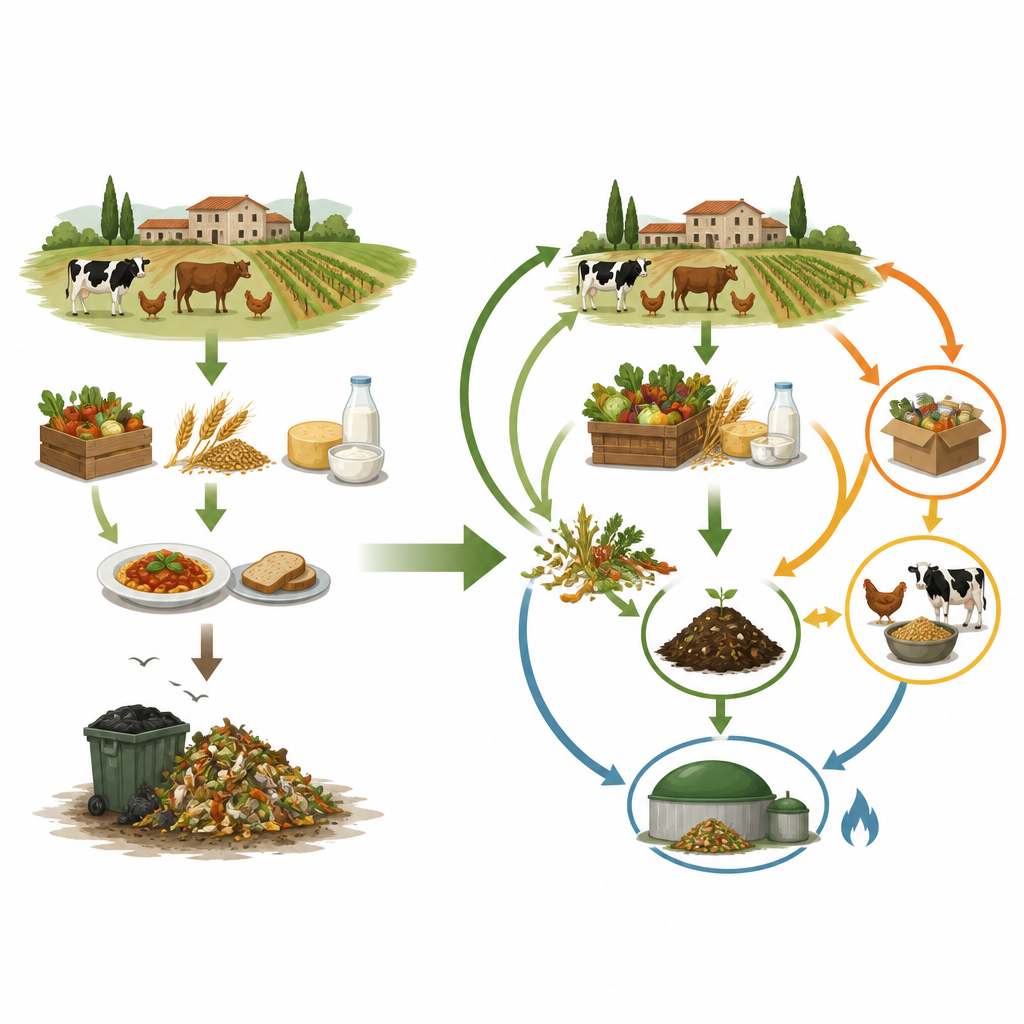
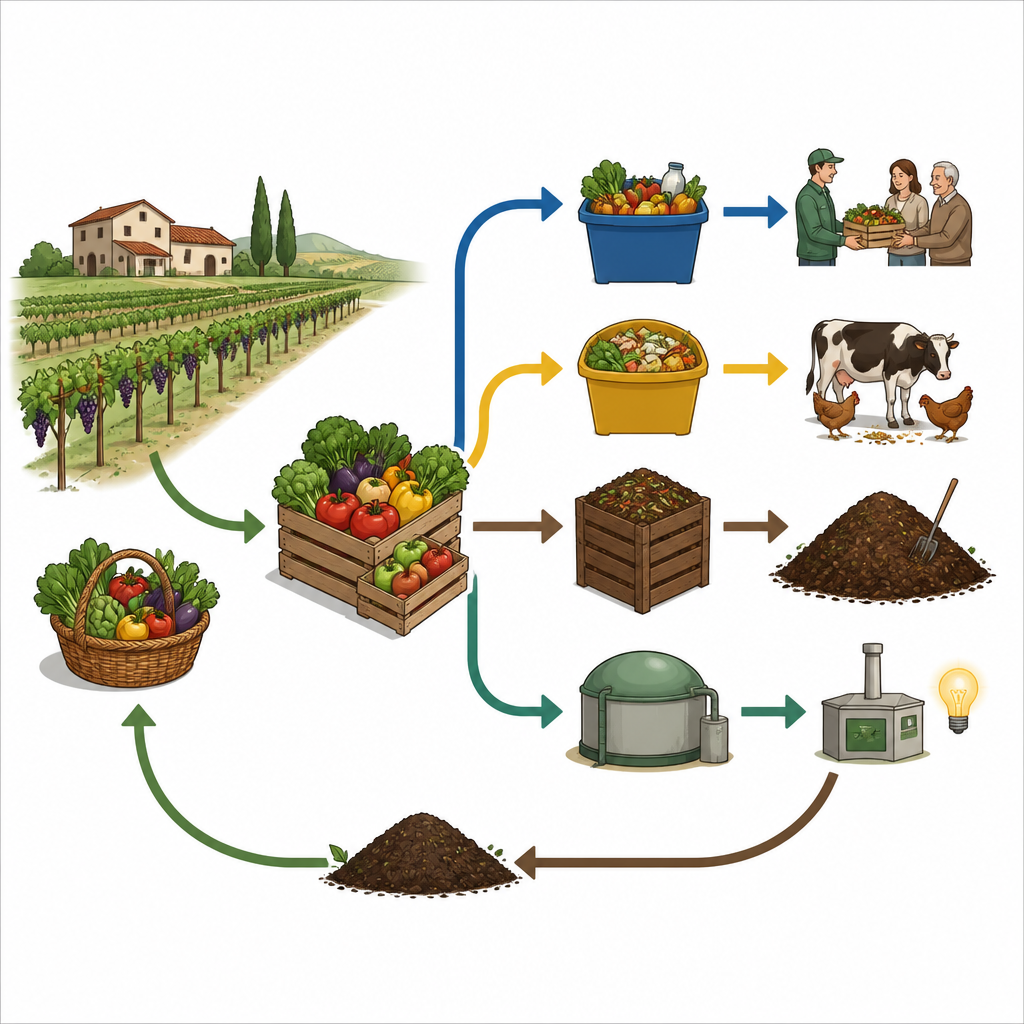
The study focuses on two kinds of lost food. Surplus food is still safe to eat but is not sold or consumed, for reasons such as short shelf life or cosmetic flaws. Food waste covers food and its inedible parts once they are removed from the human food chain. Together they form a large hidden flow that uses land, water and energy without feeding people. In Italy alone, official figures suggest that primary production on farms generated more than 650,000 metric tonnes of food waste in 2022, yet detailed information about where and how this happens has been scarce. The new dataset aims to reveal what actually occurs within farms, from how much surplus they generate to whether it is donated, sold for animal feed, processed into new products or simply discarded.
What circular farming looks like on the ground
The work sits within a broader idea known as the circular economy, in which farms rely more on renewable inputs, keep key nutrients such as carbon, nitrogen and phosphorus cycling in the landscape and find value in byproducts instead of treating them as rubbish. In agriculture this includes regenerative practices that restore soil health and biodiversity, and the recovery of plant residues, food scraps and forestry byproducts as energy or raw materials. Italian farms are central to any move toward circular food systems because they decide how crops are grown, how animals are fed and what happens to leftovers. Yet until now, these different strands of circular practice have rarely been studied together, making it hard to judge how ready farms really are to change.
How the farm survey was carried out
To fill this gap, the authors designed a detailed questionnaire and, with the help of a professional survey company and farm associations, collected responses from 1,200 Italian farms. The sample covers about one eighth of all eligible farms, spread across five size classes, fourteen types of crops and livestock and five major regions. Most questions offered predefined answers phrased in everyday farm language, refined through rounds of interviews and pilot tests. Farmers could report both numbers, such as tonnes of waste or donated food, and yes-or-no style information about practices and attitudes. The survey was run online, and farmers were free to skip questions, which led the researchers to adopt strict rules for what counted as a complete response and to label missing answers clearly.
Turning raw replies into reliable numbers
Because farm data can be patchy, the team invested heavily in data cleaning and validation. They inserted control questions that compared farmers’ reported waste tonnages with the share of production those tonnages were said to represent, and checked apparent outliers against information from company websites. They also used statistical techniques to fill in missing values for production and revenues, carefully splitting farms into groups by size and region before running the calculations. To test whether related items in the questionnaire behaved consistently, they applied a reliability check known as Cronbach’s alpha, which showed a high level of internal agreement. By weighting the responses, they adjusted for overrepresented and underrepresented groups, allowing the dataset to mirror the national farm population within known margins of error.
What the dataset can reveal about better farming
The final dataset contains 443 variables and offers a granular picture of how Italian farms currently handle surplus food and waste, how widely they use regenerative practices, and which circular inputs and technologies they have adopted, are considering or simply know about. It allows users to calculate indicators such as the share of farm output that is donated, reused, recycled or thrown away, and a “waste reduction ratio” that compares recovered surplus to total losses. Because the survey was designed in parallel with similar work on food processing and distribution, it also opens the door to following food and waste across the whole value chain. For readers, the key takeaway is that this is not yet a recipe for perfect farming, but a powerful map: it shows where Italian farms already close loops, where resources still leak away and which policies or incentives might help shift more of our food system from a take–make–trash pattern to one that wastes less and nourishes both people and the land.
Citation: Randellini, N., Scotti, G., Valentini, G. et al. Survey data on Circular Economy practices in Italian farms with a focus on surplus food and food waste. Sci Data 13, 764 (2026). https://doi.org/10.1038/s41597-026-06942-9
Keywords: circular economy, food waste, Italian agriculture, surplus food, regenerative farming