Clear Sky Science · en
Obesity rise plateaus in developed nations and accelerates in developing nations
Why the pace of weight gain matters
Obesity is often described as a worldwide epidemic, but that phrase hides important differences in how fast weight problems are growing, where they are slowing and which age groups are most affected. This study tracked how obesity has changed over the past 45 years in almost every country on Earth, revealing that the surge in richer nations has largely levelled off while many poorer countries are now seeing faster increases than ever before. Understanding these patterns helps governments and communities decide where to focus efforts to improve diets, activity and health care.
Measuring change across the world
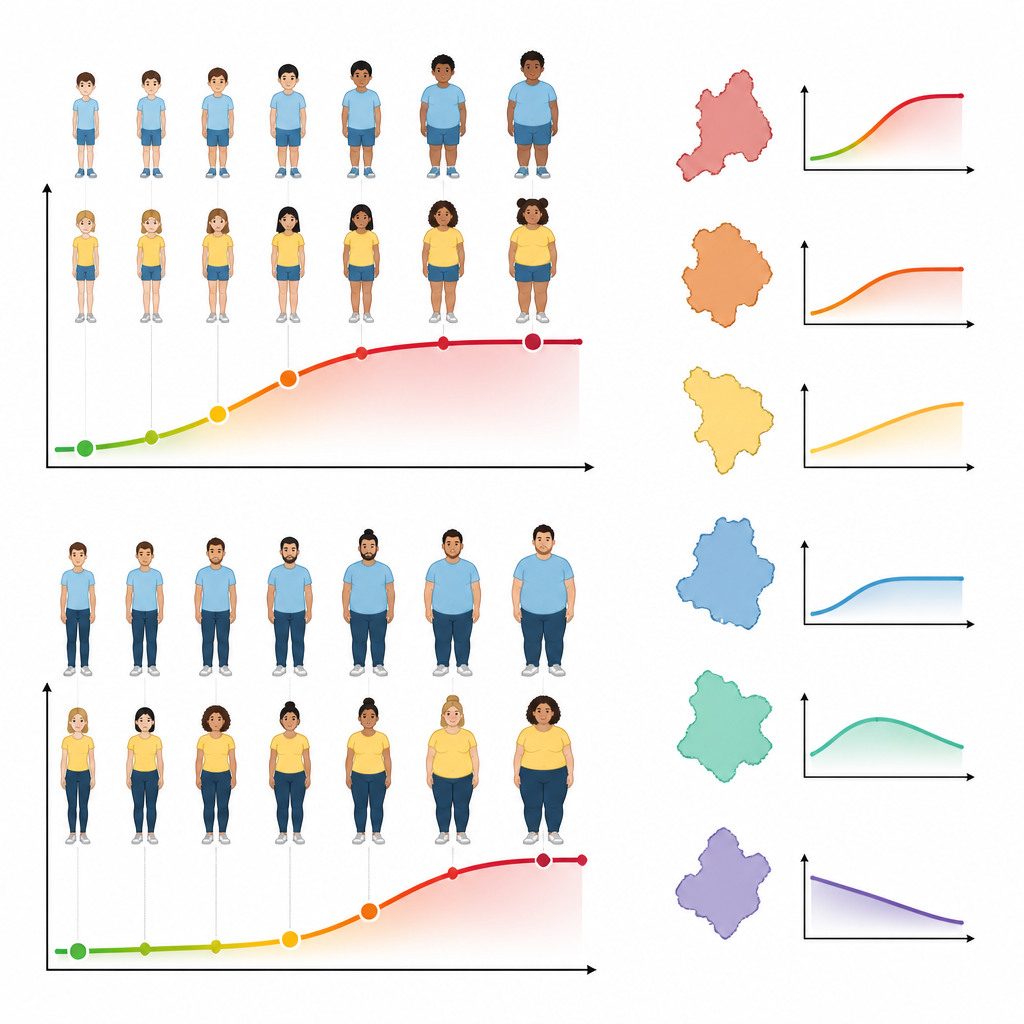
To see how obesity has evolved over time, the researchers combined results from more than 4,000 population-based studies including 232 million people aged five and older in 200 countries. Instead of looking only at how common obesity is in one decade versus another, they calculated its “velocity” – the year-to-year change in percentage of people with obesity. A positive velocity means obesity is rising; a negative one means it is falling. Using advanced statistical models, they estimated these yearly changes separately for school-aged children and adolescents, and for adults, while accounting for differences in data quality and coverage between nations.
Children in rich countries hit a plateau
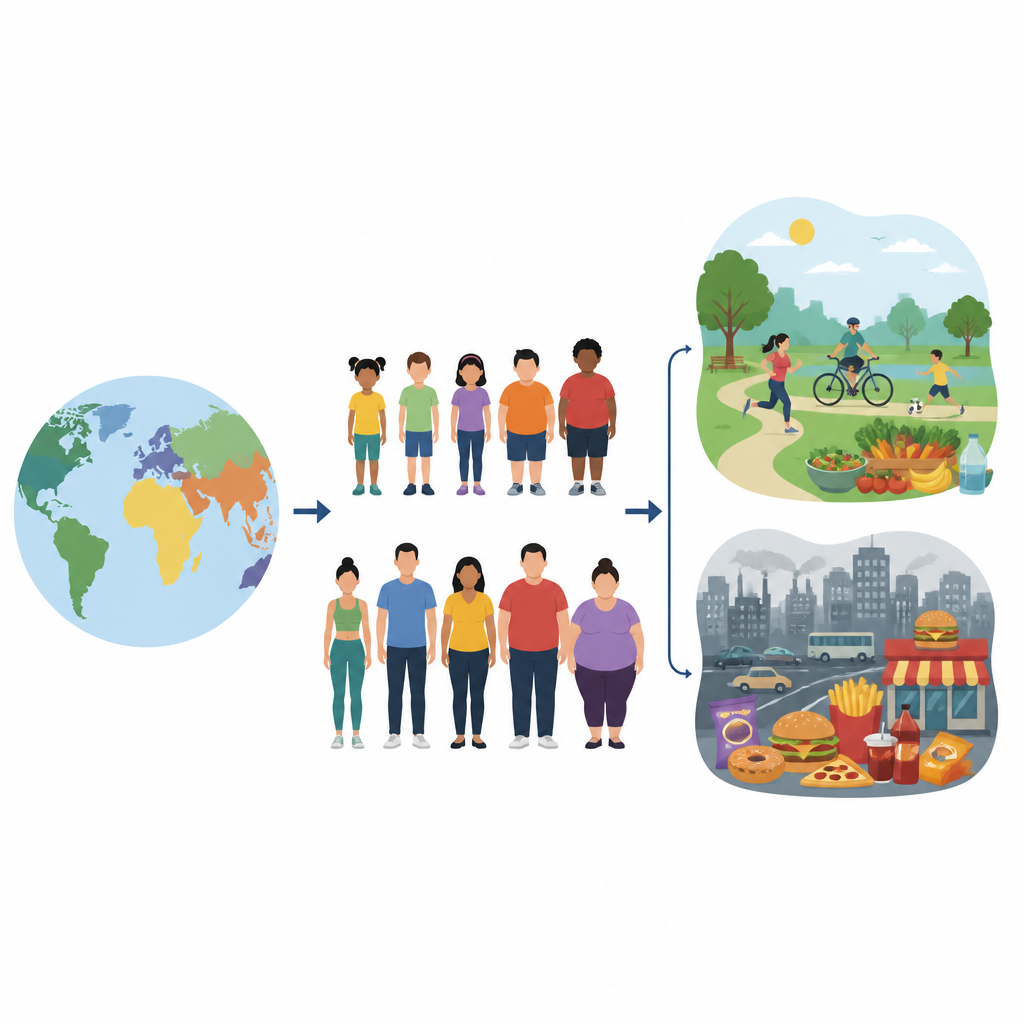
The clearest slowdown appeared among children and teenagers in high-income Western countries, as well as Japan and Taiwan. In many of these places, obesity rose quickly through the 1980s and early 1990s, then began to slow, and by the mid-2000s had largely stopped rising. In some countries such as Italy, Portugal and France, there are hints that obesity among youth may even be edging downward, although these declines are small. Importantly, this plateau has occurred at very different levels. In countries like Japan, Denmark and France, childhood obesity has levelled off at around one child in twenty, whereas in places like the United States, Kuwait and New Zealand the plateau is closer to one in five children.
Rising tide in developing regions
In stark contrast, children and adolescents in many low-income and middle-income countries are experiencing a continuing or even accelerating rise in obesity. This is true both in places where obesity is still relatively rare, such as parts of East Africa and South Asia, and in countries where high levels have already been reached, including several Pacific Island nations, parts of Latin America, and countries in the Middle East and North Africa. In more than half of all countries, especially in these regions, the speed of increase among children in 2024 was the highest seen at any point since 1980. That means that for many developing nations, the problem is worsening just as their populations also face lingering undernutrition.
Adults follow, but not always in step
Among adults, obesity has risen in almost every country since 1980, but its pace varies widely. In high-income Western nations, the growth in adult obesity generally slowed or flattened around or after the year 2000, often starting earlier in women than in men. Some countries, such as Spain, Italy and France, now show convincing signs of a slight decline in adult obesity, though again from very different starting levels. Elsewhere, including many countries in sub-Saharan Africa, Asia and Latin America, adult obesity continues to climb steadily. In some Pacific Island nations, more than two-thirds of adults are living with obesity, and in many other middle-income countries the share of adults with obesity is still rising even where it already exceeds that of rich countries.
Why paths diverge between nations and ages
The study highlights that no single global story can explain obesity. Countries with similar incomes or degrees of urbanization show very different patterns. In Eastern Europe, for example, some nations now have stable or slowing trends, while many Latin American countries with comparable economic development still face accelerating increases. Children and adults in the same country may also be on different paths, and women and men can show different speeds of change. These differences probably reflect a mix of food culture, marketing, physical activity opportunities, education, income, and policies such as school meal standards or taxes on sugary drinks, all interacting with broader economic and technological shifts.
What this means for public action
Overall, the findings show that it is possible for countries to halt, and perhaps reverse, the rise of obesity, as several richer nations appear to have done, sometimes at relatively low levels of prevalence. At the same time, many poorer countries are now seeing obesity grow faster than ever, often without having strong policies in place to promote healthy diets and active living. The authors argue that each country will need tailored approaches that make nutritious food affordable, support physical activity in daily life and ensure fair access to effective treatment, especially for people with lower incomes and education. Without such targeted action, the gap between countries where obesity is stabilizing and those where it is accelerating is likely to widen.
Citation: NCD Risk Factor Collaboration (NCD-RisC). Obesity rise plateaus in developed nations and accelerates in developing nations. Nature 653, 510–518 (2026). https://doi.org/10.1038/s41586-026-10383-0
Keywords: global obesity trends, childhood obesity, adult obesity, nutrition transition, public health policy