Clear Sky Science · en
Knowledge reshapes inquiry by changing question asking ability and impacting academic assessment
Why the questions we ask in class matter
Every day in school, students are encouraged to "ask good questions." But what does that really mean, and does getting better at asking questions actually help you earn higher grades? This study followed a group of undergraduates through a semester-long introductory psychology course to see how their question-asking changed as they learned more—and how those questioning skills related to their performance on both a creative project and a standard multiple-choice exam.
Different kinds of questions for different situations
The researchers focused on two broad types of questioning. First, they measured a general ability to ask imaginative questions about everyday objects, like a pencil or a pillow—questions that show creativity and flexible thinking, but do not depend on any specific subject knowledge. Second, they measured domain-specific questioning: how well students could ask questions about psychology topics they were learning in the course. Both kinds of questions were scored for how many questions students produced, how original those questions were, and how complex they were, based on an educational framework that ranges from simple fact-checking to deeper analysis and idea generation.

How knowledge reshapes inquiry over a semester
By testing students at the beginning and the end of the semester, the study showed that knowledge and questioning grow together—but not in a simple way. As students learned more psychology, their domain-specific questions became more numerous, more original, and more complex. They seemed better able to use what they had learned to ask richer, more probing questions about the subject. In contrast, their general question originality actually dropped over time, and the complexity of these broad, everyday questions hardly changed. This suggests that as students dig into a new field, their questioning becomes more finely tuned to that field, even as their more free-ranging curiosity may narrow.
Creative questions help projects, but not tests
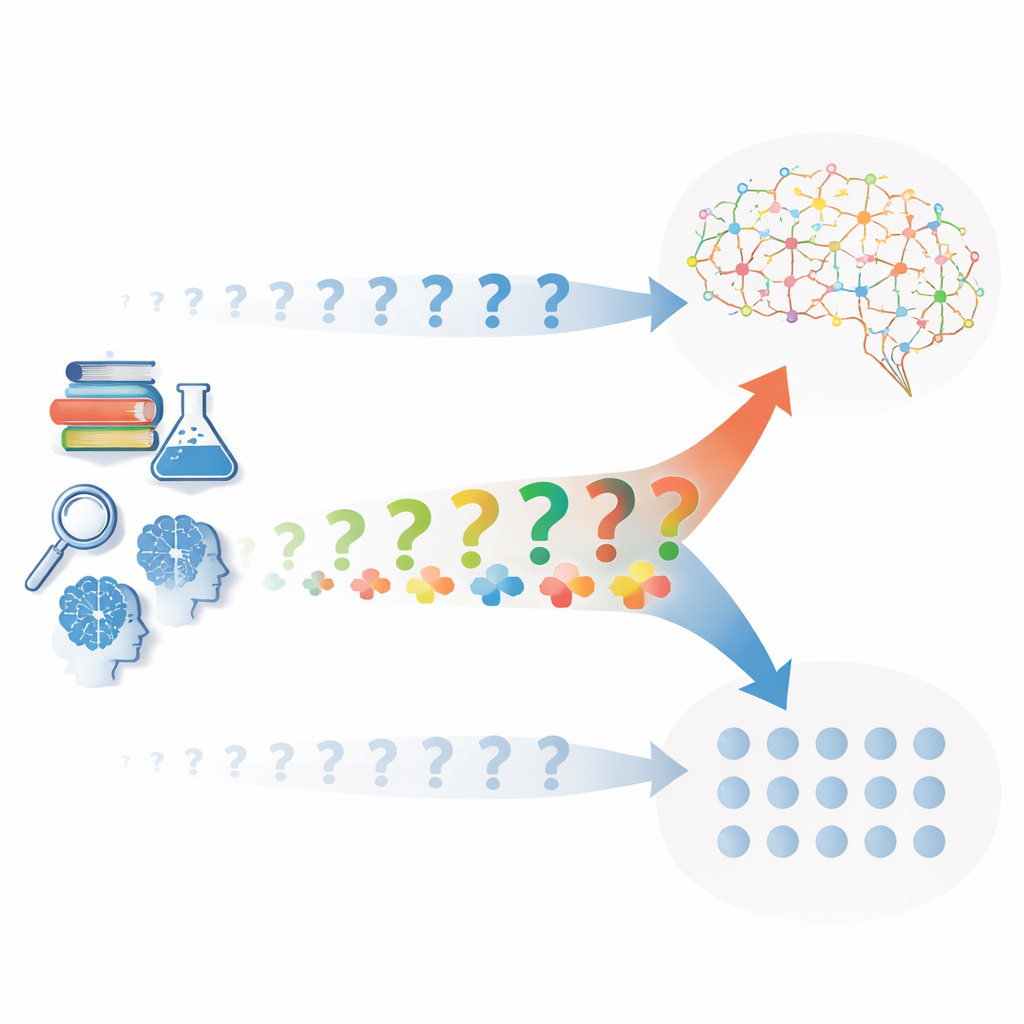
The course included two very different final evaluations: an open-ended group research project and a closed-ended multiple-choice exam. The project asked students to design and run a small experiment, then write up their methods and findings. The exam required them to choose a single correct answer for each question. When the researchers compared question-asking abilities with these outcomes, a sharp contrast appeared. Groups whose members asked more original and more complex questions—both in general and in the psychology domain—tended to earn higher grades on the creative project. However, students who showed stronger originality and complexity in questioning often did worse on the multiple-choice exam. In particular, later in the semester, surges in creative, complex questioning were linked to lower test scores.
Timing and focus: when complex questions help or hurt
Diving deeper, the study found that the timing and focus of complex questions mattered. Early in the semester, trying to ask very elaborate questions about psychology before mastering the basics was linked to weaker project performance, perhaps because it overloaded students’ thinking or created confusion within groups. Once students had a solid grasp of the material, though, complex, subject-focused questions predicted better project results, suggesting that complexity becomes an asset when it is grounded in real understanding. At the same time, spreading energy across too many questions—being very "fluent"—often hurt performance. Producing lots of questions, especially later on, tended to go along with lower project grades and lower exam scores, hinting that quality of inquiry, not sheer quantity, is what really supports learning.
What this means for classrooms and grades
Overall, the study shows that question-asking is a skill that evolves with knowledge and that its benefits depend on how students are evaluated. Rich, creative, and complex questions appear to nourish the kind of thinking needed for open-ended projects and real-world problem solving, where multiple good answers are possible. Yet those same questioning strengths can clash with the demands of timed, single-answer tests. For educators, this highlights a tension: schools often claim to value curiosity and higher-order thinking, but still rely heavily on exams that reward quick, convergent recall. The authors argue that if we truly want students to become better thinkers, not just better test takers, we need to teach and practice sophisticated questioning—and pair that instruction with assessments that recognize and reward such inquiry.
Citation: Raz, T., Kenett, Y.N. Knowledge reshapes inquiry by changing question asking ability and impacting academic assessment. npj Sci. Learn. 11, 19 (2026). https://doi.org/10.1038/s41539-026-00402-0
Keywords: question-asking, creative learning, academic assessment, open-ended projects, multiple-choice exams