Clear Sky Science · en
The role of fear learning in the development of psychosis: an EEG study utilizing a differential fear conditioning paradigm in people with psychotic vulnerability
Why everyday fear learning matters
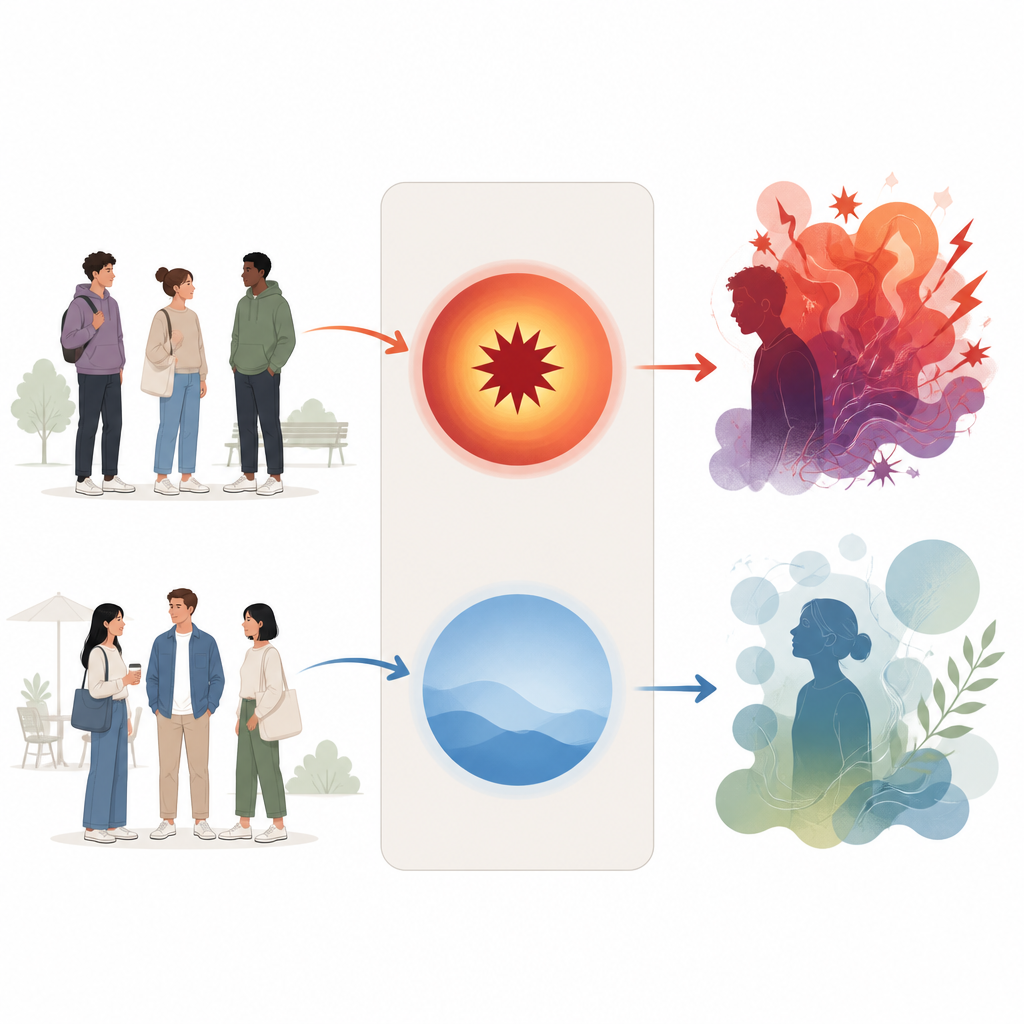
Imagine learning that a certain street corner feels unsafe because something bad once happened there. Over time, most people update that feeling when nothing bad follows. This study asks what happens when that updating process does not work so well in people who are vulnerable to psychosis, a serious mental health condition marked by paranoia and unusual experiences. By looking at how such individuals learn to tell danger from safety, and how they let go of fear, researchers hope to better understand early warning signs and improve future treatments.
How scientists probed fear and safety
The researchers invited young adults who were considered at increased risk for psychosis, along with a comparison group of healthy volunteers. Risk status was based on detailed interviews and questionnaires about unusual experiences and daily functioning, but none of the at-risk participants had full-blown psychotic disorders. In the lab, everyone went through a standard fear-learning task: they saw colored circles on a screen, and one specific color was usually followed by a brief but unpleasant electric pulse on the hand, while another color was always safe. Over time, this setup normally teaches people to feel more uneasy about the “danger” circle and more relaxed about the “safe” one.
Tracking feelings and body reactions
To capture what was happening, the team combined several kinds of measurements. After different phases of the task, participants rated how unpleasant, scary, and arousing each circle felt, and how strongly they expected a shock. At the same time, the researchers recorded brain activity with an EEG, focusing on a signal called the late positive potential, which reflects how much attention the brain pays to emotionally important events. They also measured tiny eye-blink responses to sudden sounds, a classic index of the body’s automatic startle reaction when someone is on edge.
Problems telling danger from safety
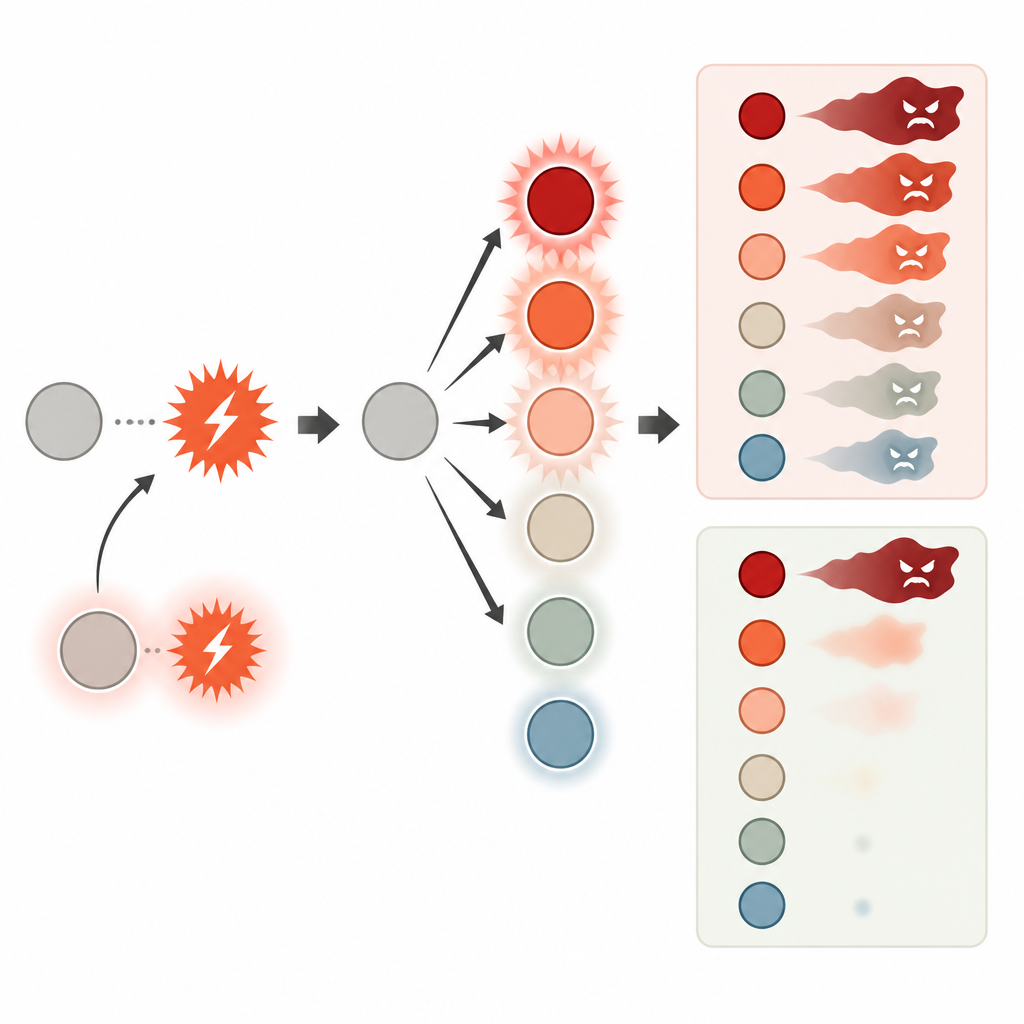
During the learning phase, people at risk for psychosis showed weaker emotional separation between the danger and safe circles in their own ratings. In other words, they did not clearly rate the danger circle as more unpleasant than the safe one compared with healthy participants. Later, when the shocks were switched off and the circles should have become less threatening, the at-risk group was slower to let their feelings catch up with this new reality. Their ratings of unpleasantness and arousal for the danger circle stayed relatively high, while healthy volunteers’ ratings dropped more quickly. Interestingly, the brain signal and startle responses did not differ much between groups, suggesting that the main difficulties appeared in conscious emotional evaluation rather than in basic bodily reactions.
Fear that spreads too far
The task also included circles whose colors were in between the danger and safe options. These “in-between” circles allowed the team to test generalization: whether fear spreads from a clear threat to similar but harmless cues. Exploratory analyses suggested that at-risk participants were more likely to respond to a range of circles as if they might predict the shock, especially in their expectations. Higher scores on a questionnaire for unusual experiences were linked to poorer discrimination between danger and safety, hinting at a gradual worsening of fear learning problems as psychotic-like experiences increase.
What this means for mental health
Overall, the findings suggest that people with psychotic vulnerability have trouble both in drawing a clean line between dangerous and safe signals and in dialing down fear once a cue stops predicting harm. These problems showed up mainly in how participants judged their own feelings rather than in their raw bodily responses. For everyday life, this could mean that situations or people continue to feel threatening long after the real danger has passed, feeding into ongoing anxiety and suspicious thoughts. The authors argue that early interventions might usefully focus on helping at-risk individuals “retrain” their emotional evaluations of threat and safety, so that their feelings can better match the changing world around them.
Citation: Özyagcilar, M., Ahrens-Demirdal, N.E., Riesel, A. et al. The role of fear learning in the development of psychosis: an EEG study utilizing a differential fear conditioning paradigm in people with psychotic vulnerability. Schizophr 12, 45 (2026). https://doi.org/10.1038/s41537-026-00761-y
Keywords: psychosis risk, fear conditioning, fear extinction, emotional learning, EEG