Clear Sky Science · en
Subjective well-being and objective living conditions: a dual approach to measuring sustainability in cities
How City Life Feels Versus How It Looks on Paper
City rankings often tell us which places are “best” to live in, using numbers about income, infrastructure, and the environment. But those league tables rarely ask a simple question: do people there actually feel satisfied with their lives? This article explores that gap between life as measured by statistics and life as it is experienced by residents in two very different Kazakh cities.

Two Cities, Two Stories
The researchers focused on Astana, Kazakhstan’s fast-growing capital, and Kyzylorda, a smaller regional center in the country’s south. Astana is a showcase city: modern, dense, and wealthy by national standards, with large investments in housing, transport, and public services. Kyzylorda, by contrast, is more modest. Its economy leans on oil, gas, and agriculture and it faces serious environmental issues linked to the drying of the Aral Sea and scarce water resources. These contrasts make the pair an ideal test case for asking whether better infrastructure and higher incomes automatically lead to happier residents.
Measuring Life by Numbers and by Feelings
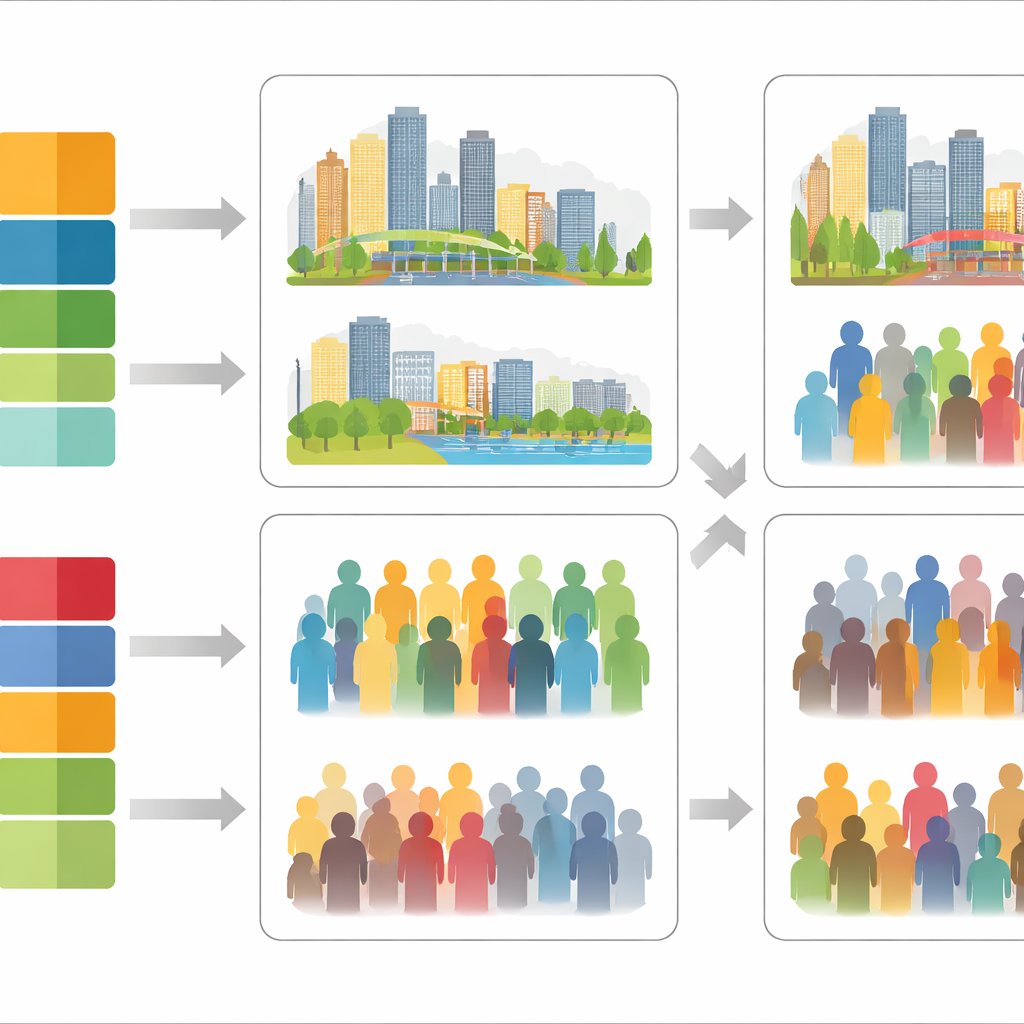
To capture the “on paper” side of urban life, the authors used a Sustainable Urban Development Index (SUDI) built from 27 official statistics covering the economy, city services, health, education, population trends, and the environment. Each indicator was standardized and combined into a single score between 0 and 1 for each city. For the “lived experience” side, they conducted a face-to-face survey of 200 adults—about 100 in each city—asking about household finances, housing, access to water and heating, satisfaction with services, main worries, and overall well-being. This dual approach allowed direct comparison between what the statistics suggest and how people judge their own quality of life.
What the Numbers Say
By objective metrics, Astana comes out ahead. Its overall index score is 0.634, meaning its development is close to the study’s “sustainable” category. The capital especially excels in urban and social infrastructure: roads, housing, schools, and hospitals are relatively abundant and well developed, and the population is young and growing. Its weak spot is the environment, where high building density, traffic, and limited greenery create air and ecological stress. Kyzylorda’s overall score is lower at 0.527, reflecting only moderate sustainability. Its social and physical infrastructure lag behind larger cities, its population faces out-migration and health pressures, and its environmental index is particularly poor, mirroring decades of ecological damage in the Aral Sea region.
What People Say
Survey responses draw a more complicated picture. Astana residents report higher incomes, better housing quality, and more secure access to water, heating, and basic services. Yet they also voice sharp concerns: high prices for food and medicine, traffic and road problems, and dissatisfaction with medical care feature prominently. In Kyzylorda, many households have lower incomes, older cars, and patchier access to hot water, central heating, and some services. Residents are more likely to report having to cut back on essentials such as food, clothing, or electricity. Despite this, Kyzylorda shows strong family networks, larger households, and a widespread sense of belonging and mutual support.
The “Satisfaction Paradox”
This tension produces what the authors call a “satisfaction paradox.” In Astana, where conditions are objectively better, residents often sound more critical, likely because expectations rise along with living standards and people compare themselves to higher benchmarks. In Kyzylorda, where environmental and infrastructure problems are more severe, many residents still report decent levels of well-being in some areas, buffered by close-knit families, traditions, and social ties. In other words, social capital—trust, support, and shared norms—seems to partly compensate for material shortages, at least in how people perceive their lives.
Why This Matters for Future Cities
For policymakers, the main message is that numbers alone do not capture how sustainable a city truly is. A place can score well on income and infrastructure but still feel stressful or unfair to its residents; another can struggle with pollution or weak services yet remain livable because relationships and community are strong. The authors argue that tracking both objective indicators and residents’ own evaluations side by side gives a more honest picture of urban progress. It also helps reveal where expectations outpace reality, where hidden vulnerabilities lie, and how strengthening social connections can support sustainability efforts, especially in resource-constrained cities.
Citation: Tazhiyeva, D., Nyussupova, G., Kenespayeva, L. et al. Subjective well-being and objective living conditions: a dual approach to measuring sustainability in cities. Humanit Soc Sci Commun 13, 535 (2026). https://doi.org/10.1057/s41599-026-06902-z
Keywords: urban sustainability, subjective well-being, social capital, Kazakhstan cities, quality of life