Clear Sky Science · en
Altruistic surrogacy and institutional non-viability: regulatory design lessons from Portugal
Why this debate matters for families
For many people who cannot carry a pregnancy, surrogacy represents a hoped‑for path to parenthood. Portugal chose to allow only altruistic surrogacy, where a woman carries a baby for someone else without pay beyond expenses. On paper, this looked like a compromise that protected women from exploitation while still opening the door to assisted reproduction. This article shows how, in practice, that promise has largely failed: the law technically allows surrogacy, but the system is so tangled that no one can realistically use it. Understanding why helps clarify what any country needs if it wants surrogacy rules that are both ethical and workable.

Three ways countries approach surrogacy
Across the world, countries take very different stances on surrogacy. Some ban it altogether, some permit paid (commercial) arrangements, and others, like Portugal, allow only altruistic surrogacy. These positions are usually justified in moral terms: worries about treating babies and women’s bodies as commodities, fears of exploitation, and a desire to respect bodily autonomy. But the authors argue that focusing only on ethics misses another crucial issue: whether the rules can actually be used in real life. A law may say surrogacy is permitted, but if the process is so burdensome, uncertain, or slow that no arrangement can be safely started and completed, the framework is “institutionally non‑viable” – it exists on paper, not in practice.
When rules exist but the path is blocked
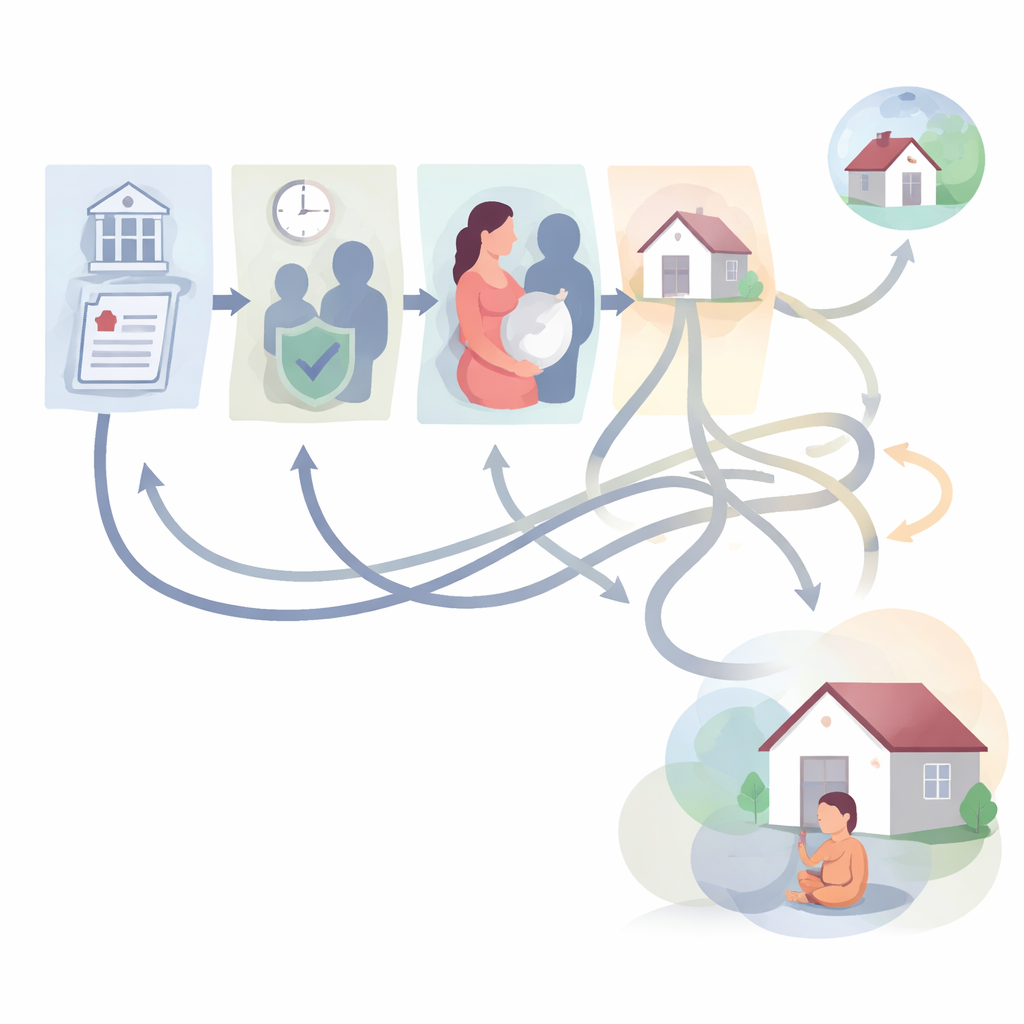
The authors define “institutional operability” as the ability of a legal system to carry a surrogacy arrangement from start to finish: approval before conception, support and clarity during pregnancy, and secure legal parentage after birth, all without resorting to informal work‑arounds or going abroad. That requires clear decision‑makers, predictable timelines, known financial responsibilities, and clear rules for what happens if someone changes their mind. If any of these pieces is missing or unstable, intended parents and surrogates face high uncertainty and costs. Demand for surrogacy does not simply vanish; instead, it is pushed into foreign clinics or informal arrangements, where protections may be weaker and children’s legal status more precarious.
Portugal’s promise and paralysis
Portugal is a vivid example of this gap between law and reality. In 2016, lawmakers introduced an altruistic‑only surrogacy model with strict safeguards: a central national council would approve each case before conception; agreements had to be in writing; and the pregnant woman’s autonomy was strongly protected. However, key parts of this framework were later struck down by the Constitutional Court, especially rules that limited how long the surrogate could withdraw consent and how agreements were structured. Parliament tried to fix the law in 2021 by tightening safeguards and extending the period during which the surrogate could change her mind, even into the birth‑registration phase. Yet the new model still depended on detailed implementing regulations that have never been brought into force. The result is a strange situation: surrogacy is, in theory, allowed, but there is no functioning route that clinics and families can follow from application to legal parentage.
Hidden costs, unpaid labour, and going abroad
The article also explores the economic and social side of these legal choices. Altruistic‑only models dramatically reduce the pool of women willing to be surrogates, making the system extremely sensitive to delays, red tape, and uncertainty. When direct payment is banned, money often reappears indirectly through broad “expense” claims, such as lost income or childcare, but in murky ways that are hard to monitor and enforce. This weakens protection for surrogates instead of strengthening it. At the same time, people who still seek surrogacy arrangements are pushed toward cross‑border options, where local safeguards do not apply and children may face legal limbo when they return home. Feminist and economic perspectives in the article highlight how the physical and emotional work of carrying a pregnancy is undervalued and made invisible in such systems, even when they are framed as ethically careful.
What this means for future laws
The authors conclude that any country that decides to allow surrogacy – whether paid or altruistic – must treat operability as a core design requirement, not an afterthought. That means setting up a clear and timely approval process, a reliable way to establish parentage soon after birth, detailed rules on consent and withdrawal at each stage, and the implementing regulations that make day‑to‑day administration possible. It also means being honest about money: banning compensation does not remove financial flows, it just makes them less transparent. Portugal’s experience warns that restrictive, altruistic‑only permission can collapse into non‑use, driving families and surrogates into more fragile and less regulated spaces. To truly protect all involved – especially women and children – lawmakers must align ethical aims with workable procedures and a realistic understanding of reproductive labour.
Citation: Pinho, M., Dias Costa, E. & Araújo, A.R. Altruistic surrogacy and institutional non-viability: regulatory design lessons from Portugal. Humanit Soc Sci Commun 13, 539 (2026). https://doi.org/10.1057/s41599-026-06847-3
Keywords: surrogacy regulation, altruistic surrogacy, Portugal, reproductive labour, cross-border surrogacy