Clear Sky Science · en
Linking organizational AI adoption to employee knowledge behaviours: the influences of appraisals and locus of control
Why this matters for everyday work
As artificial intelligence moves from buzzword to daily reality, many employees quietly wonder: will these smart systems make my job better, or slowly push me aside? This study looks at that question from a fresh angle. Instead of asking only whether AI helps companies, it asks how AI adoption changes the way workers choose to share—or hide—their know‑how from colleagues, and why some people react very differently from others.
Two opposite paths: sharing or hiding
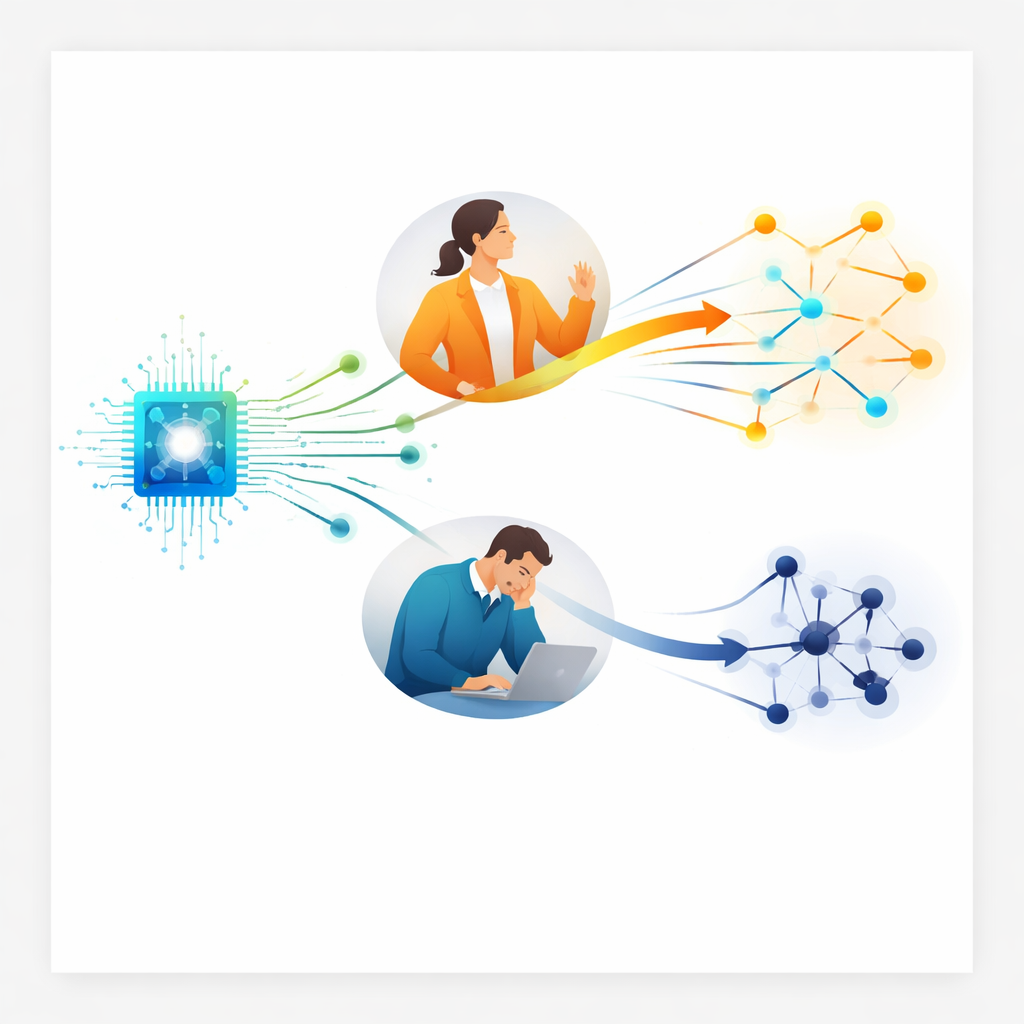
When companies roll out AI tools, they often hope information will flow more smoothly and teams will collaborate more. But the authors show that AI can push knowledge in two opposite directions. In some cases, employees become more willing to share tips, insights, and experience, helping the whole organization learn faster. In other cases, workers pull back, guarding what they know in an effort to protect themselves. These contrasting behaviours—knowledge sharing versus knowledge hiding—are not simply two ends of the same line. They are different choices, with different psychological roots.

How personal outlook shapes AI reactions
The key difference, the study finds, lies in how people see control in their lives. Some employees have what psychologists call an “internal” sense of control: they believe their own effort and skill strongly shape their future. Others lean toward an “external” view, seeing outcomes as driven more by luck, fate, or powerful outside forces. When AI arrives at work, these two groups tend to read the same change in opposite ways. Internally oriented employees are more likely to treat AI as a challenge—something demanding but full of opportunity. Externally oriented employees are more likely to see AI as a roadblock that threatens their progress and security.
From feelings about AI to day‑to‑day behaviour
The researchers surveyed 324 research and development staff in leading manufacturing firms in Shenzhen, China—companies that are already deep into AI use. Data were collected in three waves over several months, asking employees about their sense of control, how they judged AI in their company, and how their supervisors viewed their knowledge sharing and hiding. The results showed a clear pattern. For workers with a strong internal sense of control, greater AI adoption went hand‑in‑hand with seeing AI as a worthwhile challenge. That, in turn, was strongly linked to more active knowledge sharing with colleagues. For workers with a strong external sense of control, greater AI adoption was instead tied to seeing AI as a hindrance, which was strongly linked to more knowledge hiding—such as pretending not to know something or withholding useful information.
Stress, strain, and self‑protection
The study draws on well‑known ideas from stress research: tough demands at work can either energize people or wear them down, depending on how they are appraised. When AI is framed internally as a challenge, it sparks a motivational process. Employees invest more effort, seek new skills, and open up to coworkers, because they believe they can turn the new tools to their advantage. When AI is seen as a hindrance, it triggers a strain process. Workers feel drained and worried about job loss, and respond by protecting what they still control—their own knowledge. In highly competitive, fast‑moving industries, this defensive response can become especially strong, quietly undermining teamwork even as technology becomes more advanced.
What this means for people and organizations
For the lay reader, the core message is simple: AI itself is not automatically good or bad for employees’ willingness to help each other. What matters is how people feel about their own power to adapt. If workers believe they can influence their future, AI is more likely to become a springboard for learning and sharing. If they feel at the mercy of forces beyond their control, the same tools can deepen anxiety and secrecy. The authors suggest that organizations can tilt the balance toward the positive path by boosting employees’ sense of autonomy, building confidence with training, and clearly explaining that AI is meant to support—not replace—human work. In short, the way we introduce AI, and the beliefs people bring to it, will decide whether it opens knowledge up or locks it away.
Citation: Xu, F., Qin, J., Zhang, D. et al. Linking organizational AI adoption to employee knowledge behaviours: the influences of appraisals and locus of control. Humanit Soc Sci Commun 13, 471 (2026). https://doi.org/10.1057/s41599-026-06829-5
Keywords: artificial intelligence at work, knowledge sharing, knowledge hiding, locus of control, employee stress