Clear Sky Science · en
Neither/nor: a pragmatic philosophy for oscillating between conceptual and experiential knowledge
Why Everyday Life Needs Both Ideas and Experience
Modern life constantly pushes us to choose between clear-cut theories and messy reality: medical guidelines versus how our bodies feel, productivity hacks versus actual exhaustion, scientific models versus chaotic newsfeeds. This article introduces “Neither/Nor,” a philosophy that argues we should stop trying to pick a winner. Instead, it treats abstract thinking and lived experience as two separate but trainable skills—and shows how learning to move deliberately between them can reduce suffering, sharpen science, and help us navigate an uncertain world.
A Life Lived Between Numbers and Feelings
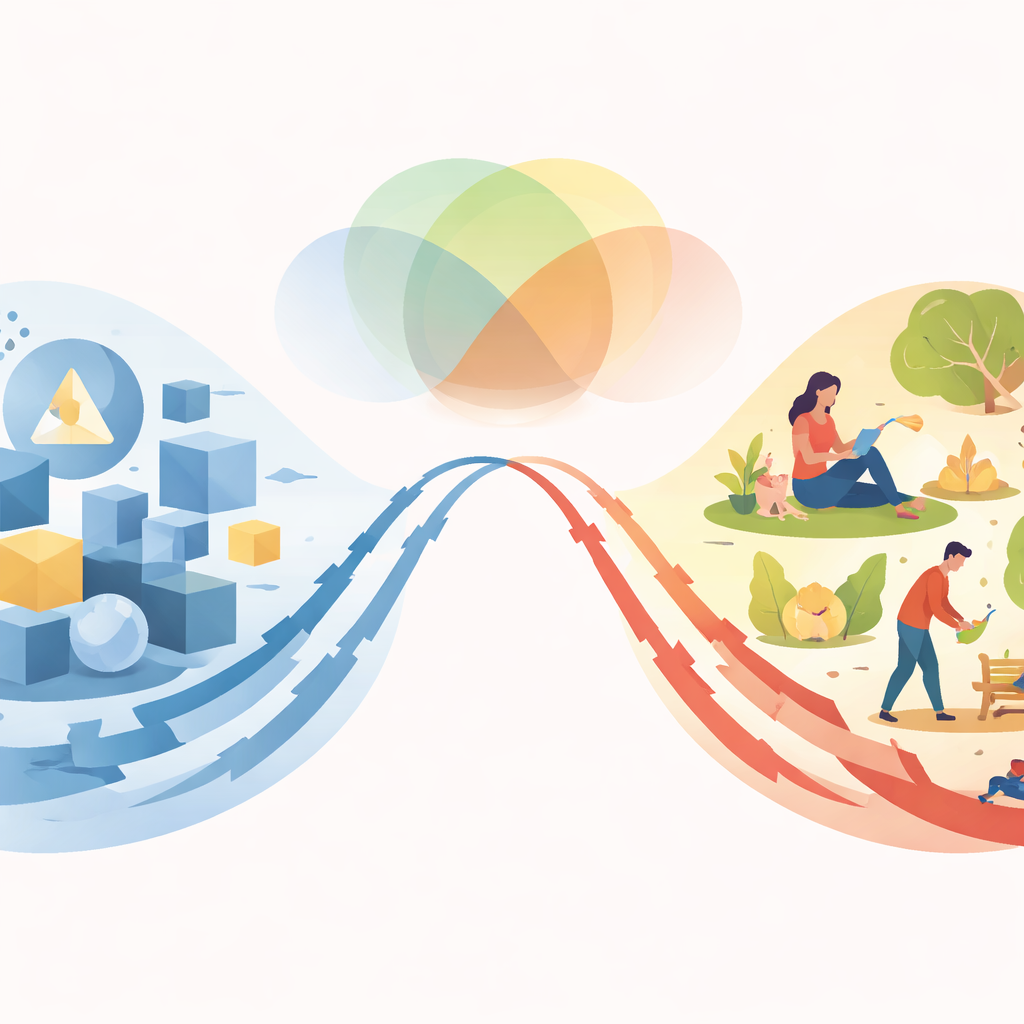
The framework begins with a vivid personal story. One author nearly died as a toddler from undiagnosed Type 1 diabetes; his life was saved when his mother matched his symptoms to a textbook description. From then on, survival meant constant calculation: counting carbohydrates, adjusting insulin doses, tracking blood sugar. Yet the neat formulas never fully captured real life. Stress, exercise, sleep, illness, even weather could throw off the numbers. This daily tug-of-war between precise rules and unruly experience becomes the central example of the paper: neither side can safely be ignored, and managing the illness demands continual negotiation between them.
The Hidden Bias Toward Abstract Ideas
The authors argue that many of us inherit an unspoken bias they call “latent Platonism”: the quiet belief that abstract concepts are more real, more reliable, and more important than what we actually feel and observe. In this view, the world is supposed to fit our categories—about health, success, love, identity—and if it does not, we assume the fault lies in ourselves or others. Medical formulas that blame patients when outcomes misalign, cultural scripts about “finding your true self,” or rigid ideas about what a “good life” must look like all exemplify this tendency. When concepts meant as rough tools harden into unquestioned rules, people can become trapped—ruminating, blaming themselves, or clinging to failing strategies—rather than adjusting to what their experience is telling them.
Two Skills and the Art of Moving Between Them
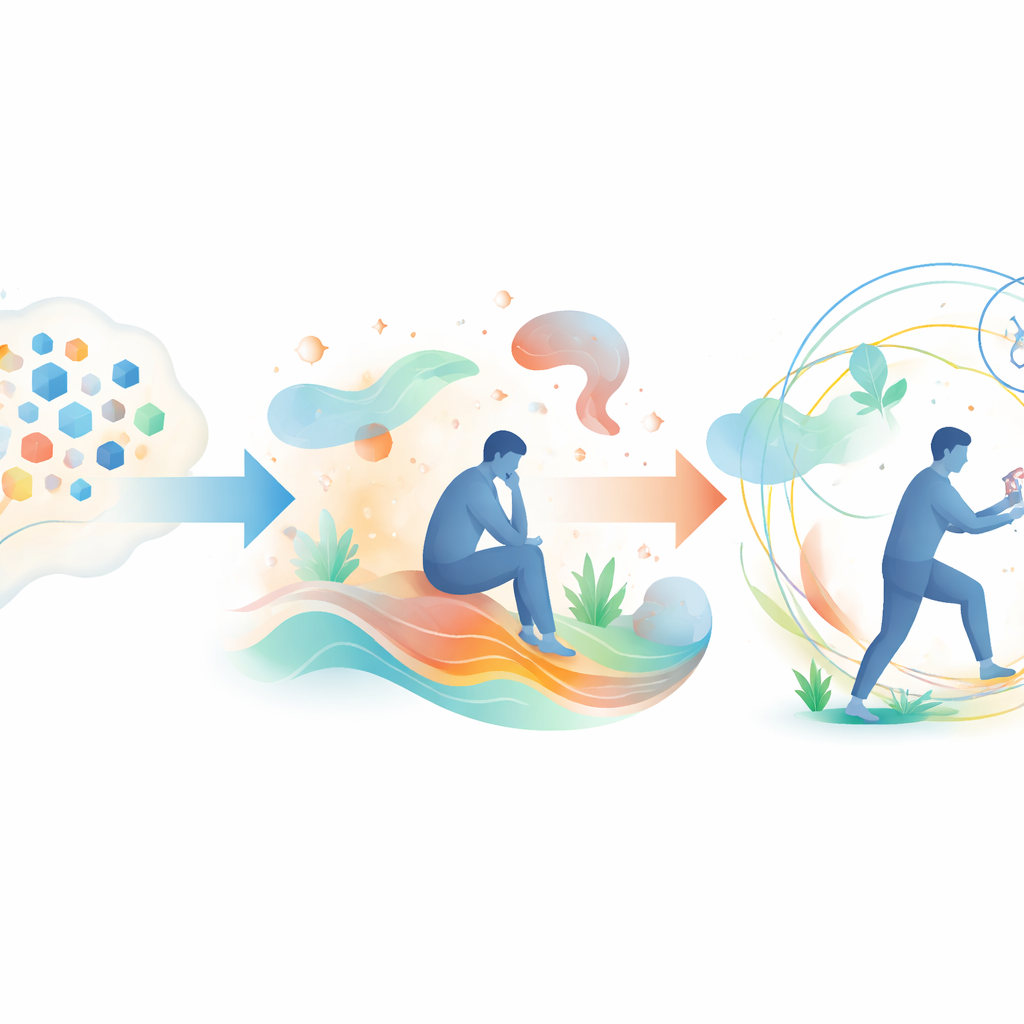
Against this backdrop, Neither/Nor proposes that conceptual thinking and experiential engagement should be treated as distinct skills we can practice, much like strength and endurance in physical training. Conceptual skill involves language, models, and long-range planning; experiential skill centers on attention to sensations, emotions, relationships, and direct action. Across philosophies—from ancient Greek skeptics and Buddhists to modern pragmatists and cognitive scientists—the paper finds versions of this split. Its key move is methodological: before trying to harmonize the two (“Both/And”), we should first learn to isolate and strengthen each one, and to practice “negation”—the deliberate ability to pause, drop out of our current mode, and switch. This oscillation is not a rigid back-and-forth, but a flexible, context-sensitive shifting: sometimes thinking more, sometimes feeling and acting more, sometimes suspending both to wait and observe.
From Personal Suffering to Better Science
The authors show how this approach applies from the inner world to large-scale institutions. On the personal level, rigid concepts about identity, love, career, or emotions can produce chronic distress when life refuses to match the ideal. Research on mindfulness, acceptance-based therapies, and psychological flexibility supports the value of stepping back from such rigid thinking and reconnecting with moment-to-moment experience. On the scientific side, Neither/Nor aligns the dynamics of personal change with those of scientific revolutions: just as individuals sometimes must question deep assumptions about themselves, scientific fields periodically face crises when their reigning models no longer fit the data. Drawing on figures like Thomas Kuhn, John Dewey, and Buddhist thinkers, the paper argues that healthy inquiry—whether in therapy, education, or research—depends on the same learnable pattern: use concepts as provisional tools, test them in experience, notice when they stop working, and be willing to invent new ones.
Living a Flexible Life in a Rigid World
In the end, Neither/Nor is less a theory to believe than a way of living to practice. It offers five guiding habits: treat concepts and experience as skills; commit to oscillating between them; focus on processes and relationships rather than fixed labels; embrace trial-and-error learning; and view current beliefs and institutions as products of history rather than timeless truths. Together, these habits help loosen the grip of latent Platonism—the urge to force reality into rigid categories—and instead cultivate a creative, experimental stance toward life. For a lay reader, the takeaway is simple but demanding: we can suffer less and flourish more not by finding the perfect set of ideas, but by learning when to think, when to feel and act, when to wait, and how to let each of these modes continually reshape the other.
Citation: Kam, B., Granic, I. Neither/nor: a pragmatic philosophy for oscillating between conceptual and experiential knowledge. Humanit Soc Sci Commun 13, 576 (2026). https://doi.org/10.1057/s41599-026-06669-3
Keywords: pragmatism, philosophy of mind, mental health, scientific inquiry, Buddhism