Clear Sky Science · en
Guns versus butter for economic growth: a disaggregated analysis of the impact of military expenditure
Why the guns-and-butter question still matters
When governments pour money into the military, do they help or hurt their economies? This question is especially pressing today, as many countries ramp up defence budgets in response to new security threats. Focusing on Greece—a wealthy nation that has spent more than 2% of its income on the military for over four decades—this study digs deep into how different types of defence spending shape economic growth in both the short and long run.

A country under pressure
Greece offers a striking case because it has faced two powerful, and often competing, priorities: defending its territory in a tense neighbourhood and rebuilding its economy after a severe debt crisis. Despite years of austerity and high unemployment, Greece has continued to devote a large share of its national income to defence, rivalled only by countries such as the United States and Türkiye within NATO. Much of this money has gone to wages and pensions for military personnel, with a smaller slice directed to equipment, infrastructure and day‑to‑day operations. Recent geopolitical shocks, including Russia’s invasion of Ukraine and rising tensions in the Aegean Sea, have triggered another surge in spending, often financed by new debt.
Old debates, new tools
Economists have long argued over whether defence budgets propel growth by boosting demand for goods and services, or restrain it by diverting money from factories, research and education. This study revisits that debate using modern statistical techniques and detailed data from 1980 to 2023. Instead of looking only at total military spending, the authors break it into four main parts: personnel, equipment, infrastructure, and other operating costs. They then study how each category moves together with income per person, investment, education levels and population growth over time, paying special attention to both short‑term bursts and long‑term trends.
Short‑term lift, long‑term drag
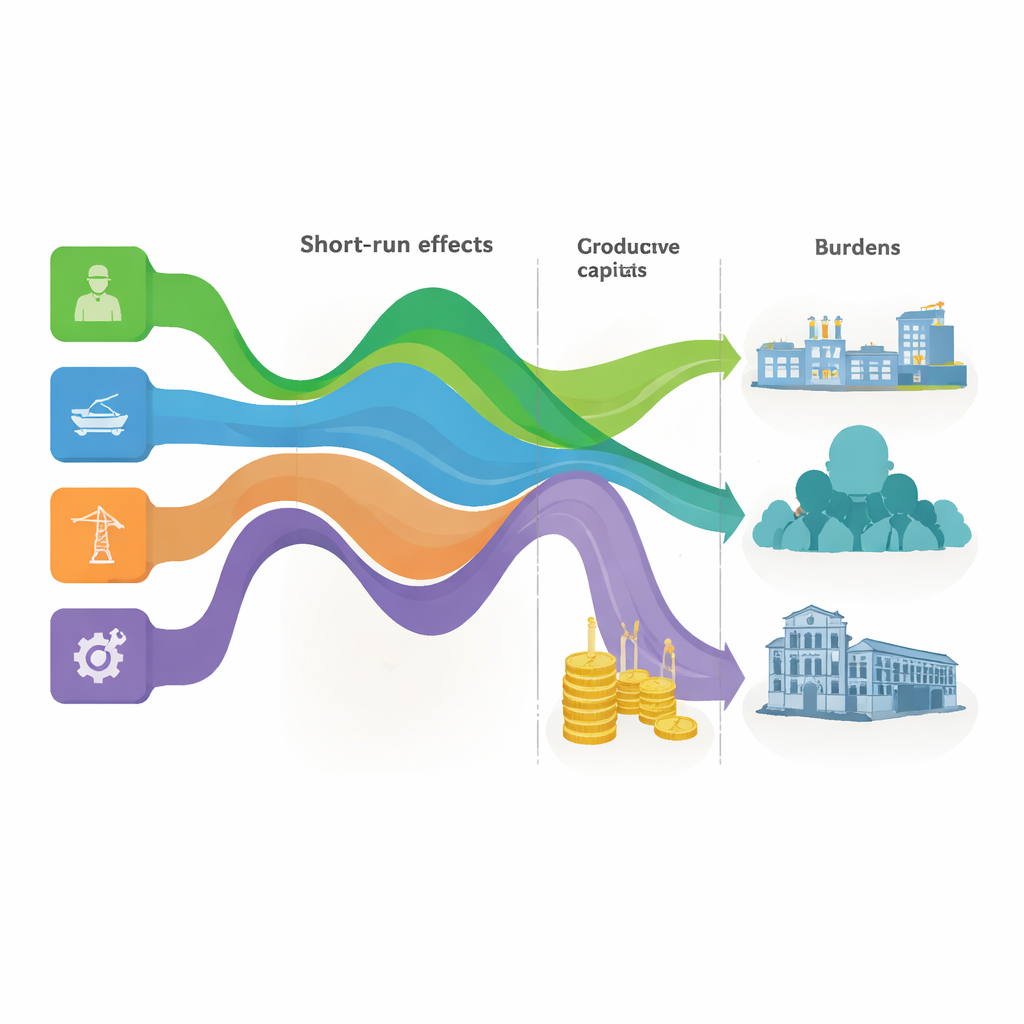
The results reveal a split personality in Greece’s defence spending. In the short run, higher military outlays are associated with faster economic growth. This fits a familiar story: when the government hires more people, pays salaries and buys supplies, it pumps extra money into the economy. In Greece, where unemployment has often been very high, defence jobs—especially relatively well‑paid positions in the armed forces—help support household incomes and local demand. The study finds that this demand boost shows up clearly in the data during the first few years after spending rises.
Over the long run, however, the picture reverses. When the authors follow the effects of defence spending over a decade or more, they find that higher military budgets are linked to lower income per person. This is true whether they look at total military spending or its separate parts. Money channelled into the armed forces appears to crowd out other, more productive uses. It limits what the government can invest in health, education, infrastructure and social services, and it can also discourage private investment by tightening budgets and keeping public debt high. In short, while defence spending can act like a short‑term economic boost, it behaves more like a brake over time.
Why personnel costs matter most
Digging into the different slices of the defence budget, the study finds that personnel spending—wages and pensions for military staff—has the strongest and most contradictory effect. In the short term, it gives the biggest push to growth by supporting jobs and incomes. But in the long term, it has the largest negative impact on economic performance. Greece devotes a much higher share of its military budget to personnel than the NATO average, and military workers enjoy generous benefits compared with much of the rest of the population. These commitments are hard to reverse and leave fewer resources for productive investment, both inside and outside the defence sector. Equipment purchases, infrastructure projects and operating costs also weigh on long‑run growth, but their drag is smaller than that of personnel.
A feedback loop between security and prosperity
The study also uncovers a two‑way feedback between the economy and the military budget. Stronger growth tends to encourage higher defence spending, while changes in defence spending feed back into growth in later years. This mutual influence means that choices about guns and butter cannot be separated: fiscal strains created by heavy military commitments today can shape the room for manoeuvre in the future, especially in a country still managing high public debt and past crises.
What this means for policy
For a lay reader, the central lesson is straightforward: in Greece, more defence spending may help the economy for a while, but if pushed too far and maintained too long, it undercuts prosperity. The authors argue that a smarter balance is needed—one that limits rigid commitments such as wages and pensions, shifts some resources toward technology and operations that can spill over into the civilian economy, and promotes domestic arms production instead of expensive imports. In essence, they show that security and growth can support each other only if defence budgets are designed with long‑term economic health firmly in mind.
Citation: Tsitouras, A., Tsounis, N. Guns versus butter for economic growth: a disaggregated analysis of the impact of military expenditure. Humanit Soc Sci Commun 13, 442 (2026). https://doi.org/10.1057/s41599-025-05580-7
Keywords: military spending, economic growth, Greece, defence budget, public debt