Clear Sky Science · en
Navigating the credibility risks of environmental scientists’ activism
Why This Question Matters
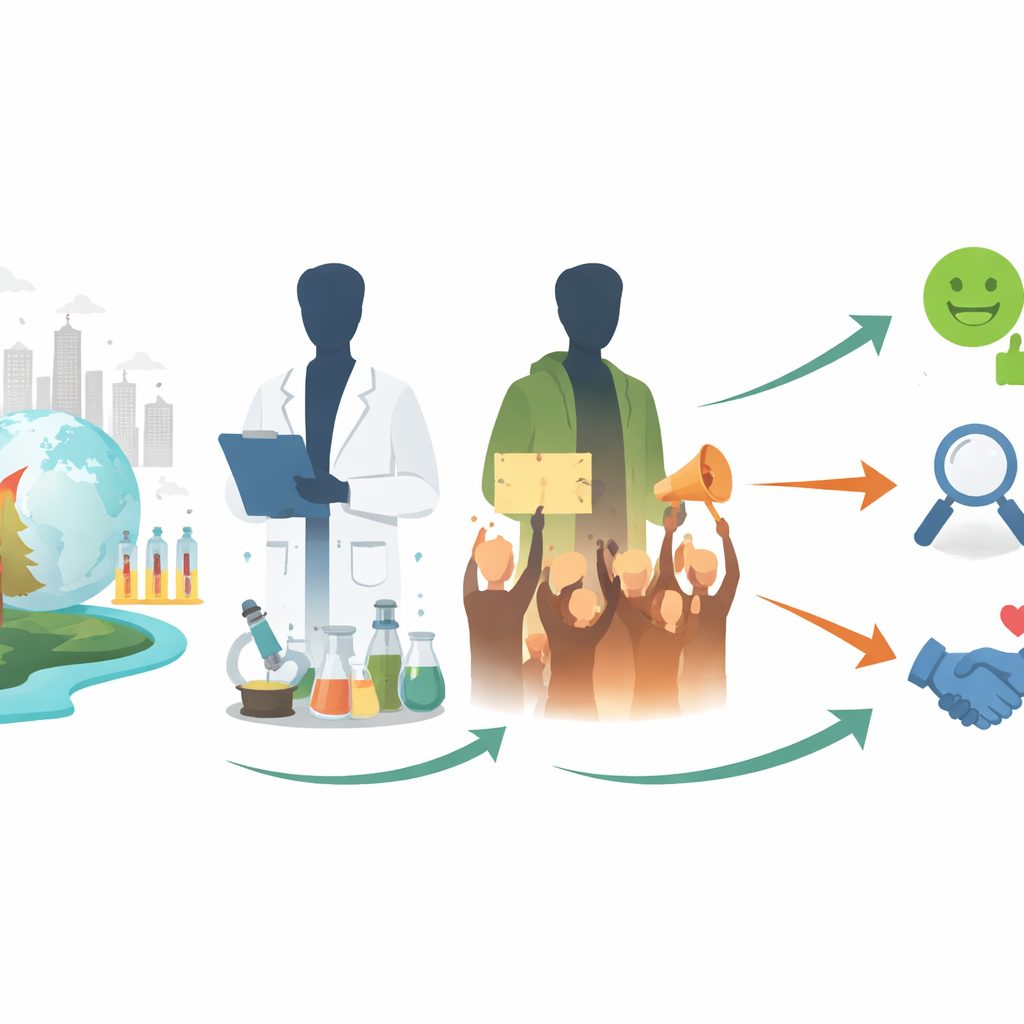
Climate change has pushed many environmental scientists out of the lab and into the streets, joining marches, signing petitions, or even taking part in civil disobedience. But does this public activism help their cause—or quietly erode the very trust that makes scientists influential in the first place? This article examines how ordinary people react when scientists step into the role of activist, and what that means for public confidence in climate research.
Balancing Passion and Perceived Neutrality
The authors start from a tension that many scientists feel: on one hand, the urgency of the climate crisis seems to demand visible action; on the other, scientists’ voices carry weight precisely because they are seen as neutral experts. Supporters of activism argue that traditional ways of communicating science are too slow, and that joining protests or civil disobedience can signal how serious the situation is. Critics worry that once scientists are viewed as political players, people may see their research as biased and tune them out. Despite the intensity of this debate, there has been surprisingly little direct evidence on how the public actually responds when scientists become activists.
Testing Reactions to Everyday Activism
To probe these questions, the researchers conducted two large online experiments with adults in the United States. In both studies, participants read short profiles of environmental scientists and then rated them on qualities such as competence, hypocrisy, and trustworthiness. In Study 1, nearly 500 people saw images of scientists in city settings and read about their work on recycling or energy use. One version portrayed the scientist as an activist who attends rallies and contacts politicians; the other depicted the same scientist as someone who focuses on public talks and media interviews without mentioning activism. Because the pictures, topics, and wording were carefully matched, the key difference was whether the scientist was described as an activist or as a more traditional communicator.
What Happens When Protest Escalates
Study 1 found that the activist scientists were seen as slightly less competent and somewhat more hypocritical than their non-activist counterparts, although people still rated both groups positively overall. Importantly, there was no clear difference in how persuasive participants found the scientists’ messages. In Study 2, the researchers turned to a more intense scenario: civil disobedience. More than 600 people read about scientists who either took part in disruptive protests—such as blocking trains carrying fossil fuels and being arrested—or stuck to research and teaching, like organizing lecture series and answering questions about climate change. This time, ratings diverged more strongly. Scientists who engaged in civil disobedience were judged as less expert, less credible, and more hypocritical. Trust in the broader research field those scientists represented also dipped, suggesting that doubts can spill over from individuals to their discipline.

Who Discounts Activist Scientists—and Who Does Not
The picture was not the same for everyone. People who already behaved in environmentally friendly ways or who had high general trust in science were less likely to downgrade activist scientists. Politically left-leaning participants and those who thought of themselves as activists were also more forgiving. By contrast, individuals with lower trust in science, fewer green habits, or more conservative political views showed stronger negative reactions when scientists took part in activism, especially disruptive forms. In other words, activism tended to damage credibility most among the very audiences that are hardest to convince about climate action.
What This Means for Scientists and the Public
The authors conclude that environmental scientists who engage in activism face small but reliable credibility costs, which become moderate when activism involves arrests or blockades. These findings do not mean that scientists should avoid activism altogether. Protests can still raise public attention, energize movements, and pressure leaders to act—even if they ruffle feathers. But the work shows that activism is not a free lunch: it can nudge perceptions of scientists from impartial experts toward partisan actors, especially in a politically polarized setting like the United States. For scientists weighing whether to march, risk arrest, or stay behind the podium, this research provides a clearer view of the trade-offs between speaking out loudly and preserving the trust that underpins their influence.
Citation: Thürmer, J.L., Braid, J., McCrea, S.M. et al. Navigating the credibility risks of environmental scientists’ activism. Commun Psychol 4, 61 (2026). https://doi.org/10.1038/s44271-026-00409-8
Keywords: scientist activism, climate change communication, public trust in science, environmental psychology, civil disobedience