Clear Sky Science · en
Planting food forests can increase soil biodiversity in agricultural landscapes of Northwest Europe
Why soil life under our feet matters
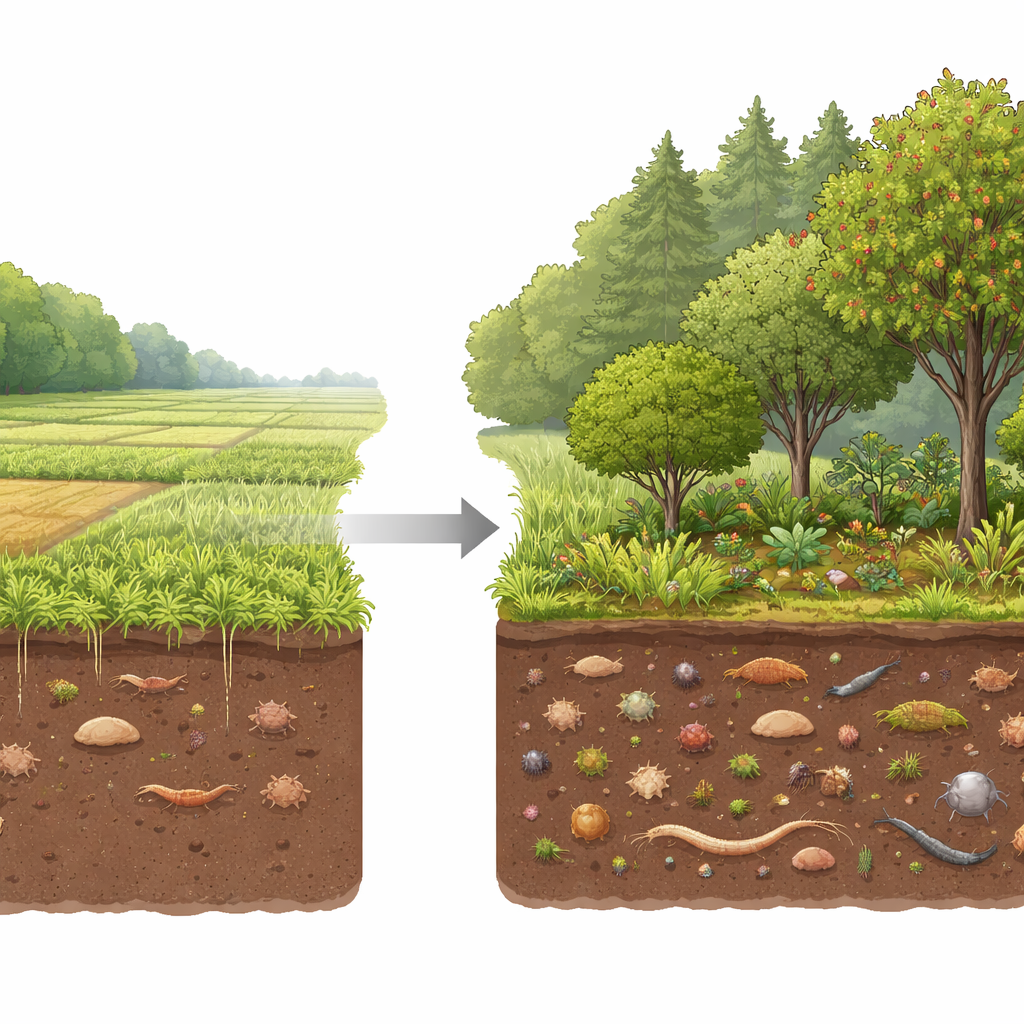
When we picture farms, we usually think about what grows above ground: fields of grass, rows of grain, or stands of trees. Yet much of a farm’s health is decided out of sight, in the bustling world of organisms living in the soil. This study asks a timely question for anyone interested in sustainable food: if farmers replace conventional fields with “food forests” – edible landscapes that mimic small woodlands – can they bring back a richer underground web of life without giving up food production?
A new kind of edible landscape
Food forests are designed to look and function more like semi-open woodlands than like plowed fields. Instead of a single crop, they layer fruit and nut trees, shrubs, herbs and ground covers on the same patch of land, often without synthetic fertilizers, pesticides or heavy tillage. Many such systems in Belgium and the Netherlands are now more than five years old, making it possible to test whether they actually change the soil. The researchers compared 15 food forests to nearby grasslands, croplands and mixed forests on similar soils, treating these as real-world alternatives that a farmer or landowner might choose.
Taking a census of hidden life
To understand what was happening underground, the team measured both the soil’s basic physical and chemical properties and the communities of organisms living in it. They sampled bacteria, several groups of fungi, single-celled protists, tiny roundworms called nematodes, small arthropods such as mites and springtails, larger creatures like woodlice, millipedes, centipedes, ground beetles and harvestmen, and earthworms. Using a mix of DNA-based techniques and traditional species identifications, they looked at how many organisms were present (biomass or individuals), how many kinds there were (different measures of diversity), and how community composition differed among land uses.
Food forests shift soils toward woodland life
The soil itself in food forests turned out to be “in between” that of conventional fields and full forests. Bulk density (a measure of compaction), acidity and nutrient levels sat roughly halfway between croplands and forests. Against expectations, however, the total amount of soil life was not lower than in forests; for most groups it was similar or even higher in food forests, except for one major fungal group. Compared with grasslands and especially croplands, food forests usually hosted more biomass or more individuals, particularly of litter-loving and disturbance-sensitive animals such as mites, isopods, millipedes, centipedes and harvestmen. Some groups, like earthworms and certain root-associated fungi, were still more abundant in grasslands, likely because of thick grass root mats and manure inputs there.
A mixed community with modest gains in diversity
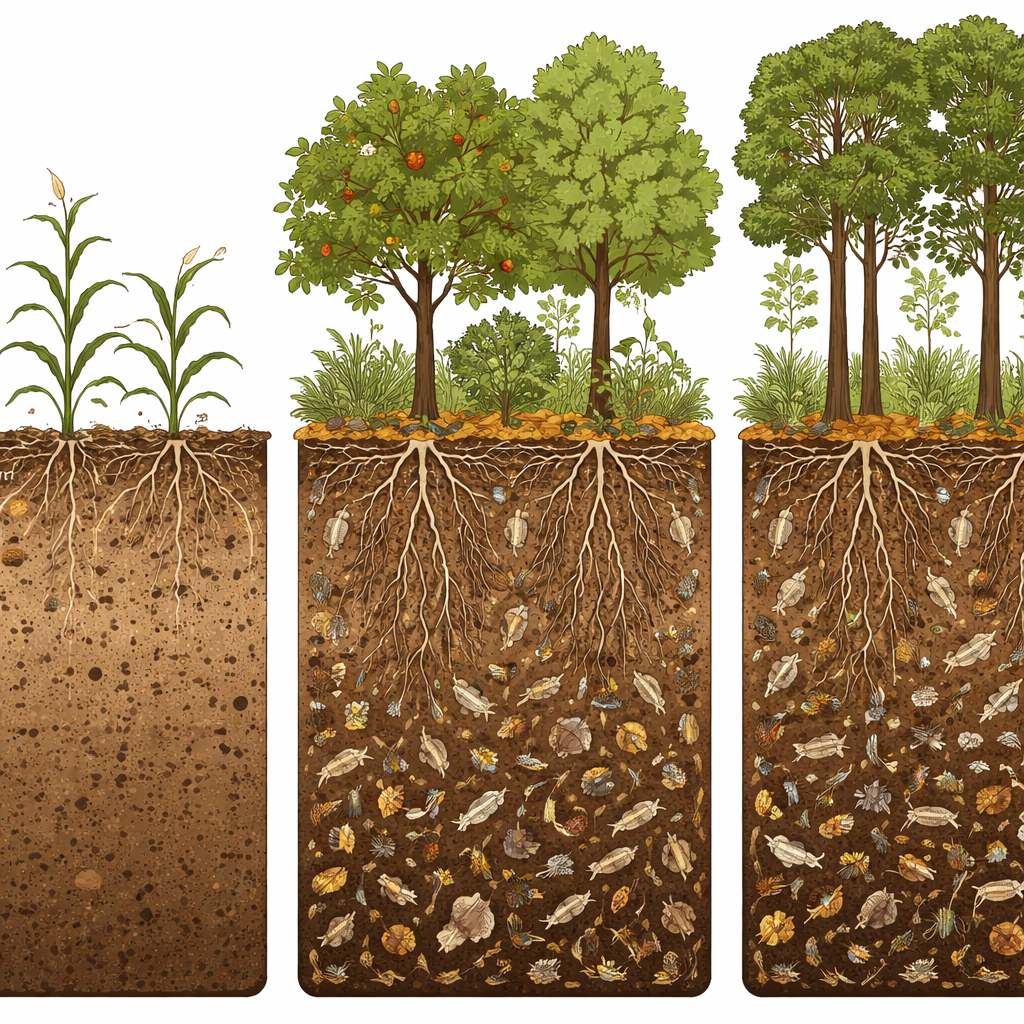
When the researchers looked at which species were present, food forests typically held communities that were neither fully forest-like nor field-like. For non-arbuscular mycorrhizal fungi, larger arthropods and, to a lesser extent, protists and small arthropods, the species mix in food forests fell between that of forests and that of croplands and grasslands. For bacteria and nematodes, food forests still resembled fields more than forests, hinting that these faster-responding groups retain a memory of past agricultural use. Overall, the number of species was higher in food forests for some groups – notably certain fungi and macroarthropods – but differences in diversity were often small, and local conditions and geography explained more variation than land use alone.
What this means for future farming
Taken together, the results show that planting food forests on former fields can quickly change and partly enrich the soil community. Even though the studied systems were relatively young, they already supported more abundant communities of many soil organisms than neighboring grasslands and croplands, without showing any clear losses in diversity. Because food forests foster different combinations of species, especially those sensitive to disturbance and reliant on leaf litter, they could boost soil biodiversity across whole landscapes dominated by intensive farming. As these systems age, their soils may continue to move away from a field-like state toward richer, more woodland-style communities, offering a promising path to produce food while rebuilding life in the soil.
Citation: van der Zanden, I., Moereels, L., Schelfhout, S. et al. Planting food forests can increase soil biodiversity in agricultural landscapes of Northwest Europe. npj biodivers 5, 11 (2026). https://doi.org/10.1038/s44185-026-00125-w
Keywords: food forests, soil biodiversity, agroforestry, agricultural landscapes, soil organisms