Clear Sky Science · en
Feasibility study on using a detection dog to localize hibernacula of Vipera berus
Why Hidden Snake Winter Homes Matter
Across Europe, the small but venomous European adder is quietly disappearing. In Germany it is already considered critically endangered. One weak point in its life cycle is winter: the snakes retreat into underground hideouts, called hibernation sites, where they must stay dry and undisturbed for months. Land restoration and construction can accidentally destroy these hidden shelters, killing many animals at once. This study explores an unusual ally for protecting adders: a trained detection dog that can sniff out their underground winter homes without disturbing the snakes themselves. 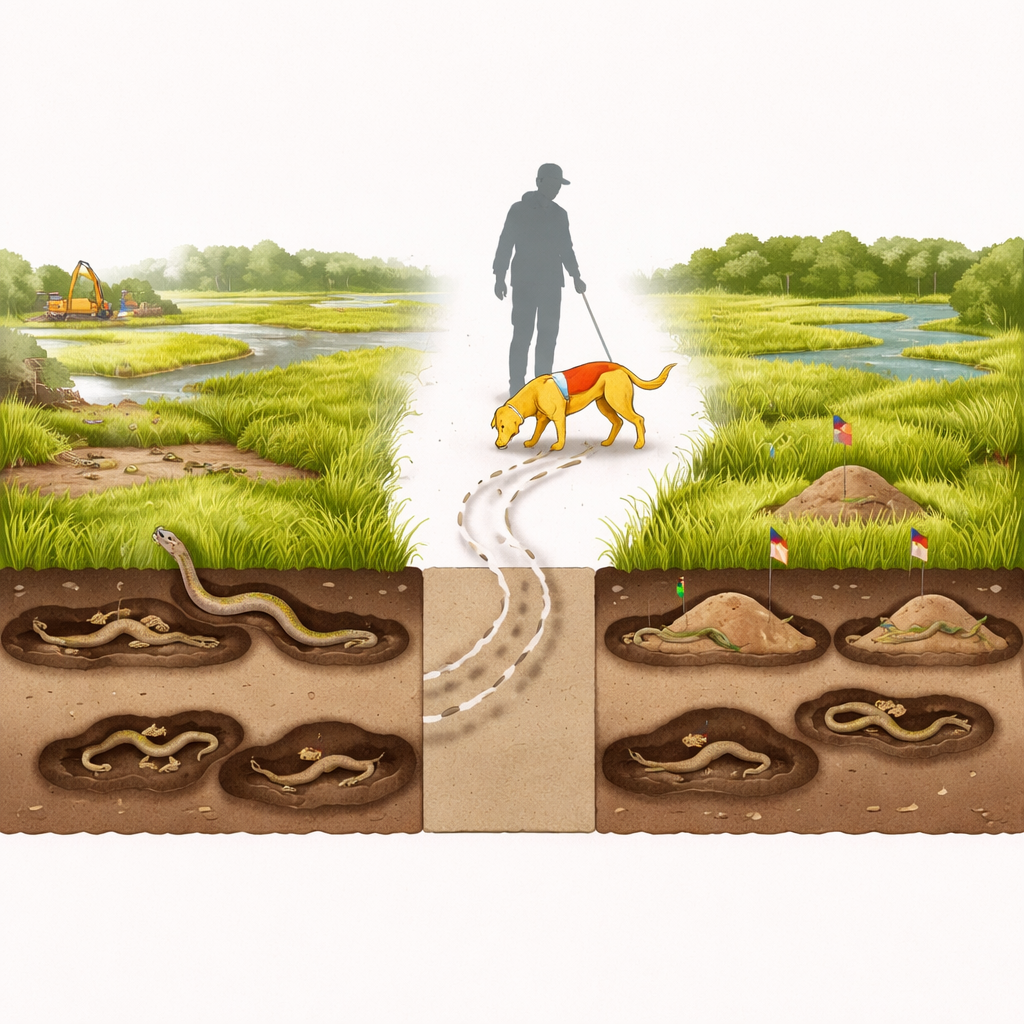
The Trouble with Finding Underground Adders
Protecting adders means knowing exactly where they spend the winter, but their hibernation sites are largely invisible. Adders slip into old mammal burrows, gaps among stones, and root systems, sometimes more than a meter below the surface. Traditional methods rely on watching where snakes bask in spring, which only offers a rough guess, or on attaching radio transmitters, which is costly, invasive, and only tracks a few individuals. As peatlands are rewetted and secondary habitats reshaped, managers risk flooding or burying these crucial shelters simply because they cannot see them. A fast, accurate, and non-invasive way to map hibernation sites could prevent local wipeouts and support smarter habitat restoration.
Teaching a Dog to Smell Adders
The researchers trained a young English Springer Spaniel to recognize adder scent using two harmless sources: shed skins and fecal swabs collected from wild and captive snakes. The dog learned to lie down when it found the target odor, earning a reward each time. To test how well this sense of smell worked underground, the team built a large box filled with either stones or peat, mimicking natural hiding places. They hid one scented tube and four unscented tubes in upright pipes and gradually moved the scent deeper, from the surface down to 1.2 meters. Because neither the dog handler nor the observer watching the search knew where the sample was hidden, the tests avoided subtle human cues that might influence the dog.
From Test Box to Real Fields
In the controlled setup, the dog correctly indicated the adder scent in most runs, even when it was buried deep. Overall, it found 127 out of 140 targets, with only a single false alarm. Shed skins were somewhat easier to detect than fecal swabs, and performance declined as the odor source was buried deeper, especially for swabs in peat at depths beyond one meter. The next step was to move outdoors. On two sites with no adders present—a horse pasture and a canal embankment—the team buried scented tubes about 50 centimeters deep, mixed with blank tubes. The dog located 69 of 70 real samples and completely ignored the blanks, showing that it could work accurately in real soil and weather conditions without being misled by human or container smells. 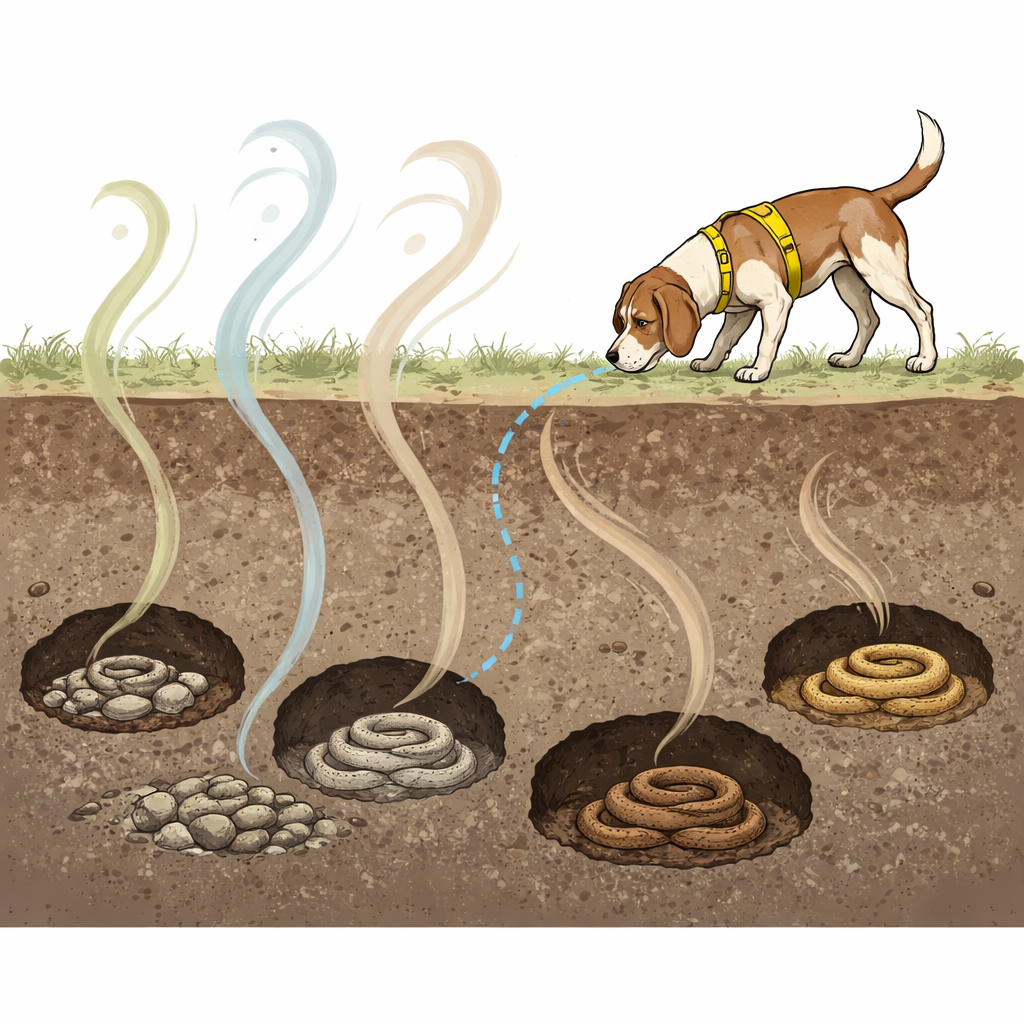
Finding Real Hibernation Sites
The crucial question was whether training on collected material would transfer to living snakes. In a small pilot test, the team searched areas where a few adders had been previously tracked with radio transmitters and were known to be hibernating. In one peatland and one canal site with confirmed winter shelters, the dog indicated positions within half a meter of the tracked snakes’ underground locations. In two additional search areas without tagged animals, the dog still pointed to features that looked like natural hibernation sites, such as a burrow under a tree stump. While the pilot work involved only one dog and very few tagged snakes, it suggests that the animal could generalize from the smell of sheds and droppings to the richer scent blend of a live, hibernating adder.
What This Means for Saving Adders
To a layperson, the main message is simple: a well-trained dog can reliably smell where adders are spending the winter, even when they are hidden underground. That means conservation teams could map and protect these invisible refuges before restoring peatlands, raising water levels, or moving earth for construction. Compared with radio tracking, detection dogs can cover more ground, cause less stress to the snakes, and be cost-competitive once trained. The authors stress that more dogs, more tagged animals, and further field tests are needed to confirm how often this works in different landscapes. Still, this feasibility study shows that conservation dogs could become a powerful, gentle tool to reduce accidental adder deaths and help safeguard other secretive reptile species that hide below the surface.
Citation: Schemel, M., Buchholz, S. & Mausbach, J. Feasibility study on using a detection dog to localize hibernacula of Vipera berus. Sci Rep 16, 14681 (2026). https://doi.org/10.1038/s41598-026-51778-3
Keywords: European adder, detection dogs, hibernation sites, peatland restoration, reptile conservation