Clear Sky Science · en
Efficacy and safety of DMB-I (latrepirdine) therapy in mild to moderate dementia in Alzheimer’s disease: results of a multicenter, double-blind, randomized, placebo-controlled, clinical trial in three parallel groups
Why this memory study matters
As people live longer, more families face the slow loss of memory and independence that comes with Alzheimer’s disease. Many current treatments offer only modest help, and some must be started very early in the illness. This study tested a tablet called DMB-I, a form of the older drug latrepirdine, to see whether it can safely support thinking and day-to-day abilities in people who already have mild to moderate dementia due to Alzheimer’s disease.

Who took part in the trial
The researchers enrolled 135 men and women between 60 and 90 years old, all diagnosed with mild to moderate dementia consistent with Alzheimer’s disease. Everyone was already taking memantine, a standard drug that helps protect brain cells from damage caused by the chemical messenger glutamate. This background treatment was kept the same in all three groups so that any added benefit could be linked to DMB-I. Participants were randomly assigned to receive either a low dose of DMB-I, a higher dose, or placebo tablets with no active drug, three times a day for 26 weeks, without patients or doctors knowing who received what.
How the team measured change
To track thinking, the study used widely accepted tests that focus on memory, language, attention, and problem solving. The main test, called ADAS-cog, gives higher scores when thinking problems are worse. Other scales rated overall mental status, doctors’ impressions of change, the ability to handle everyday tasks such as shopping and managing medicines, and general quality of life. Scores were collected at the start, after 12 weeks, and after 26 weeks, allowing the team to see whether people improved, stayed stable, or declined over time compared with the placebo group.
What the results showed
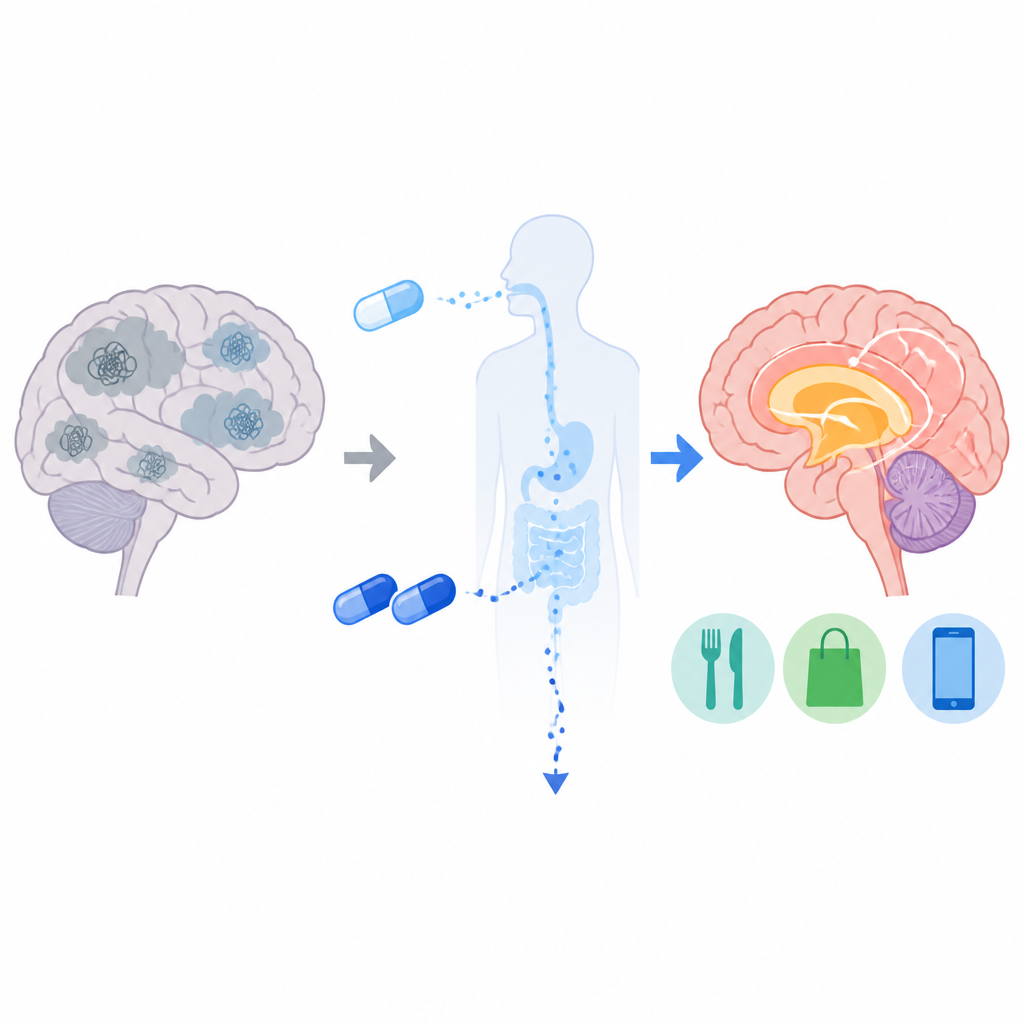
After six months, people taking the higher daily dose of DMB-I showed a clear benefit on the main thinking test compared with those on placebo. Their ADAS-cog scores improved by about three and a half points from baseline, while the placebo group changed very little, leading to a statistically meaningful difference between groups. Both DMB-I doses also showed better results than placebo on doctors’ global ratings and on a scale of everyday independence, especially at the higher dose. The smaller dose improved some measures, but its advantage over placebo was less certain.
Safety and limits of the study
Side effects were common but mostly mild, and they occurred at similar rates in all three groups, including placebo. Typical complaints were dizziness, sleepiness, or fatigue, and no severe or life-threatening reactions or deaths were reported. This suggests that DMB-I was generally well tolerated in older adults who often had other health problems and were taking several medicines. However, all participants were from one country, and their Alzheimer’s diagnosis was based on clinical exams and brain scans rather than advanced laboratory or imaging markers, so some may have had other forms of dementia. The trial also lasted only 26 weeks, leaving open the question of how long benefits might persist.
What this could mean for families
In plain terms, adding the higher dose of DMB-I to standard memantine treatment helped many patients think a bit more clearly and manage daily tasks slightly better over six months, without introducing major new safety concerns. The size of the benefit was similar to that seen with several existing Alzheimer’s drugs. Based on these findings, the researchers chose the 60 mg per day dose as the best balance of effect and tolerability and are planning a larger, longer trial to see whether DMB-I can become a reliable option for supporting memory and independence in everyday clinical care.
Citation: Gorin, B.I., Pozdnyakov, S.O., Potapova, K.A. et al. Efficacy and safety of DMB-I (latrepirdine) therapy in mild to moderate dementia in Alzheimer’s disease: results of a multicenter, double-blind, randomized, placebo-controlled, clinical trial in three parallel groups. Sci Rep 16, 14027 (2026). https://doi.org/10.1038/s41598-026-49538-4
Keywords: Alzheimer dementia, latrepirdine, clinical trial, cognitive function, memantine