Clear Sky Science · en
New large pterosaur tracks from Korea and their implications on terrestrial behavior
Ancient Footprints Tell a New Story
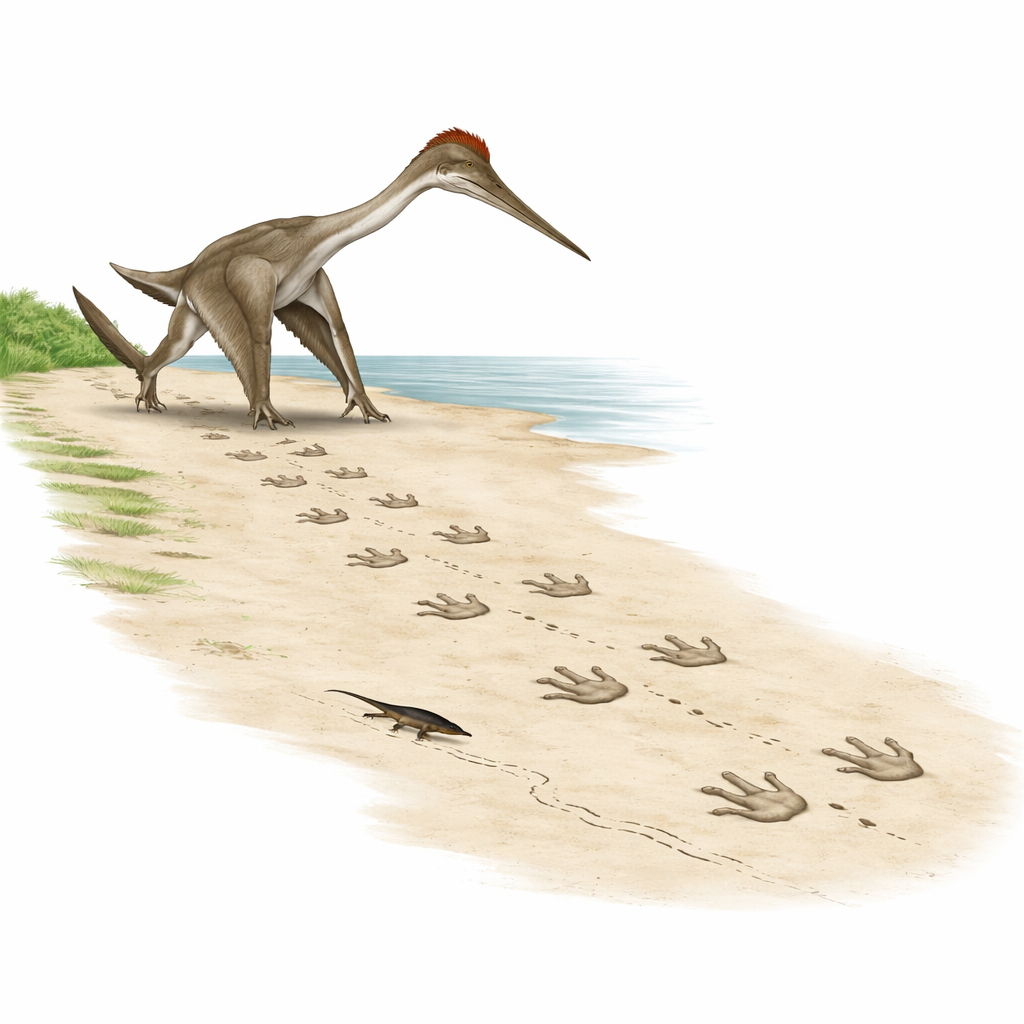
On a mudflat in what is now southern Korea, a flying reptile once strode across the shore while a much smaller creature scurried nearby. Millions of years later, their footprints hardened into stone. This study deciphers those tracks, offering a rare glimpse of how some pterosaurs—often imagined only as sky-soaring gliders—may have hunted on land like modern storks or herons. For readers, it is a window into how scientists use subtle clues in rocks to reconstruct dramatic moments from deep time.
A Busy Lakeshore from the Age of Dinosaurs
The tracks come from the Jinju Formation in the Gyeongsang Basin of South Korea, a region that, about 106 million years ago, was a network of rivers and lakes. These mudflats preserved an exceptional array of footprints from dinosaurs, crocodile relatives, frogs, lizards, and pterosaurs. Within this rich setting, researchers uncovered a sandstone slab bearing two intertwined stories: large, clear impressions of a big pterosaur walking on all fours, and a delicate trail from a much smaller, salamander-sized animal, complete with a faint tail drag. Microbial films that once coated the wet sediment helped lock these details in place, acting like a natural protective layer.
A New Kind of Giant Pterosaur Track
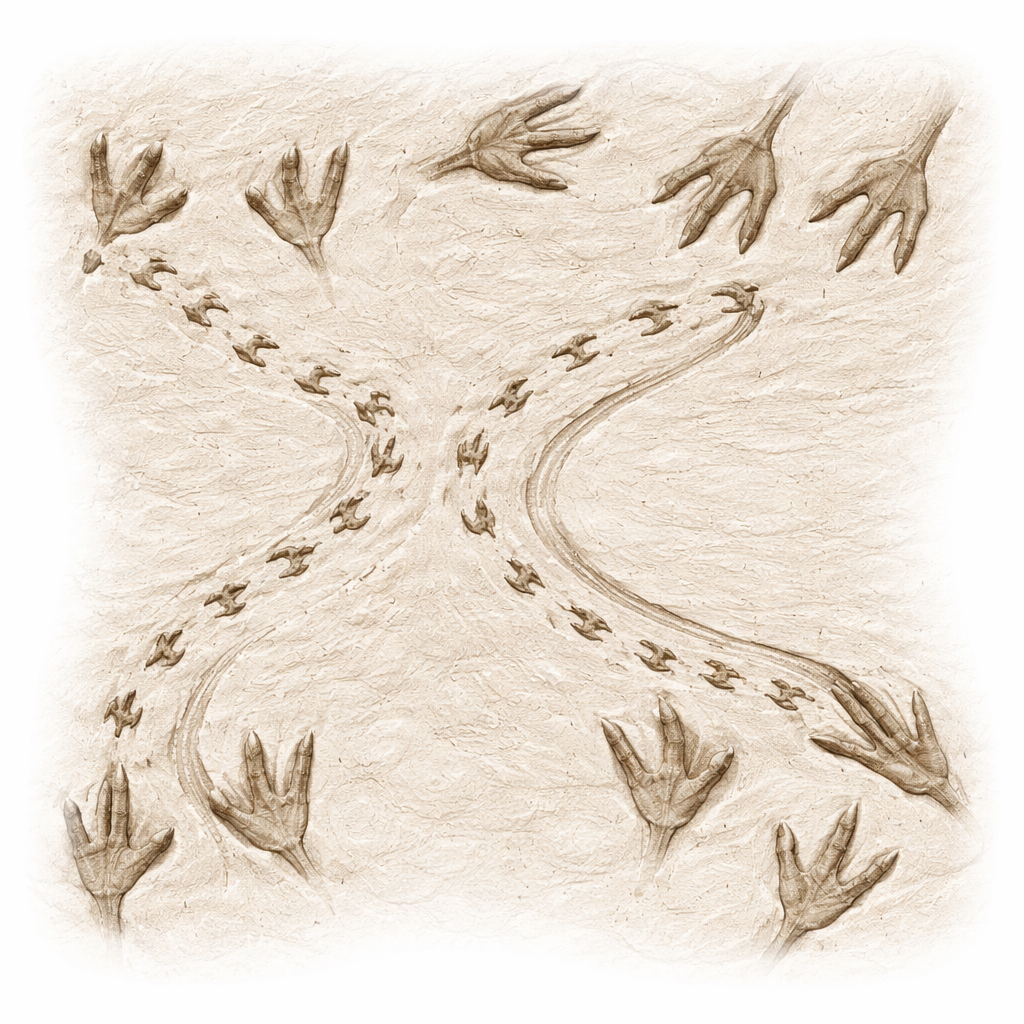
The team formally names the big trackmaker Jinjuichnus procerus, a new type of pterosaur footprint. Each “hand” print shows three slender fingers with sharp claw marks, including an exceptionally long rear-pointing third finger that sometimes left a drag line as it swept backward. The “foot” prints are four-toed, compact, and triangular, with relatively short toes attached to a long, narrow midfoot. This foot structure, with its parallel, elongated bones and shortened toes, matches what is known from a group of pterosaurs called neoazhdarchians—large, long-necked forms thought to spend much of their time walking and foraging on land, rather than skimming over water.
Clues to a Possible Chase on Foot
The small vertebrate trackway nearby is made of tiny hand and foot marks and a sinuous tail groove, suggesting a salamander or perhaps a lizard. At first, its steps are short and regular, implying steady, unhurried movement. Then the trackway suddenly bends about 25 degrees to the left, the tail groove straightens, and the stride grows longer before shortening again. These changes are what one might expect from an animal that abruptly accelerates and then slows down. Importantly, both the pterosaur and the small animal left shallow impressions at one end of the slab and deeper ones at the other, implying they traversed the same soft surface within a short time span, under nearly identical ground conditions.
Reading Behavior from Stone
The authors combine the shape of the tracks, their spacing, and their disruption of the microbial surface to estimate how fast the pterosaur was moving and how its path related to the smaller animal’s. Using established methods that link footprint size and stride length to hip height and walking speed, they conclude that the pterosaur was moving relatively briskly compared with other known pterosaur trackways. The two trails run broadly in the same direction, with the small animal’s tail mark lining up closely with the larger trackway after the point where its stride length jumps. Taken together—shared surface conditions, matching depth patterns, sudden speed and direction changes in the small animal, and a fast-moving, ground-capable pterosaur—these lines of evidence make an interaction between the two animals a plausible, though not provable, scenario.
What This Means for Life on the Ground
To non-specialists, the exciting message of this work is that some pterosaurs were not just creatures of the air but confident walkers and likely hunters on land. Jinjuichnus procerus adds to growing evidence that neoazhdarchians behaved more like stalking shorebirds, using long legs and keen senses to pursue small vertebrates across mudflats and lake margins. While the slab cannot conclusively freeze a chase in progress, it strongly suggests that a large pterosaur and a small, salamander-like animal shared both space and moment in time, and that their fleeting encounter is still legible in stone more than 100 million years later.
Citation: Jung, J., Kim, K.S., Xing, L. et al. New large pterosaur tracks from Korea and their implications on terrestrial behavior. Sci Rep 16, 12363 (2026). https://doi.org/10.1038/s41598-026-48019-y
Keywords: pterosaur tracks, neoazhdarchian, Cretaceous Korea, trace fossils, terrestrial predation