Clear Sky Science · en
A pilot study of assessing visual hallucinations using virtual reality in lewy body disorders
Why strange sights in Parkinson’s matter
People living with Parkinson’s disease and related conditions sometimes see things that are not really there, from shadowy figures to small animals. These visual experiences can be upsetting, hard to describe, and even change how doctors manage treatment. This study explores whether virtual reality, a technology better known from gaming, can give doctors a safer and more precise window into these troubling sights.
Seeing with and without triggers
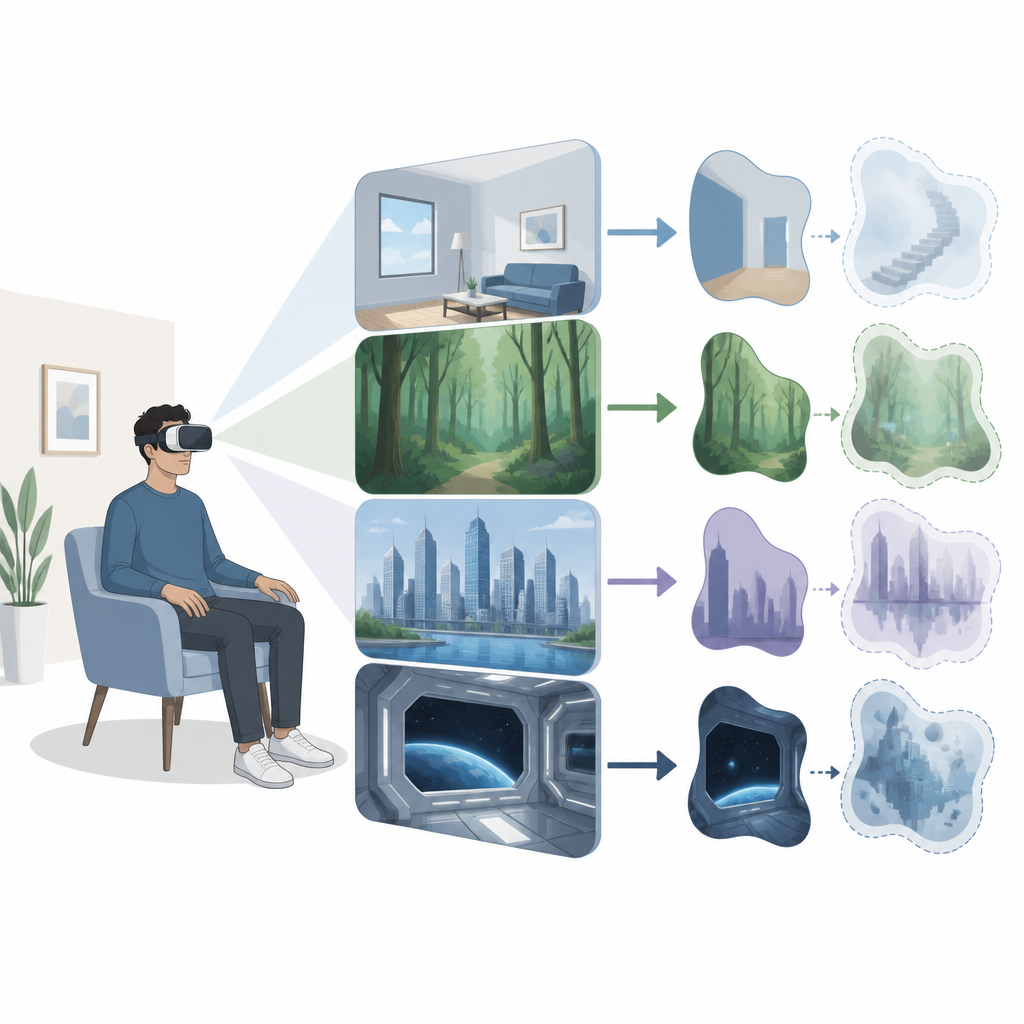
In Parkinson’s disease and dementia with Lewy bodies, the brain can create vivid images without a matching object in the real world. Doctors usually learn about these episodes through patients’ memories and caregiver stories, which can be incomplete or blurred by time, fear, or confusion. It is also hard to tell apart a full hallucination from a simpler mistake, such as misreading a coat on a chair as a person. The researchers wondered if a controlled virtual world, where every tree, lamp, and shadow is known in advance, could help sort out what people actually see from what their brains invent.
Building a controlled virtual world
The team designed a one-time visit where eleven volunteers with Parkinson’s disease or dementia with Lewy bodies wore a head-mounted virtual reality headset with built-in eye tracking. Inside the headset, they explored four main scenes: a plain room, a simple forest, a futuristic station, and a city. The scenes were shown under brighter and darker conditions and sometimes with visual fog to make details harder to see. Before the main test, participants practiced naming common virtual objects and moving around so that confusion from learning the controls would be minimal.
Listening to what people saw
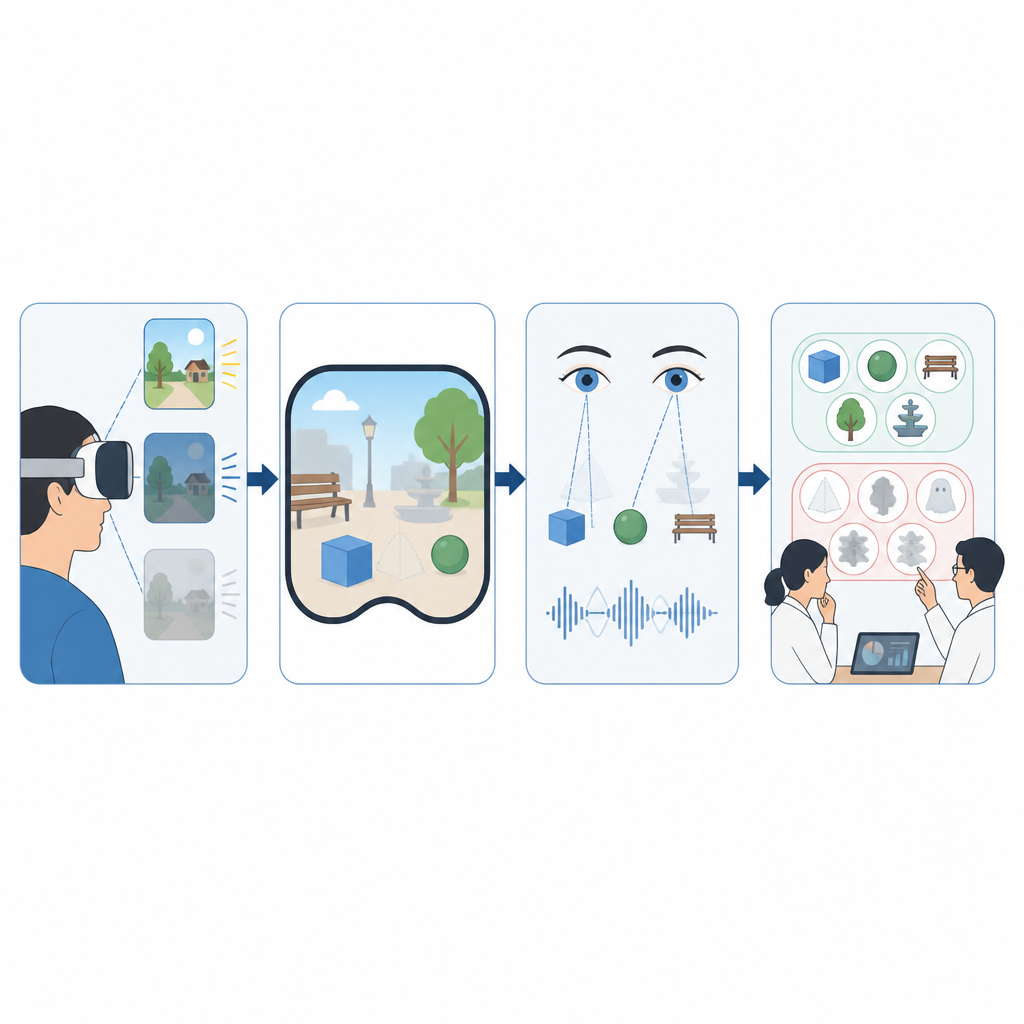
During the main session, new objects appeared around the volunteers as they wandered or looked around, while the headset quietly recorded where their eyes were pointing and what they were seeing. Participants were asked to speak out loud about what they noticed, especially anything odd or familiar from past strange experiences. Afterward, two clinicians who did not run the sessions replayed the recordings, using the eye-tracking data to know exactly which object or patch of scenery each person was viewing at any moment. They labeled each unusual description as either a misperception, where something real was described incorrectly, or a hallucination, where the person described something with no matching object in the scene.
What the virtual worlds revealed
Across the eleven volunteers, the reviewers found 23 unusual visual events: 17 misperceptions and 6 hallucinations. These events were far more frequent than would be expected based on what people had reported about their typical hallucinations over a month of everyday life. Many episodes appeared in darker, visually degraded scenes, especially in the forest and city, echoing long-standing clinical ideas that poor lighting and unclear shapes can nudge the brain toward filling in the gaps. Some participants reported seeing a hanging figure in a tree or movement they took to be cars or cyclists where none were actually present. People who already had a clinical history of visual hallucinations tended to show more errors in virtual reality, but with this small group the difference was not strong enough to be certain and the virtual episodes did not exactly match their usual home experiences.
Promise, limits, and next steps
Importantly, the virtual reality sessions were well tolerated. Aside from one case of moderate dizziness, volunteers were willing to continue and many said they would use such tools again at home or in clinic. Still, there were technical snags, such as slight glitches in how scenes were drawn and the use of a fixed order of environments, both of which might have affected what people saw. Language and memory problems also made it harder for some to describe their experiences clearly. The authors see this work as a first step rather than a finished test. In plain terms, they showed that it is possible to safely provoke and capture subtle visual mix-ups in a controlled virtual world, offering a new way to study how and when the brain misreads what the eyes bring in. With larger studies and more polished software, such tools may one day help doctors track these symptoms more objectively and tailor care for people with Lewy body disorders.
Citation: Hirczy, S.S., Lin, YH., Xiong, W. et al. A pilot study of assessing visual hallucinations using virtual reality in lewy body disorders. Sci Rep 16, 15898 (2026). https://doi.org/10.1038/s41598-026-46644-1
Keywords: Parkinson’s disease, Lewy body disorders, visual hallucinations, virtual reality, eye tracking