Clear Sky Science · en
A Middle Stone Age occupation identified at Baden-Baden in the grasslands of the Free State, South Africa
Ancient people on a high grassy dune
In the heart of South Africa’s grasslands, far from the famous coastal caves, a wind-shaped dune has quietly preserved traces of some of the earliest Homo sapiens. At a place called Baden-Baden 2, scientists have uncovered stone tools and environmental clues that reveal how people lived on this open landscape around 90,000 to 75,000 years ago—and how tricky it can be to read time in shifting desert sands.
A windy hill above old lakes
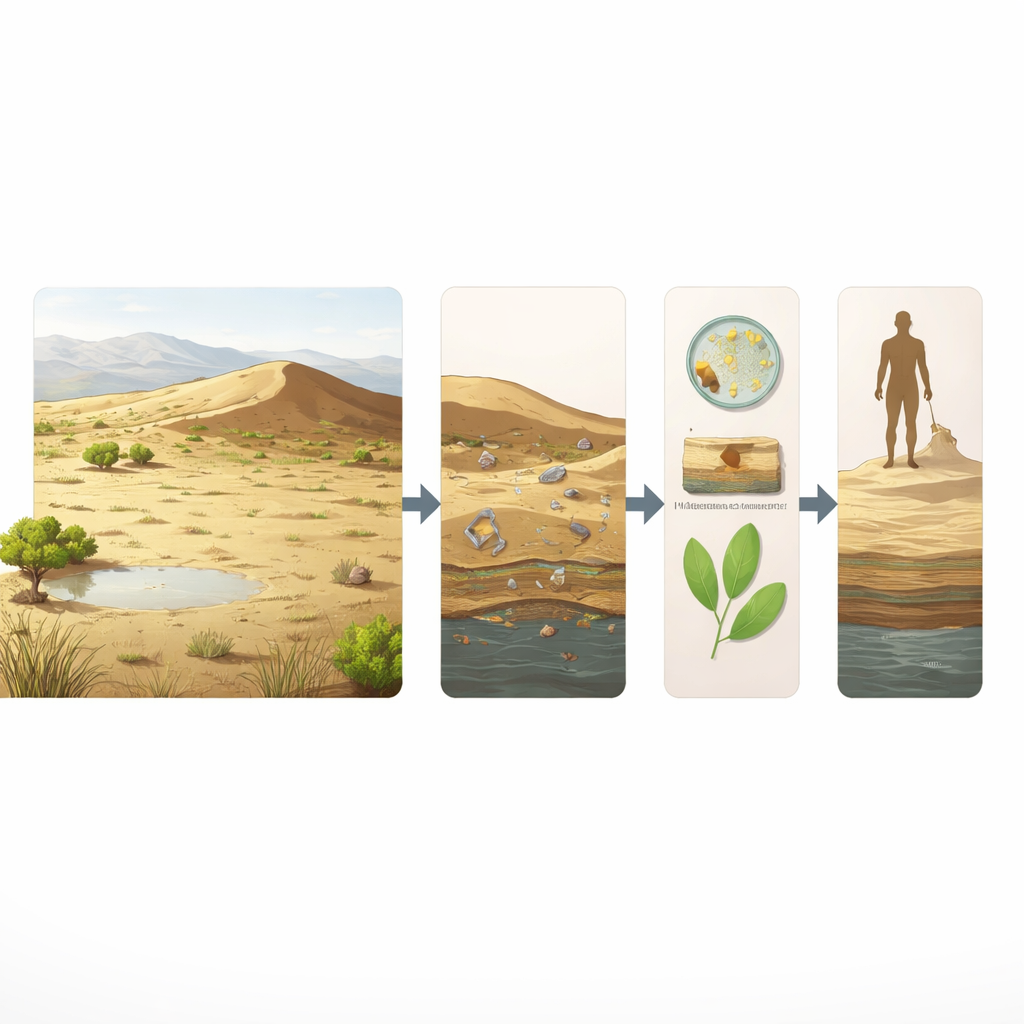
Baden-Baden 2 sits on the crest of a crescent-shaped sand dune overlooking a chain of shallow pans—remnants of ancient rivers and lakes—on South Africa’s central plateau. During a warm phase of the Ice Age known as Marine Isotope Stage 5, this region was dotted with water bodies that drew people and animals into what is otherwise a semi-arid grassland. The new site adds a crucial inland chapter to a story that has so far been dominated by dramatic cave finds along the coast, showing that early Homo sapiens also thrived in wide-open, treeless country.
Reading history in disturbed sand
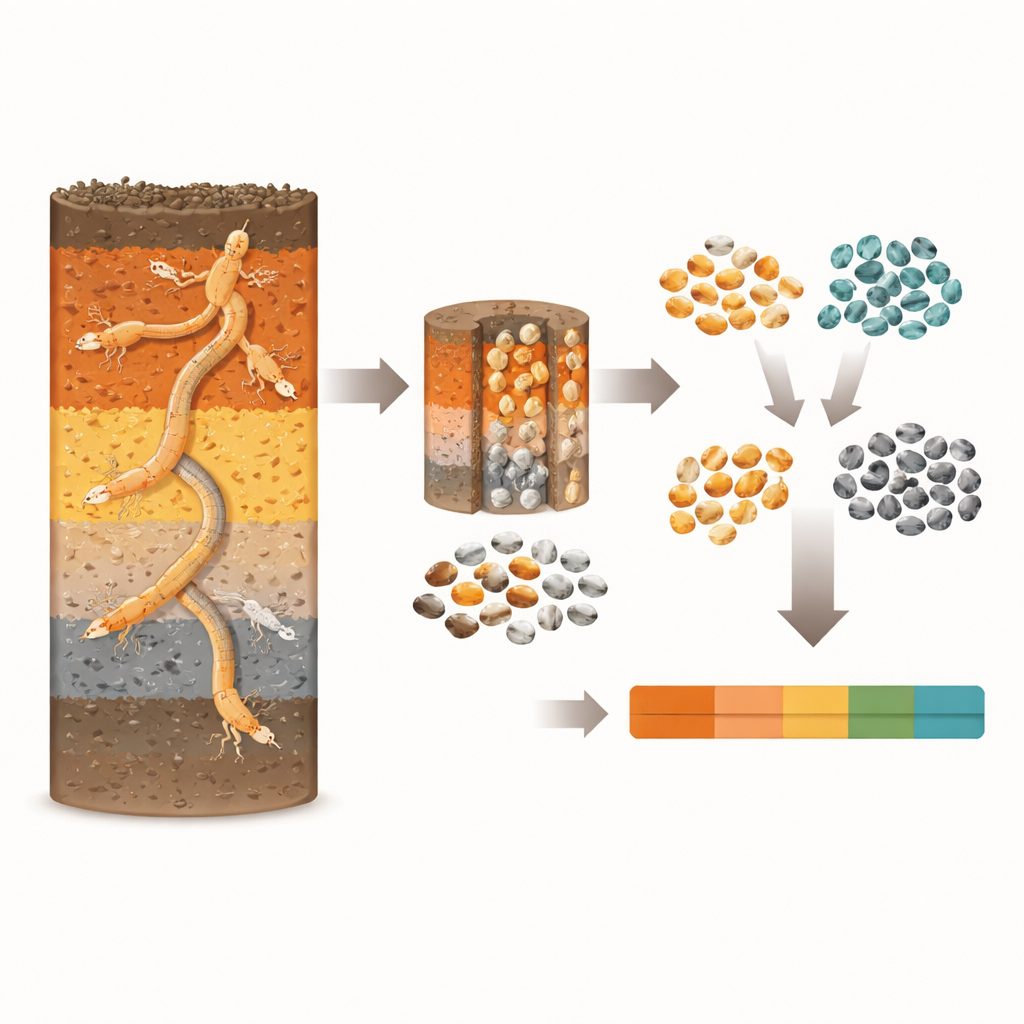
To work out when the site was occupied, the team had to solve a geological puzzle. The dune is built of wind-blown quartz sand arranged in cross-bedded layers, but over time the deposits were thoroughly churned by roots and especially by termites tunneling up and down. This "biological mixing" moves sand grains between layers, scrambling the record. The researchers combined several methods—microscopic study of thin slices of sediment, measurements of magnetic minerals, and a dating technique called optically stimulated luminescence, which measures when individual grains of quartz last saw sunlight—to untangle this disturbed stack of sand.
Letting single grains tell their age
Instead of dating bulk samples, which would blend young and old material, the team measured thousands of single quartz grains. Because termites tend to carry younger grains downward, each sample contained a wide spread of apparent ages. Using a statistical approach known as a finite mixture model, the scientists grouped grains into clusters with similar signals and identified the main older component in each layer as the best indicator of when that sand was first buried. This careful grain-by-grain approach shows that the lower part of the excavated sequence began to accumulate about 106,000 years ago, while the archaeological layers that contain tools span roughly 91,000 to 75,000 years ago.
Life in a stable but dry grassland
The sediments also preserve tiny wax molecules from ancient plants, which act like chemical fingerprints of past vegetation and moisture. Analyses of these "leaf wax" biomarkers indicate that the landscape around Baden-Baden 2 was dominated by grasses and low shrubs, with little tree cover, under a summer-rain climate not unlike today’s, though probably somewhat drier in the older layers. Across the period of human occupation, the plant signal is surprisingly stable, suggesting that people used this dune and nearby pans through several tens of thousands of years without large swings in local habitat.
Stone tools that blur old labels
The 1,153 stone artefacts recovered from the dune reveal a toolkit focused on producing long, narrow flakes and small blades from carefully prepared cores of hornfels, a fine-grained rock. Classic Middle Stone Age features such as Levallois-type flakes occur, but the overall technology resembles even earlier industries often grouped under the loose label of the "early" Middle Stone Age, previously thought mostly older than 130,000 years. Comparing Baden-Baden 2 with other South African sites shows that this style of technology overlaps in time with a variety of later Middle Stone Age industries, challenging simple schemes that tie particular tool types neatly to specific time slices.
Why this grassland site matters
By pinning down the age, environment, and technology of Baden-Baden 2, the study shows that inland grasslands were important arenas for early Homo sapiens innovation, not just the better-known coasts. It also demonstrates that dating open-air sites built of wind-blown sand demands grain-scale methods that allow for intense termite mixing. Taken together, the findings reveal people living on a high dune above seasonal lakes in a stable grassland setting, using a versatile stone toolkit that bridges older and younger traditions—and they call for a more nuanced, region-by-region view of how our species unfolded across southern Africa.
Citation: Richard, M., Bin, B., Longet, B. et al. A Middle Stone Age occupation identified at Baden-Baden in the grasslands of the Free State, South Africa. Sci Rep 16, 12027 (2026). https://doi.org/10.1038/s41598-026-43246-9
Keywords: Middle Stone Age, South Africa archaeology, human evolution, paleoclimate, stone tools