Clear Sky Science · en
Children’s resource taking varies with experimentally manipulated relative status
Why kids’ choices about prizes matter
On the playground and in the classroom, children constantly decide how to share — or keep — toys, snacks, and rewards. These everyday moments reveal how kids think about fairness, power, and friendship. This study asks a simple but revealing question: when children are allowed to take prizes from another child, does it matter whether they just won or lost a game, and whether they see themselves as higher or lower in status than their partner? The answers shed light on how early in life children start to tune their behavior to social rank and how boys and girls may already navigate status in different ways.
Games, winners, and a “taking” decision
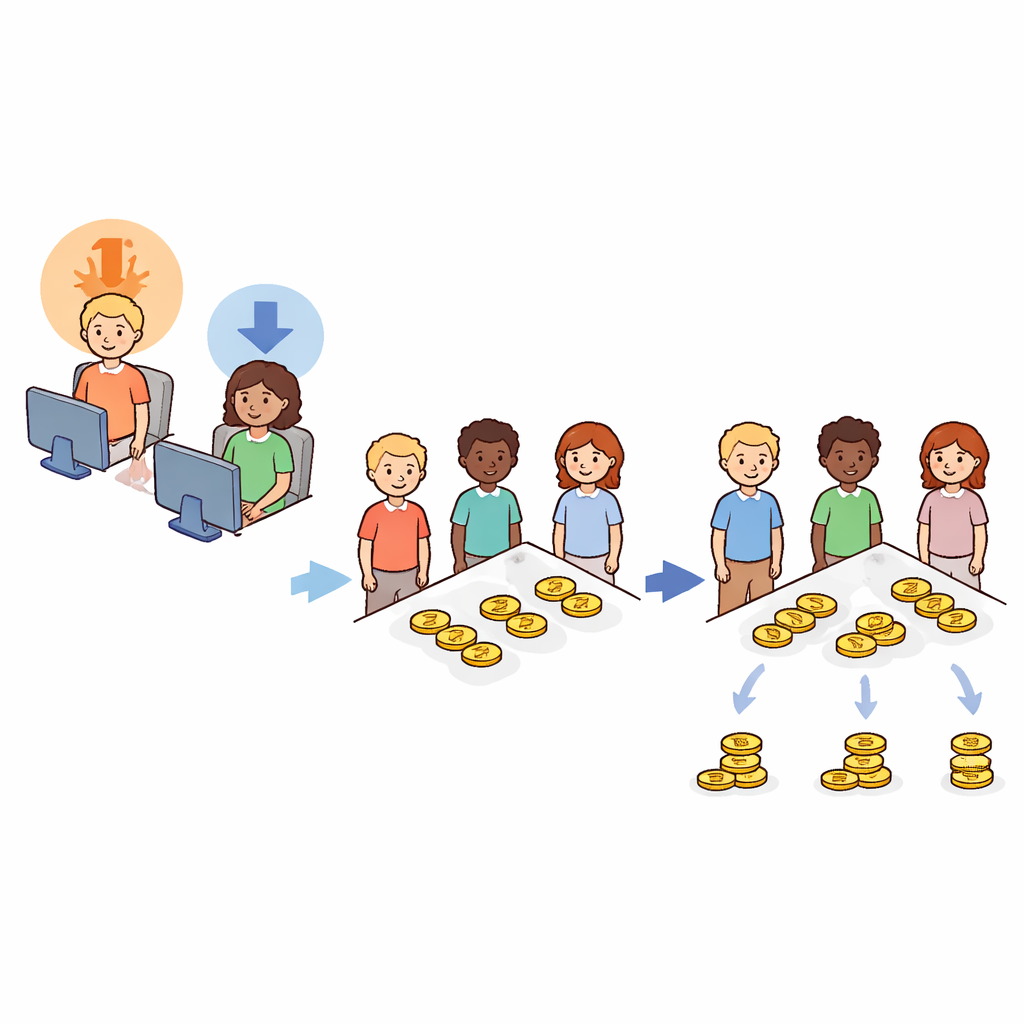
The researchers worked with 4- to 8-year-old children who first played an online version of the classic “Where’s Waldo?” search puzzle. In one setup, children believed they were competing live against another child; in fact, they were playing against a pre-recorded video designed so that they would either always win or always lose. This created a clear sense of being a “winner” or a “loser.” Afterwards, the children saw two new, unfamiliar peers on screen, each shown with the same number of reward tokens. One new peer was described as someone who had previously won the game, and the other as someone who had lost. The child chose which of these two peers to interact with—and then decided how many of that peer’s ten tokens to take for themselves, from none to all ten.
Preferring winners and reading status
Most children, regardless of whether they had just won or lost, preferred to play with a peer described as a winner. When asked why, many who chose the winner mentioned status directly, saying things like that the peer “had won.” This shows that even young children are not only aware of who holds higher status, but also actively seek out those peers. The crucial question, however, was what they would do once they were in a position to take resources from that chosen partner. By combining whether a child had just won or lost with whom they chose—a prior winner or prior loser—the researchers could place each child in a relationship of higher, lower, or equal status relative to their partner.
Who takes more from whom?
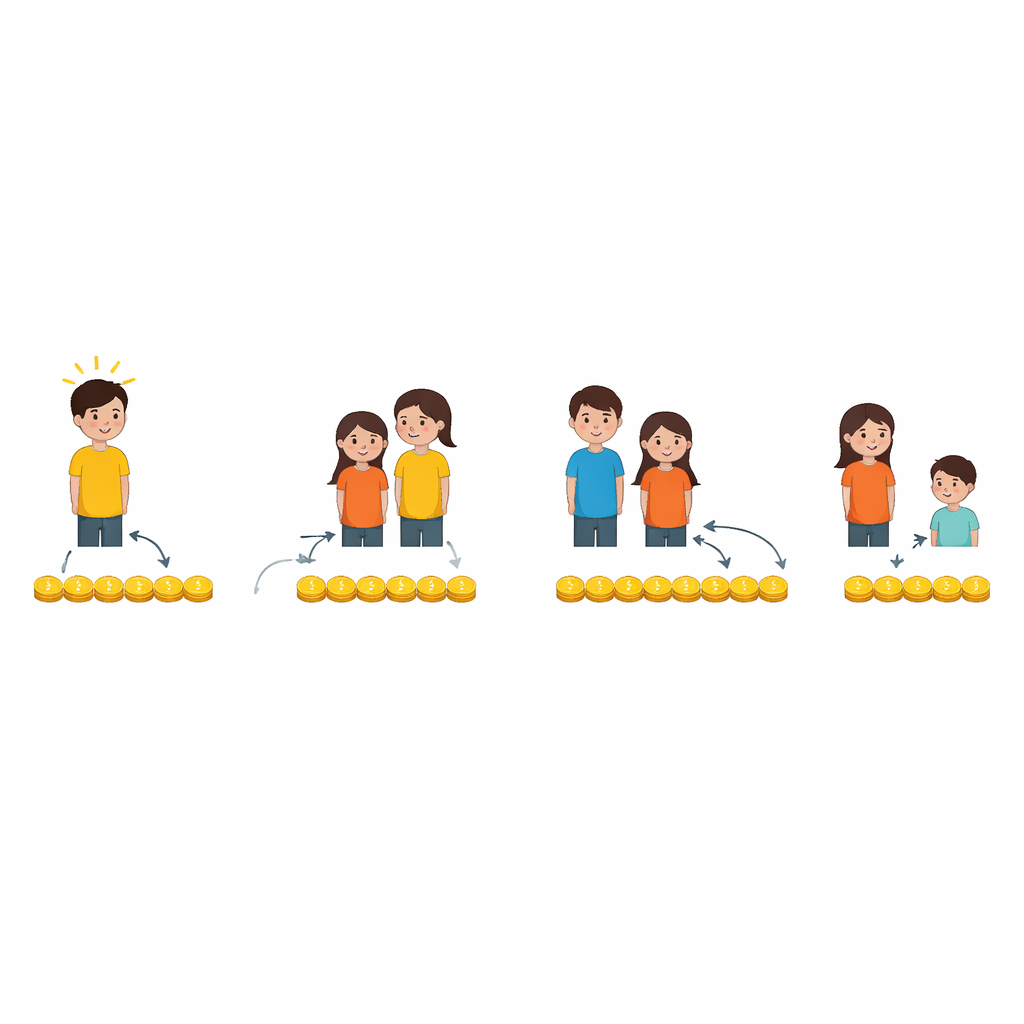
The results revealed a striking pattern. When children found themselves in a low-status position—having lost earlier and then choosing to take from a prior winner—they tended to take a lot: on average about 70% of the tokens, well above an even split. In contrast, high-status children—those who had won and then chose to take from a prior loser—were surprisingly restrained, taking about half the tokens and not differing from equal division. When children and their chosen peers had equal status (both had previously won or both had lost), gender differences appeared. Boys in these equal-status pairings took clearly more than half of the tokens, while girls’ choices clustered around an even split. Boys also more often explained their decisions in terms of wanting more for themselves, whereas girls did not show a single dominant type of explanation.
What happens when status is not social?
A second study repeated the basic design but removed the sense of competing against another child. This time, children played against the clock: some were given enough time to reliably find Waldo; others were given too little time and thus “failed.” Afterwards, they again saw two new peers with equal tokens, but these peers were now introduced only by name, with no mention of winning or losing. In this setting, children on average took more than half of the tokens from their chosen peer, regardless of whether they had just succeeded or failed, and regardless of gender. Without a clear social hierarchy between themselves and the peer, success or failure alone did not shape how much they took.
How early social rank and gender shape taking
Together, the two studies suggest that children’s willingness to take from others is guided less by how well they have performed and more by how that performance is woven into a social relationship. When a clear rank difference exists, lower-status children take more, and higher-status children behave more evenly. When rank is equal and clearly social, boys in particular seem more inclined to grab a larger share, whereas girls lean toward splitting resources fairly. These early-emerging patterns hint that sensitivity to hierarchy—and gendered ways of handling it—develop well before adolescence. Everyday decisions about who gets how many prizes are already moments where children navigate status, fairness, and their own place among peers.
Citation: Berelejis, C., Ritov, O., Engelmann, J. et al. Children’s resource taking varies with experimentally manipulated relative status. Sci Rep 16, 11311 (2026). https://doi.org/10.1038/s41598-026-40976-8
Keywords: child social status, resource allocation, gender differences, fairness in children, peer competition