Clear Sky Science · en
Reduced activation in empathy core regions during observation of social interactions in patients with borderline personality disorder: an fMRI-study
Why this study matters
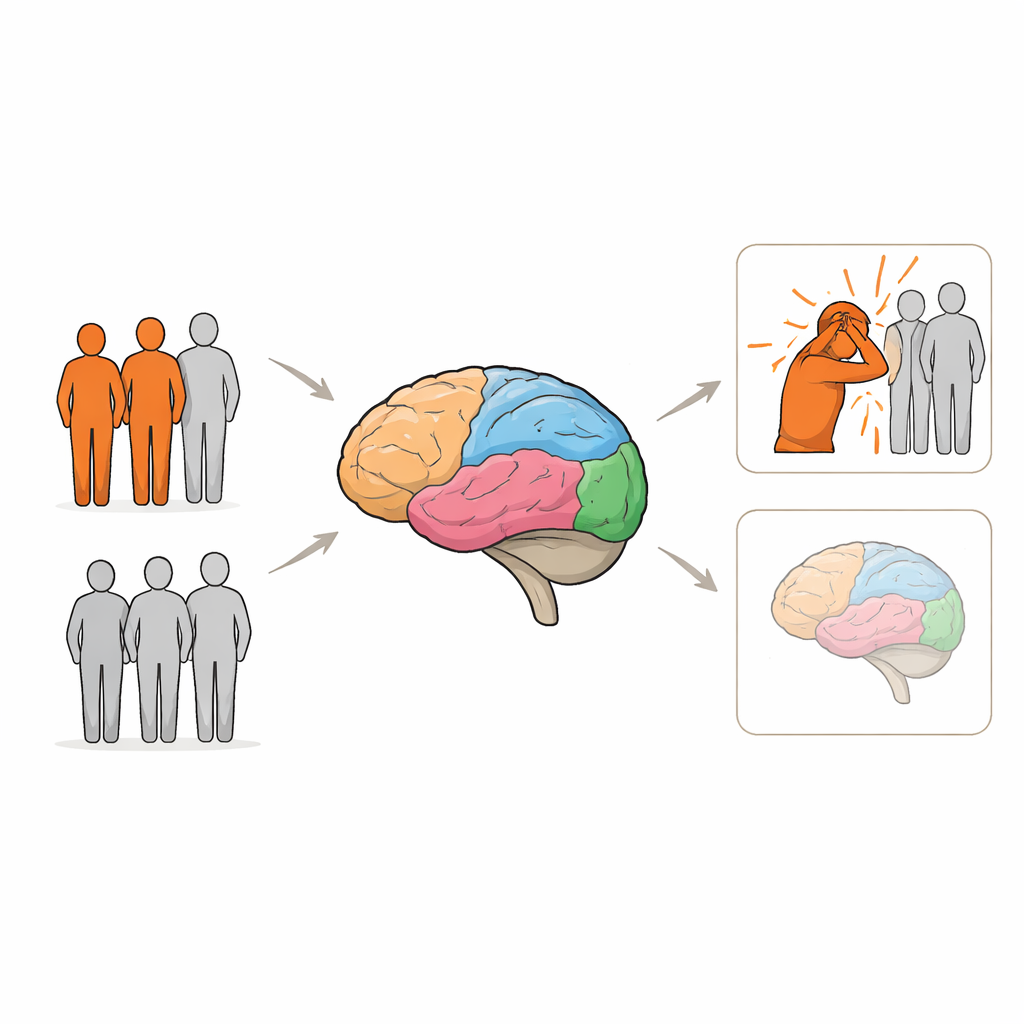
Most of us can tell when someone else is hurting, whether it is a scraped knee or a broken heart. People with borderline personality disorder (BPD), however, often report overwhelming emotional pain and difficult relationships, and past research suggests their empathy works differently. This study uses brain scanning to explore how women with BPD respond to images of social situations involving both physical and emotional pain, shedding light on how their brains process other people’s suffering and everyday interactions.
Looking at pain in everyday scenes
The researchers recruited 50 female inpatients with BPD and 55 healthy women of similar age. While lying in an MRI scanner, participants completed the Social Interaction Empathy Task, which shows short scenes of two people interacting. Some pictures depicted clearly physical pain (such as someone getting hurt), others showed emotionally painful situations (such as rejection), and some were neutral interactions. In each trial, participants rated how painful the situation seemed, either imagining the pain for themselves (first-person view) or for the woman in the picture (third-person view).
Different feelings about social pain
Compared with healthy women, those with BPD rated neutral scenes and emotionally painful interactions as more painful overall. When they took the first-person view, patients rated psychological pain especially strongly, whereas healthy participants tended to rate that pain as stronger when judging it from the outside, in the third-person view. In contrast, the groups did not differ much in how painful they found physically painful scenes. Outside the scanner, patients also had higher pain thresholds in a pressure test on the hand, meaning it took more physical pressure before they reported pain, and they rated that pressure as slightly less painful on one hand. Together, this pattern suggests a heightened sensitivity to social and emotional hurt, coupled with a somewhat dulled experience of bodily pain.
What their brains were doing
Brain scans revealed that, across all types of scenes, women with BPD showed lower activity than healthy controls in several regions often linked to empathy, emotion, and understanding others: the right insula and anterior cingulate cortex, parts of the frontal lobes, the middle temporal gyrus, sensorimotor areas, and the putamen. These areas usually help us tune into another person’s feelings and to mentally step into their situation. Rather than showing extra activation to match their strong pain ratings for social situations, patients’ brains were actually less active in these empathy-related networks, especially for neutral and emotionally painful scenes.
Zooming in on perspective and personality traits
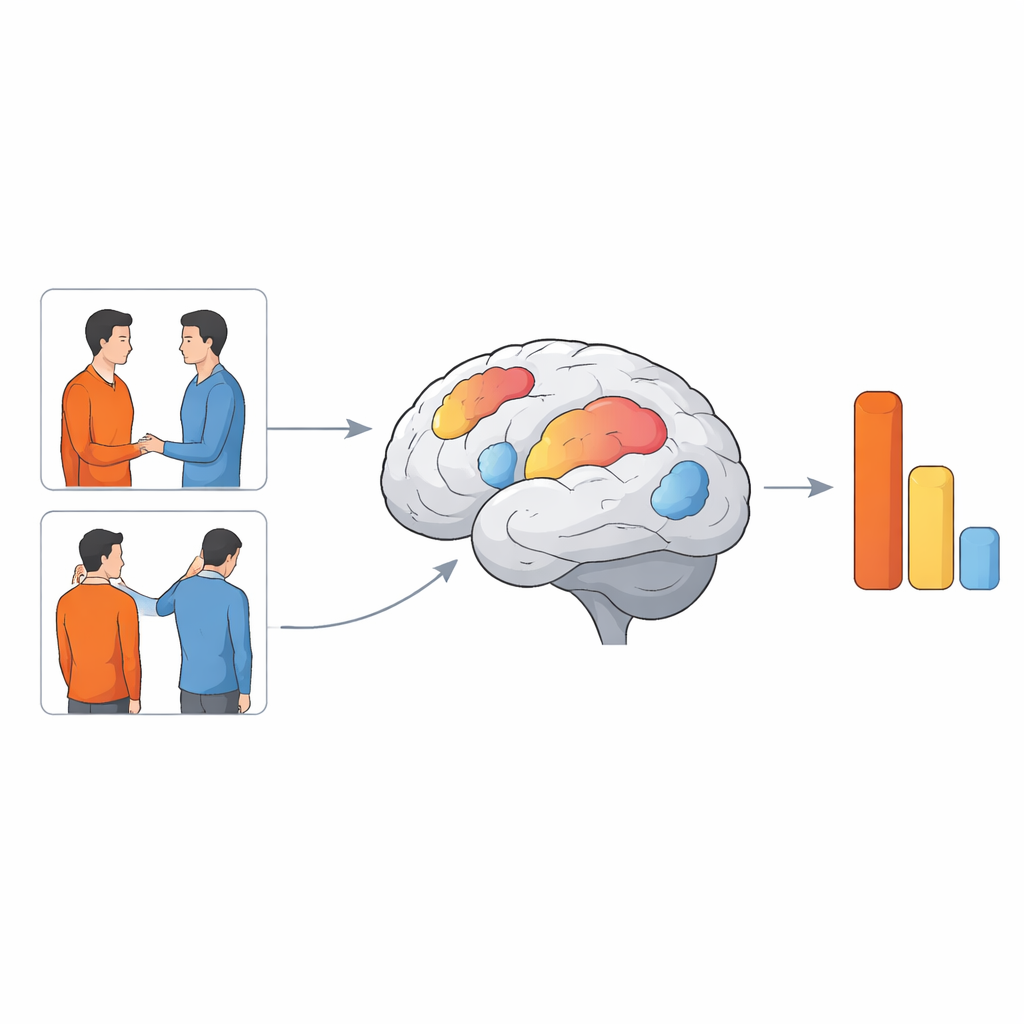
The task also separated first-person from third-person views. Across all participants, imagining oneself in the scene (first-person) activated a region in the left middle temporal gyrus more strongly than imagining the other person. Activity in this area during neutral scenes was lower in people who had more difficulty identifying their own feelings (a trait called alexithymia) and in those with more self-harm behavior. Among healthy women, higher activation of the same region during psychological pain scenes was linked to better perspective taking on a standard empathy questionnaire. Patients with BPD, in contrast, showed reduced scores on this cognitive perspective-taking measure but higher personal distress, fitting a profile of feeling easily overwhelmed by others’ emotions while struggling to adopt an outside view.
Two kinds of pain, two brain patterns
By directly comparing physical and psychological pain in the same task, the study showed that the brain treats them differently. Emotionally painful scenes produced the strongest responses in visual and midline regions (such as the precuneus and cuneus), which are involved in imagining situations and reflecting on oneself. Physically painful scenes, in contrast, more strongly activated the middle temporal gyrus and inferior parietal areas often tied to processing others’ bodily states. Neutral interactions sat somewhere in between but were rated as surprisingly painful by patients with BPD, hinting that they may interpret even ordinary social situations as potentially threatening or hurtful.
What this means for understanding BPD
To a layperson, the key message is that people with BPD are not “unempathetic”; rather, their brains seem to engage the empathy network less efficiently while they experience social situations as more painful and threatening, especially when imagining themselves in them. This mismatch—strong emotional reactions but reduced activity in regions that support perspective taking and emotion regulation—may help explain why relationships feel so intense and unstable for many people with BPD. The findings also suggest that therapies which strengthen the ability to take another person’s perspective and to clearly label one’s own feelings could help rebalance how social pain is processed in the brain.
Citation: Flasbeck, V., Enzi, B., Juckel, G. et al. Reduced activation in empathy core regions during observation of social interactions in patients with borderline personality disorder: an fMRI-study. Transl Psychiatry 16, 232 (2026). https://doi.org/10.1038/s41398-026-03989-5
Keywords: borderline personality disorder, empathy, social pain, fMRI, psychological pain