Clear Sky Science · en
Enhancing students’ art attitudes and analytical thinking skills through a design thinking-based metaverse approach
Why a Virtual Art Room Matters
Many children learn about famous paintings from flat pictures in textbooks or on classroom screens. While this can show what an artwork looks like, it rarely lets students feel as if they are stepping inside the scene or talking about it in depth with their classmates. This study explored a new way to teach art appreciation that combines virtual worlds with a step‑by‑step problem‑solving method. The goal was to see whether this approach could help primary school students enjoy art more and think more deeply about what they see.
A New Kind of Art Lesson
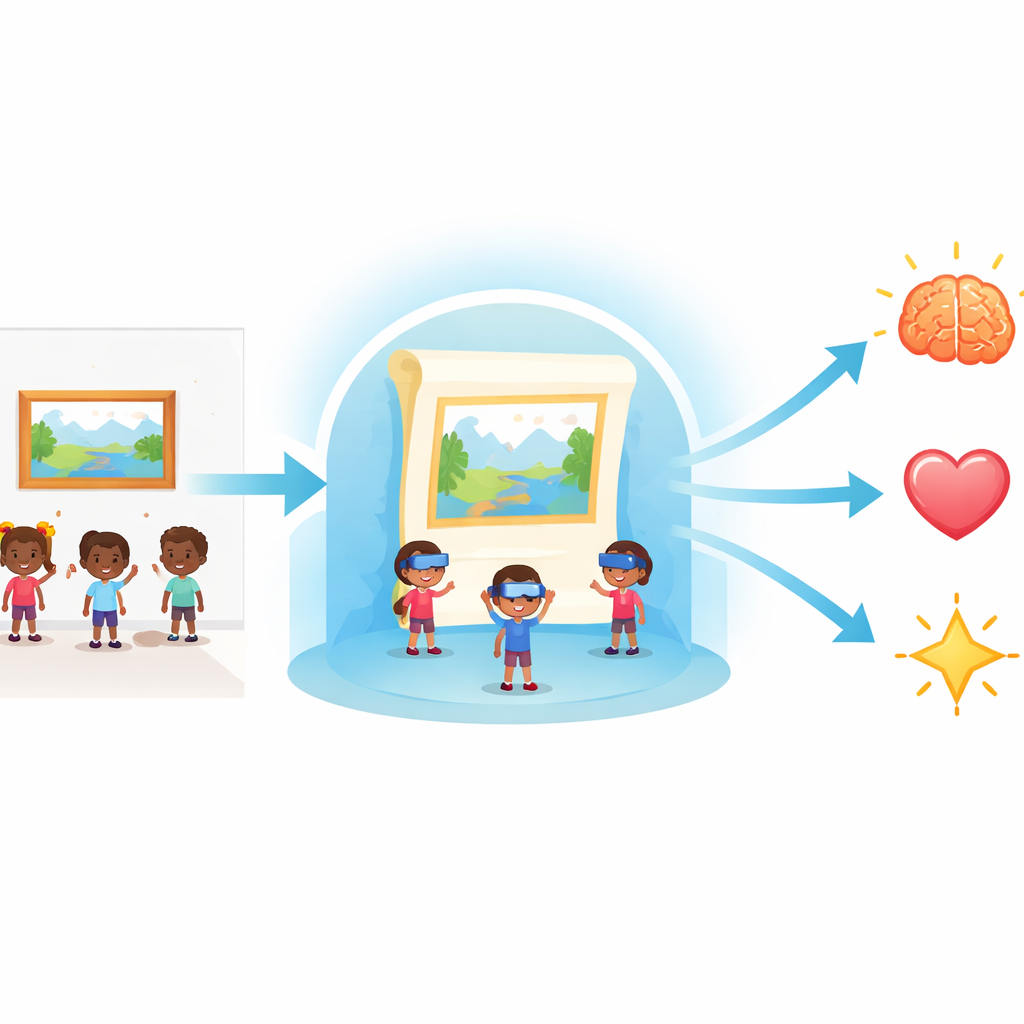
The researchers created a teaching approach called Meta‑DTAA, which brings students into a metaverse space for art appreciation. In this virtual world, children use head‑mounted displays and digital avatars to move around a famous Chinese scroll painting, "Along the River During the Qingming Festival." Instead of passively looking at a reproduction, they can fly, teleport, and zoom into different parts of the scene. At the same time, the lessons are organized around a design‑thinking framework that guides students through stages such as getting to know the artist’s world, defining what they want to explore, generating ideas, creating written comments, and finally sharing and refining those comments together.
Learning by Exploring Together
In the Meta‑DTAA lessons, the heart of the experience is the "ideate" stage, when teacher and students enter the virtual environment together. There, children follow a simple questioning pattern—who, what, when, where, why, how, and how much—to examine the artwork from overall layout down to tiny details. They can circle areas of the painting with virtual brushes, move around to see the scene from many angles, and react to what they notice in real time. The teacher can watch students’ movements, join their explorations, and respond instantly to questions. Later, everyone returns to the real classroom to turn their experiences into commentary texts, then re‑enter the metaverse to display these texts alongside the virtual painting, browse each other’s work, and discuss how to improve it.

Putting the Approach to the Test
To see whether this new approach really helped, the team ran a three‑week experiment with 66 fifth‑grade students in southeastern China. One group used Meta‑DTAA with the metaverse environment, while a control group learned with the same design‑thinking steps and question prompts but in a traditional classroom using two‑dimensional reproductions. Both groups studied a different artwork beforehand so that the researchers could measure their starting levels in art attitude, analytical thinking, and knowledge. After the main lessons on the Qingming Festival scroll, the students completed attitude questionnaires, knowledge tests, and written commentaries, and a subset took part in group interviews about their experience.
What Changed for the Students
The results showed clear advantages for the students who learned in the metaverse. After accounting for their starting scores, these students reported more positive attitudes toward art than those in the traditional class. Their written commentaries showed stronger analytical thinking, especially in how well they organized what they saw, explained the artist’s intentions and values, and connected the painting to wider social and cultural ideas. Both groups improved in basic recognition of artistic features, but only the metaverse group showed big gains in higher‑level skills. They also scored better on knowledge tests about the painting. In interviews, these students said the immersive environment made learning more engaging, allowed them to explore freely and repeatedly, and helped them notice details and techniques they had missed before. Some also mentioned practical drawbacks, such as visual blocking by other avatars and noise during discussions.
What This Means for Future Classrooms
For a layperson, the core message is that placing children inside a carefully designed virtual art space—rather than simply showing them pictures—can make a real difference in how they feel about art and how deeply they think about it. The study suggests that when virtual experiences are paired with a clear structure for asking questions, exploring, creating, and reflecting, students not only enjoy art more but also learn to analyse and interpret it in richer ways. While the approach still needs refinement and larger, longer‑term trials, it offers a practical blueprint for bringing metaverse technologies into everyday art lessons and for helping young learners move from simply looking at artworks to truly understanding and discussing them.
Citation: Guan, J., Xu, J., Hui, Z. et al. Enhancing students’ art attitudes and analytical thinking skills through a design thinking-based metaverse approach. Humanit Soc Sci Commun 13, 587 (2026). https://doi.org/10.1057/s41599-026-06949-y
Keywords: art appreciation, metaverse learning, virtual reality in education, design thinking, analytical thinking skills