Clear Sky Science · en
Analysing the complex association between school principals’ hubristic leadership and teachers’ work motivation: the serial mediation of administrative communication and job stress
Why the Way Principals Lead Matters
Most of us remember a school principal who seemed larger than life—for better or for worse. This study looks at what happens when principals become too sure of themselves and stop listening to others. Focusing on public schools in Türkiye, the researchers explore how overconfident, self-centered leadership from principals can drain teachers’ energy, raise their stress levels, and ultimately weaken the motivation that keeps classrooms running well.

When Confidence Turns Into a Problem
The authors examine a leadership style called hubristic leadership. This is more than ordinary confidence: it appears when principals exaggerate their own importance, ignore feedback, and prioritize personal success over the school’s needs. Like the myth of Icarus flying too close to the sun, such leaders may seem bold and visionary but can create serious problems. In schools, this behavior can make teachers feel dismissed, undervalued, and unsure about their roles. The study asks four key questions: whether this kind of leadership lowers teachers’ motivation, and whether school communication and job stress help explain how that damage occurs.
How the Study Was Carried Out
The researchers surveyed 525 teachers working in public schools across Türkiye. Teachers completed online questionnaires that measured four things: how hubristic they perceived their principals to be, how effective administrative communication at their school felt, how stressed they were at work, and how motivated they felt in their profession. The team used a well-known framework from work psychology that separates “job demands” (things that drain energy, like pressure and ambiguity) from “job resources” (things that support people, like clear guidance and support). In this view, hubristic leadership acts as a demanding, harmful condition, while good communication is a resource that can protect teachers.
Broken Lines of Communication
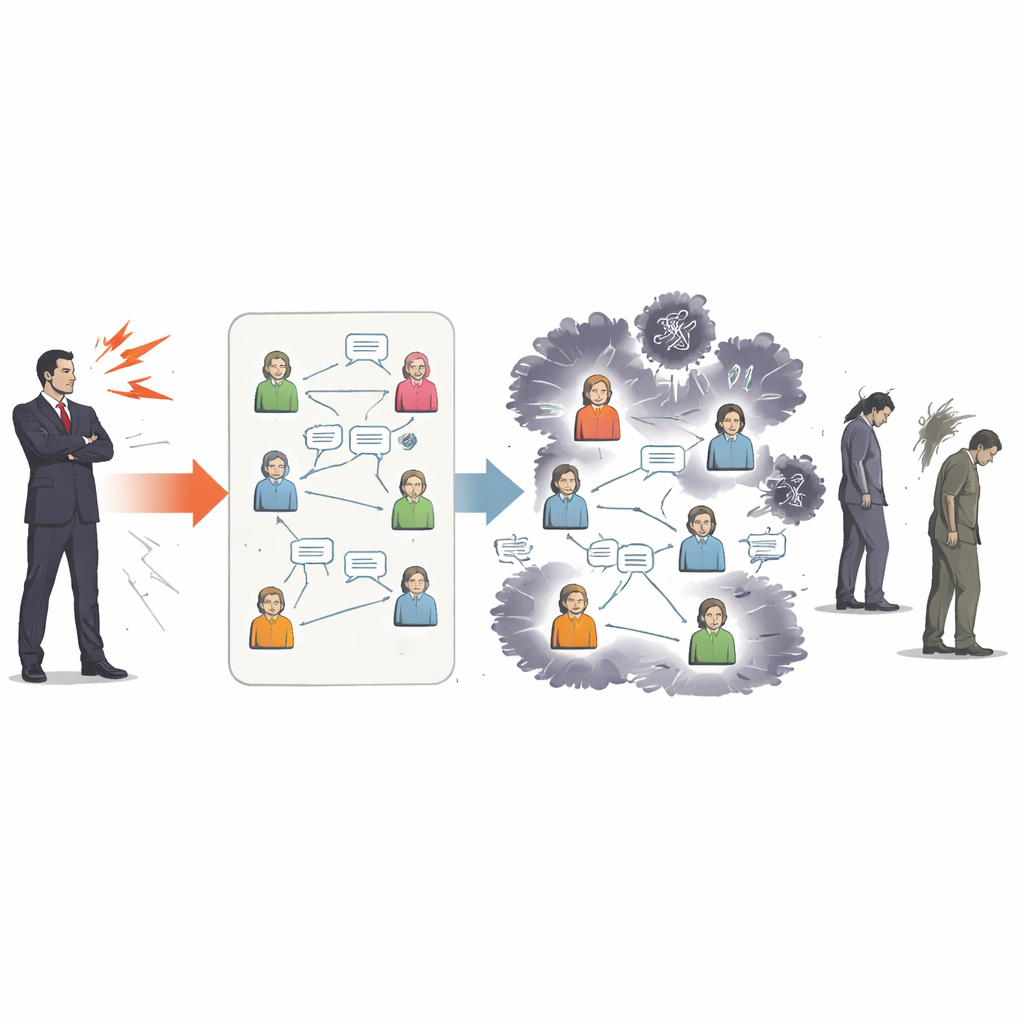
Results showed clear patterns. Teachers who saw their principals as more hubristic also reported worse communication in their schools, higher stress, and lower motivation. Effective administrative communication—regular, clear, two-way exchanges between principals and teachers—emerged as a key protective factor. When communication was strong, it softened the blow of a principal’s overconfidence, helping teachers feel more informed, supported, and connected. When communication was poor or disrespectful, uncertainty grew, tensions rose, and the negative impact of hubristic leadership on motivation became stronger.
Stress as the Hidden Middle Link
The study also found that job stress is a crucial middle link in this chain. Hubristic principals were tied to higher teacher stress, and higher stress, in turn, was linked to lower motivation. The researchers showed that hubristic leadership does not just hurt motivation directly; it does so partly by first undermining communication, which then increases stress, which finally erodes teachers’ drive to do their best. When both communication and stress were included in their statistical model, they together explained a substantial portion of how and why hubristic leadership harms teacher motivation.
What Schools Can Do About It
The findings carry practical lessons for schools and education systems. In centralized systems like Türkiye’s, principals sit at a crucial bottleneck between national policies and everyday classroom life. The study suggests that training principals in humility, empathy, and active listening, along with setting up formal channels for teacher voice and feedback, can help limit the damage of hubristic tendencies. Regular, transparent communication and deliberate efforts to monitor and reduce teacher stress—such as clarifying roles and balancing workloads—can rebuild trust and protect motivation, even when leadership is imperfect.
What This Means for Teachers and Students
In simple terms, when principals let power go to their heads, teachers feel more stressed and less motivated, and this threatens the quality of education students receive. But the picture is not hopeless. Clear, respectful communication and attention to teachers’ well-being can act like shock absorbers, reducing the impact of harmful leadership styles. By focusing on these everyday practices, schools can create healthier environments where teachers feel valued and energized, and students benefit from more stable, engaged classrooms.
Citation: Üztemur, S., Kirişçi-Sarıkaya, A. & İlğan, A. Analysing the complex association between school principals’ hubristic leadership and teachers’ work motivation: the serial mediation of administrative communication and job stress. Humanit Soc Sci Commun 13, 380 (2026). https://doi.org/10.1057/s41599-026-06687-1
Keywords: school leadership, teacher motivation, job stress, administrative communication, hubristic leadership