Clear Sky Science · en
Development and validation of a burnout scale for undergraduate students in English as a medium of instruction programs
Why learning in English can feel so draining
For many university students around the world, classes in science, engineering, medicine, and business are now taught in English, even when it is not their first language. This promise of global opportunity can come with a hidden cost: constant strain, frustration, and a feeling of falling behind. The article explains how this pressure can build into burnout, and introduces a new tool designed to detect when students in English‑medium programs are reaching a breaking point so that universities can step in earlier.
School pressure plus language pressure
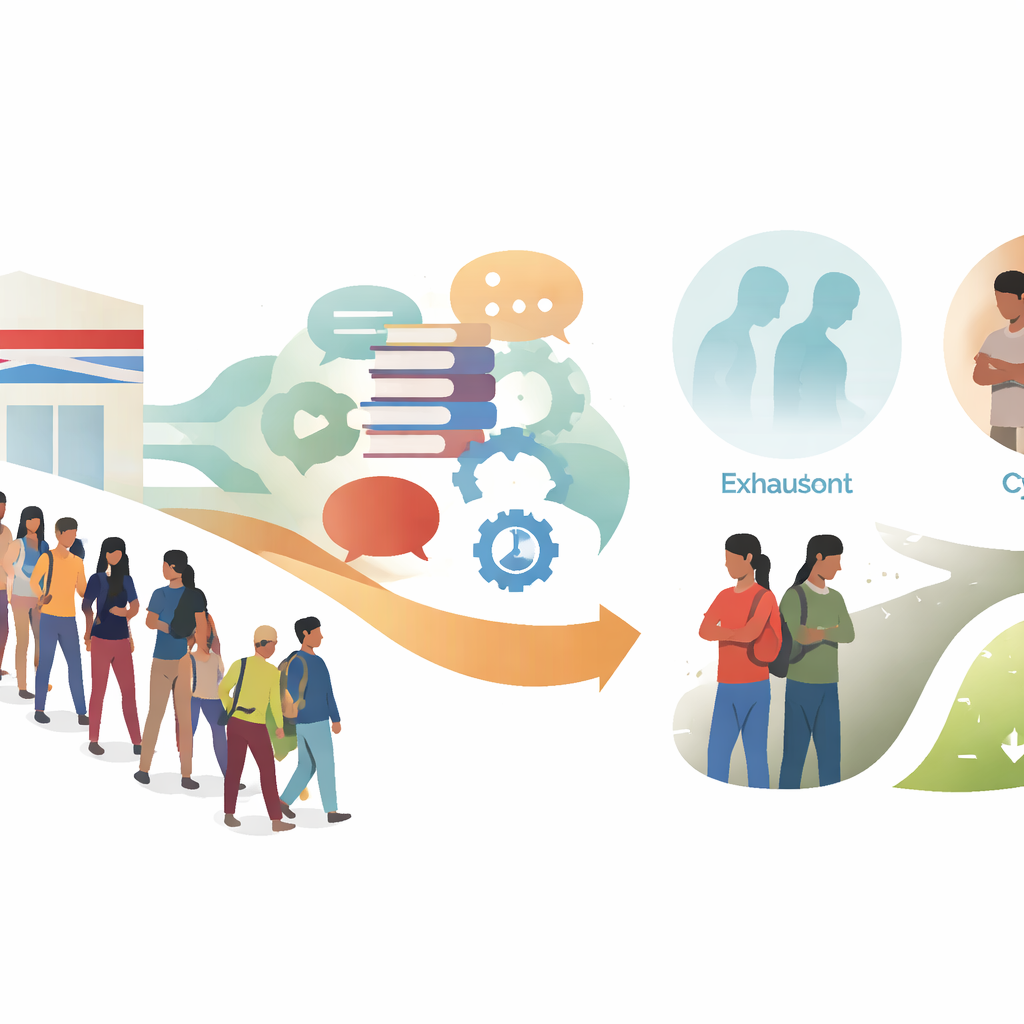
Burnout is usually discussed in the context of demanding jobs, but students can experience something very similar. Long hours of study, competitive grading, and high expectations can lead to emotional exhaustion, growing negativity, and a sense of failure. When all of this happens in a language that is not the students’ own, the load becomes even heavier. Understanding rapid lectures, specialized vocabulary, and dense textbooks in English demands extra mental effort. In many universities, students also receive limited language support, leaving them to translate and interpret complex material on their own. These combined academic and language demands create ideal conditions for burnout.
Four warning signs of burning out
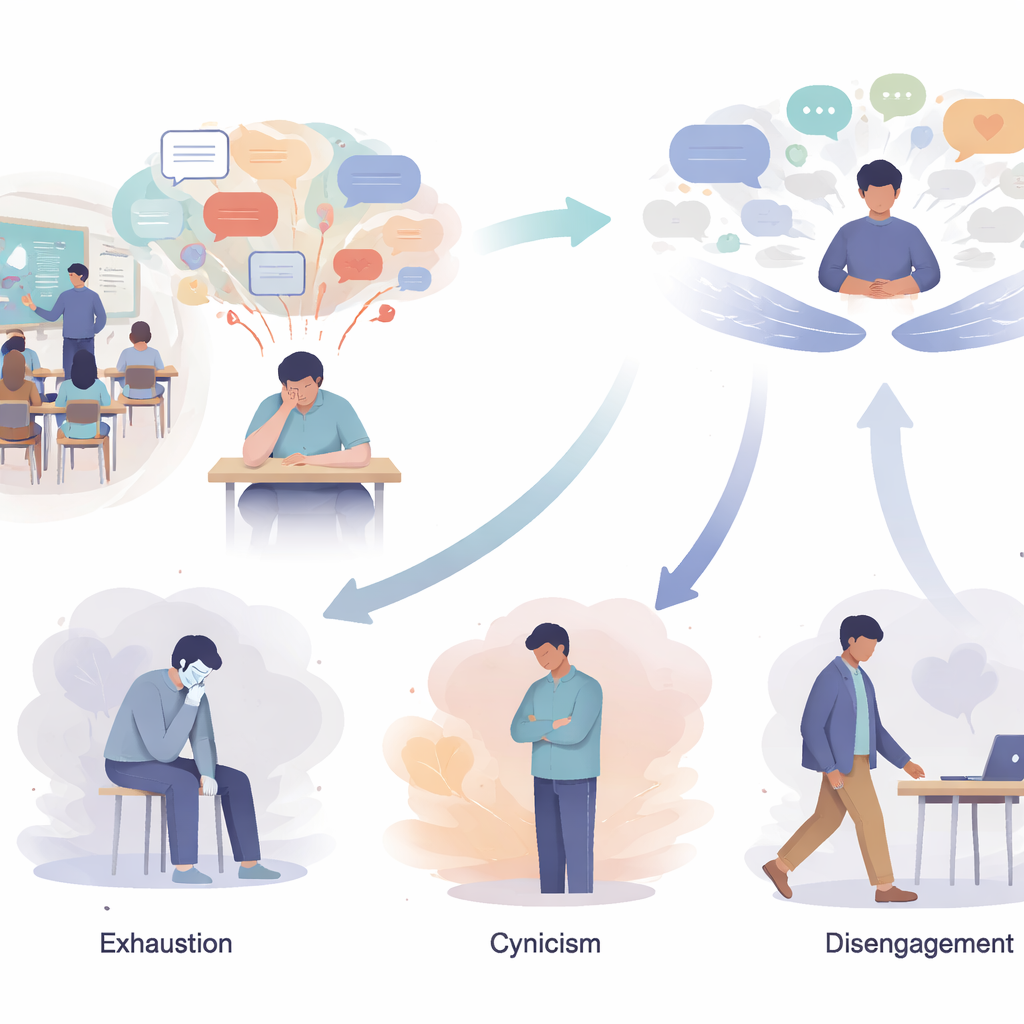
The authors focus on four aspects of burnout that show up in students in English‑medium classrooms. The first is exhaustion: feeling drained, worn out, and overwhelmed by the constant effort of learning through English. The second is cynicism, where students become emotionally distant and develop a negative attitude toward their studies or the use of English itself. The third is disengagement, seen when students withdraw, participate less, or mentally “check out” from their courses. The fourth, academic efficacy, is different: it reflects students’ belief that they can handle their tasks and succeed. While the first three feed burnout, strong academic efficacy appears to buffer against it, helping students cope with challenges more effectively.
Designing a burnout thermometer for EMI students
To create a practical “thermometer” for this kind of stress, the researchers adapted questions from two widely used burnout surveys and rewrote them for English‑medium settings. Every item was anchored to the use of English as the language of instruction, making it clear that the focus is on stress linked to studying in English rather than to university life in general. The team refined the wording so it would be easy for non‑native English speakers to understand and also translated the scale into Arabic. They then collected responses from 497 undergraduates in Saudi Arabia, spanning healthcare, engineering, computer science, business, and science programs where English is the teaching language.
What the numbers reveal about student strain
Using advanced statistical methods, the authors tested whether their 17‑question scale truly measured the four intended aspects of burnout and how these aspects relate to one another. Exhaustion, cynicism, and disengagement turned out to be tightly linked: students who scored high in one tended to score high in the others. Academic efficacy moved in the opposite direction—students who felt more capable and effective showed lower burnout scores. Among the four, exhaustion stood out as the strongest signal of overall burnout and the best predictor of problems, underscoring how central emotional and mental fatigue are when studying complex subjects in a second language.
How this tool can help students and universities
The new burnout scale gives universities a focused way to spot EMI students who are struggling before their grades or health collapse. Because it separates exhaustion, cynicism, disengagement, and academic efficacy, it can guide tailored responses—such as extra language support for students who are worn out by comprehension problems, teaching strategies that encourage active participation for those who are pulling away, and workshops that build study skills and confidence. For a layperson, the article’s message is clear: learning tough material in a foreign language is not just an academic challenge, it is an emotional one. By measuring the early signs of burnout in English‑medium programs, educators can design more humane environments that protect students’ well‑being while still opening doors to global knowledge.
Citation: Alhamami, M., Alrabai, A. Development and validation of a burnout scale for undergraduate students in English as a medium of instruction programs. Humanit Soc Sci Commun 13, 361 (2026). https://doi.org/10.1057/s41599-026-06525-4
Keywords: student burnout, English medium instruction, university mental health, language learning stress, academic efficacy