Clear Sky Science · en
Rapid earnings growth in finance concentrates top earnings in a few large cities
Why big paychecks cluster in a few cities
Across many wealthy countries, a growing share of the very highest paychecks now flows to workers in just a handful of cities. This article explores how finance jobs in places like New York, London, Frankfurt or Stockholm help funnel top earnings into these urban hubs, reshaping maps of opportunity, politics and everyday life far beyond the trading floors themselves.
From shared growth to uneven fortunes
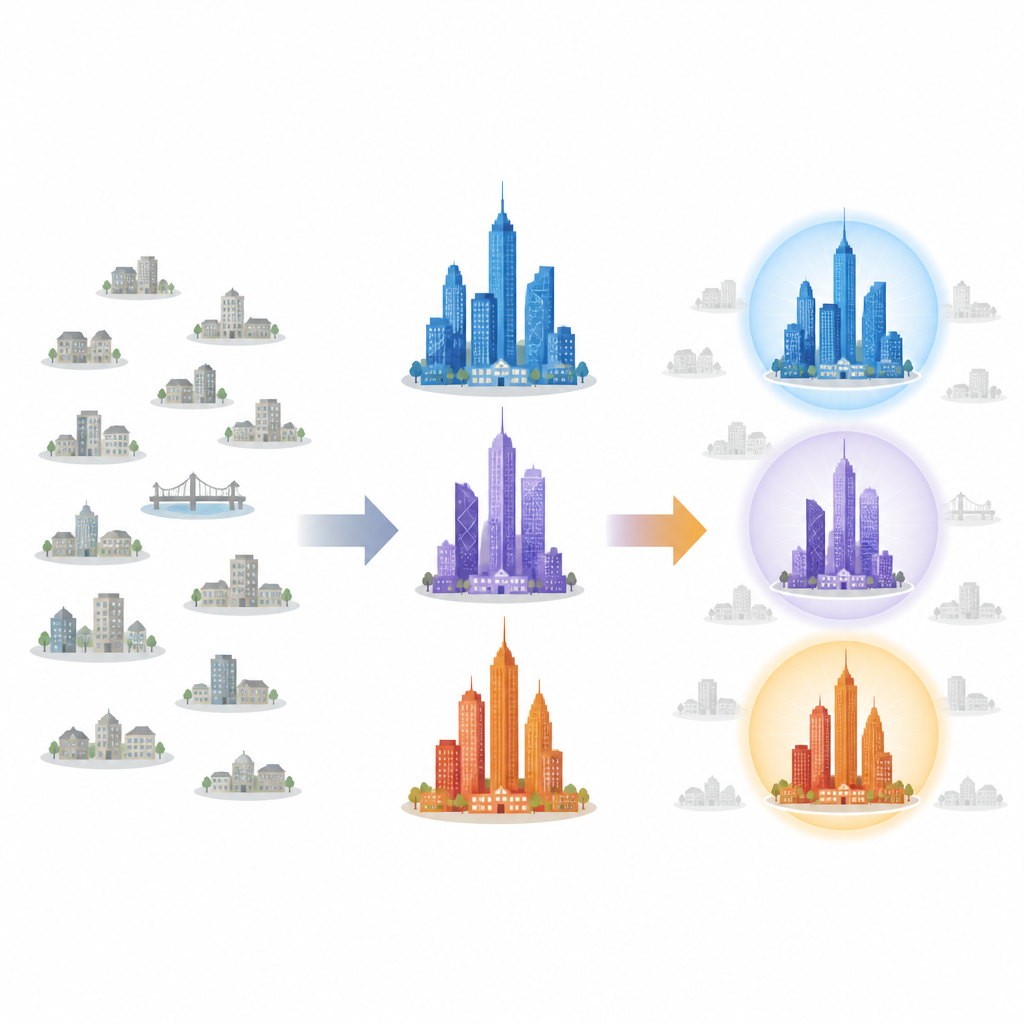
After the Second World War, pay tended to rise together across regions, and income gaps between cities narrowed. Around 1980, that pattern flipped. In countries across North America, Western Europe and Japan, pay at the top began rising much faster than in the middle or at the bottom, especially in large cities. As a result, a small number of metropolitan areas started to pull away from the rest of their countries in both average pay and inequality. Scholars have debated whether this is mainly about national trends, like overall growth in top incomes, or local forces such as high housing costs and the pull of so called superstar cities.
Following the money in finance
The authors argue that the key lies in what has happened inside the financial sector. Using more than one billion linked employer–employee records from ten rich countries between 1989 and 2019, they compare each nation’s main financial center with a similar large city that has little or no stock market activity. This design lets them ask how much of the rise in very high earnings can be traced specifically to jobs in finance in cities that host national stock exchanges, rather than to simple size, general urban growth or differences in education or amenities.
Financial cities punch far above their weight
The analysis shows that workers in financial centers account for a striking share of national growth in top earnings. On average, employees in these cities explain about two thirds of the increase in the income share going to the national top 1 percent, even though they make up a much smaller slice of each country’s workforce. When contributions are adjusted as if each city held the same share of national employment, financial centers still contribute about six times as much to growth in top earnings as their comparison cities. Within financial centers themselves, high earners have also pulled away from their neighbors, with the top 5 percent capturing a rising share of local pay.

Finance jobs drive the local surge at the top
Digging deeper, the authors show that the main engine of this concentration is the financial sector inside those financial cities. Across the ten countries, finance jobs in financial centers account for roughly one quarter of the rise in national top 1 percent earnings, and about half of the growth in the share of pay going to the local top 5 percent. Employment in finance did not boom everywhere; in many cases it was flat or even shrinking. Instead, pay within finance soared for certain roles tied to stock and derivatives markets. Earlier research links these jumps to firms sharing the extra income from booming financial activity with key employees, rather than to dramatic changes in raw talent.
Different national patterns, shared concerns
The strength of this pattern varies. In centralized economies such as Spain, Sweden and Denmark, a single financial city plays an outsized role in concentrating top earnings. In more federal countries such as Germany, Canada and the United States, the effect of finance is smaller but still present, and high pay practices have spread more to other sectors. In Scandinavian countries, by contrast, finance has remained a smaller but extremely well paid niche. Even after accounting for national growth, trade exposure and city size, the link between financial market activity and the overrepresentation of financial cities in top earnings remains strong.
What this means for people and places
For non-specialists, the message is that where top incomes are earned is not just an accident of where rich people live. The study shows that the way finance has grown since the 1980s has steered a large share of very high pay into a few financial cities, magnifying gaps between regions and between neighbors within those cities. This helps explain why opportunities, political influence and visible wealth often cluster in certain downtowns while other places lag behind, and it suggests that debates about inequality and regional fairness cannot ignore how specific industries, and their pay practices, are rooted in particular places.
Citation: Neumann, N., Godechot, O., Henriksen, L.F. et al. Rapid earnings growth in finance concentrates top earnings in a few large cities. Nat Cities 3, 447–457 (2026). https://doi.org/10.1038/s44284-026-00407-1
Keywords: finance sector, income inequality, global cities, urban labor markets, spatial inequality