Clear Sky Science · en
Individual differences in alexithymia modulate cognition-emotion interactions in daily life ongoing experiences
Why our inner life matters
Everyone knows what it feels like for the mind to wander on a busy day, or to get stuck replaying a worry while trying to focus. But people differ a lot in how clearly they feel and understand their emotions. This study looks at how those differences shape the dance between thoughts and feelings in everyday life, using data collected from people on their smartphones as they go about their day.
Checking in on thoughts in real time
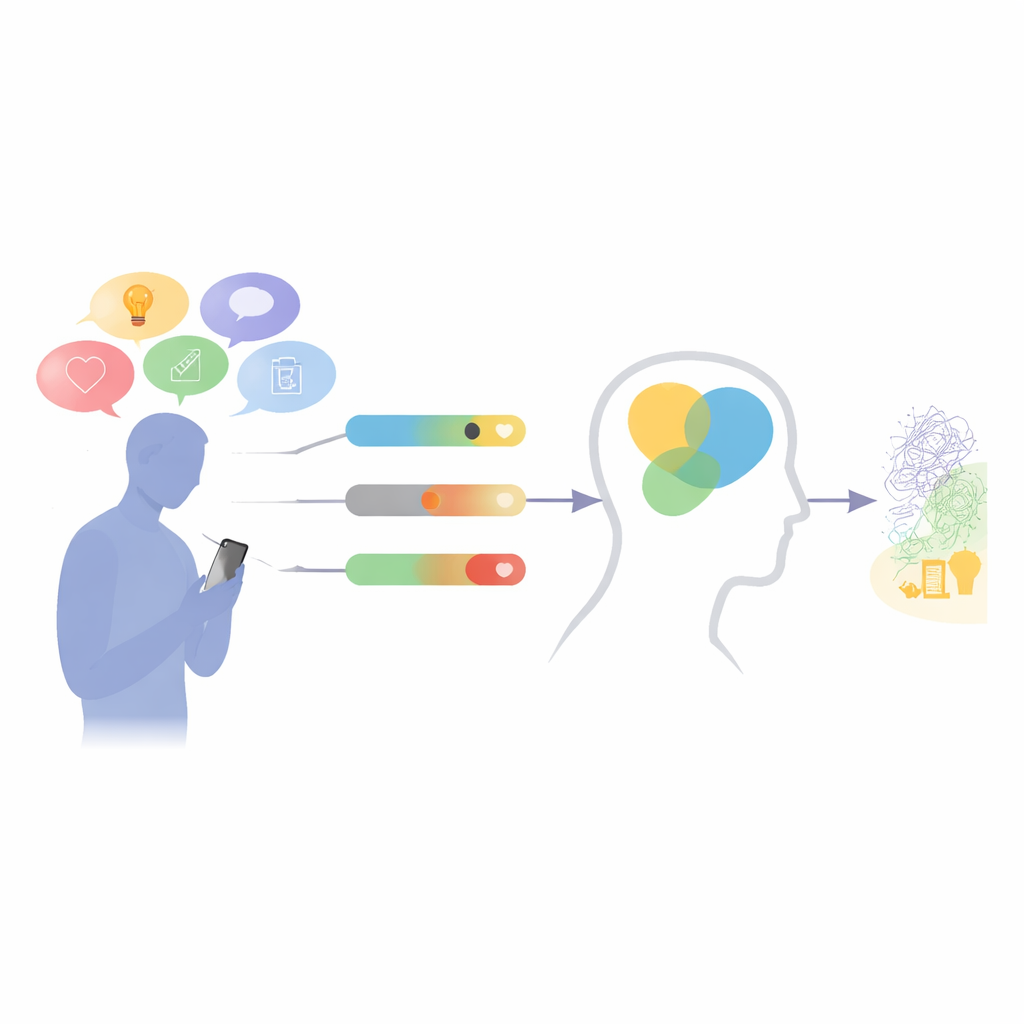
Instead of asking volunteers to recall how they had felt at the end of the day, the researchers pinged 190 university students seven times a day for five days. Each time, participants reported what they had just been thinking about and how they were feeling: how pleasant or unpleasant their mood was, how intense their feelings were, and how stressed they felt. They also noted whether they were alone or around other people. This phone-based approach captures the flow of the inner stream of thought and emotion as it unfolds in real life, rather than in an artificial lab setting.
Four main styles of daily thinking
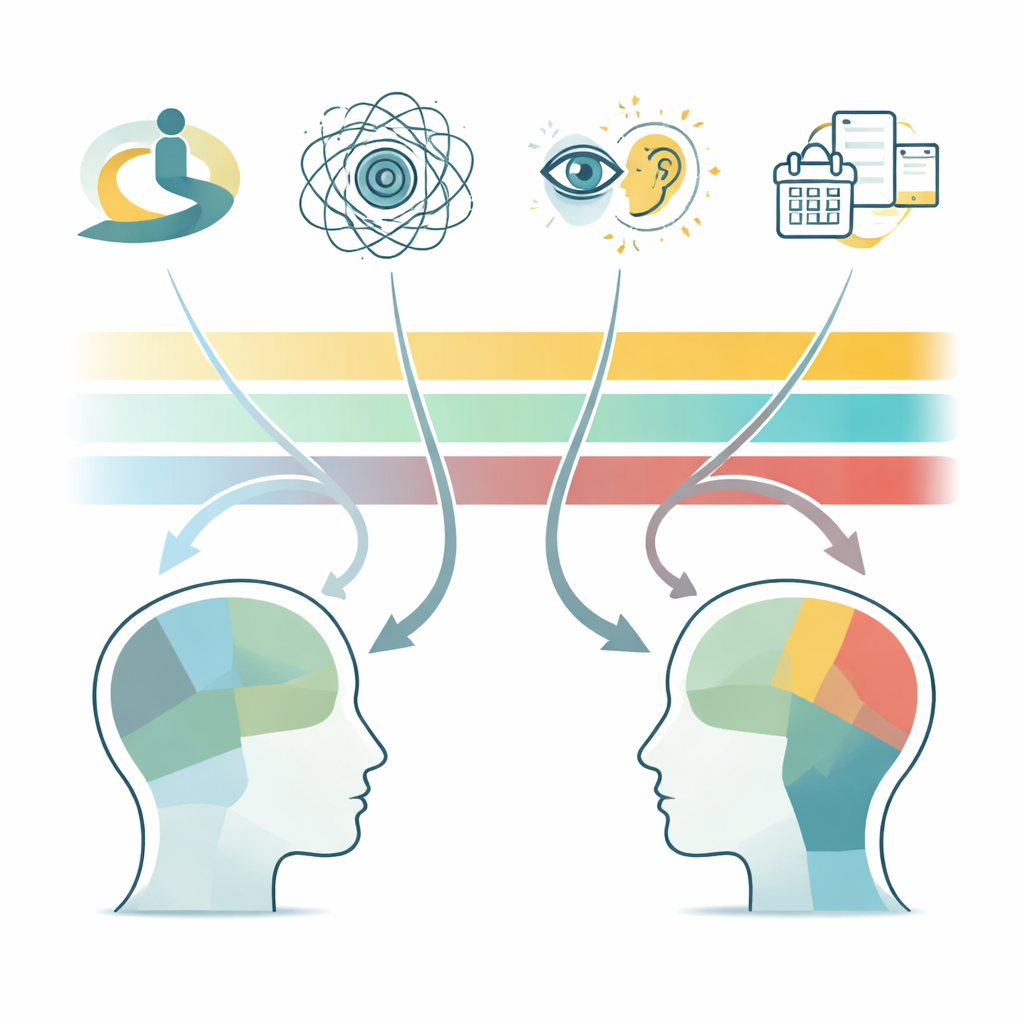
From thousands of these brief reports, the team used a statistical method to uncover four broad styles of ongoing thought. One style, called future-self thinking, involved meaningful, goal-directed thoughts about one’s future and personal plans. A second, intrusive distraction, captured unwanted, interrupting thoughts that pull attention away from what someone is doing. A third, sensory engagement, reflected vivid inner sights, sounds, and words. The fourth, task-focus, described being absorbed in what one was currently doing, especially in response to the outside world. These four patterns together summarized about half of all the variation in people’s self-reported thinking during daily life.
Mood, energy, stress, and where the mind goes
The researchers next asked how these four styles of thought were tied to current feelings. When people were in a happier mood, they tended to think more about their future selves, be more absorbed in their tasks, and experience richer sensory inner worlds. Sadder moments, especially when feelings were strong, were linked to more intrusive, distracting thoughts. Higher emotional intensity boosted all kinds of thinking, while low energy was linked to drifting away from tasks. Stress generally went along with more future-focused and task-focused thinking and more intrusive distraction, but it did not reliably shift sensory engagement. Being around others also mattered: social settings were tied to more sensory-rich and task-focused thoughts, and fewer intrusive distractions, than being alone.
Emotional blind spots and the thinking–feeling link
The key twist in this study involved alexithymia, a personality trait that reflects difficulty noticing and understanding one’s own emotions. Participants completed a standard questionnaire that measures three aspects: trouble identifying feelings, trouble putting feelings into words, and a tendency to focus on outside events more than inner states. People with higher overall alexithymia reported fewer future-self thoughts in general. Those who especially struggled to identify their feelings were least likely to engage in future-oriented, self-focused thinking when they were intensely sad, suggesting that they may miss chances to use negative feelings as a cue for planning and coping. In contrast, people who strongly focused on the external world showed thought patterns that hardly changed with shifts in mood or stress: their level of task-focus and intrusive distraction stayed relatively flat across good and bad feelings, even though they still reacted to how intense those feelings were.
Concrete experiences and social moments
Another pattern emerged around sensory engagement. Everyone tended to have more vivid sensory inner experiences when they felt happier. But for people high in alexithymia, this boost was larger, and their sensory-focused thoughts rose especially in social situations compared with when they were alone. This suggests that individuals who struggle to understand their emotions may lean more on concrete sights and sounds, particularly in shared settings, rather than on reflecting on their inner states. When sad and alone, however, they showed less of this sensory richness, hinting at a blunted or less detailed inner experience during difficult moments.
What this means for everyday well-being
Overall, the study shows that our daily thoughts are not random noise: they fall into recognizable patterns that track how we feel, and these patterns are shaped by how well we can sense and interpret our emotions. People who find it hard to read their feelings think less about their future selves during intense sadness, and those who are strongly outward-focused show less flexibility in how their thinking responds to changes in mood and stress. These subtle shifts in the coupling between thoughts and emotions may help explain why some individuals are more vulnerable to persistent low mood or unhelpful thinking habits. By mapping these links in real time, the work points toward new ways to tailor interventions—such as training in emotional awareness or guided future thinking—to people’s unique inner landscapes.
Citation: Lei, A., Faysal, M., Chitiz, L. et al. Individual differences in alexithymia modulate cognition-emotion interactions in daily life ongoing experiences. Commun Psychol 4, 71 (2026). https://doi.org/10.1038/s44271-026-00434-7
Keywords: alexithymia, mind wandering, emotional awareness, experience sampling, thought patterns