Clear Sky Science · en
Barren depths from 82° N to the North Pole reveal scarcity of fish in the Central Arctic Ocean
Hidden Life at the Top of the World
When we picture the Arctic Ocean, many of us imagine a rich hunting ground for whales, seals and polar bears. But what if the deep waters between 82°N and the North Pole are, in fact, almost empty of fish? This study asks a simple but surprising question: how much life is really swimming in the dark mid‑depths of the Central Arctic Ocean—and what does the answer mean for wildlife and future fishing?
Following a Ship into the Ice
To find out, researchers sailed a modern icebreaking research vessel from the waters north of Svalbard all the way to the North Pole during the summers of 2022 and 2023. They used echo‑sounders—sonars that show where animals are in the water—and trawls that collect whatever the sounders detect. At the same time, they measured temperature and salt in the water, sampled tiny drifting animals called zooplankton, and recorded sightings of whales, seals, seabirds and polar bears. These combined tools let them see how ocean conditions, small prey and big predators fit together as the ship moved from the Atlantic‑influenced shelf into the deep Central Arctic Ocean. 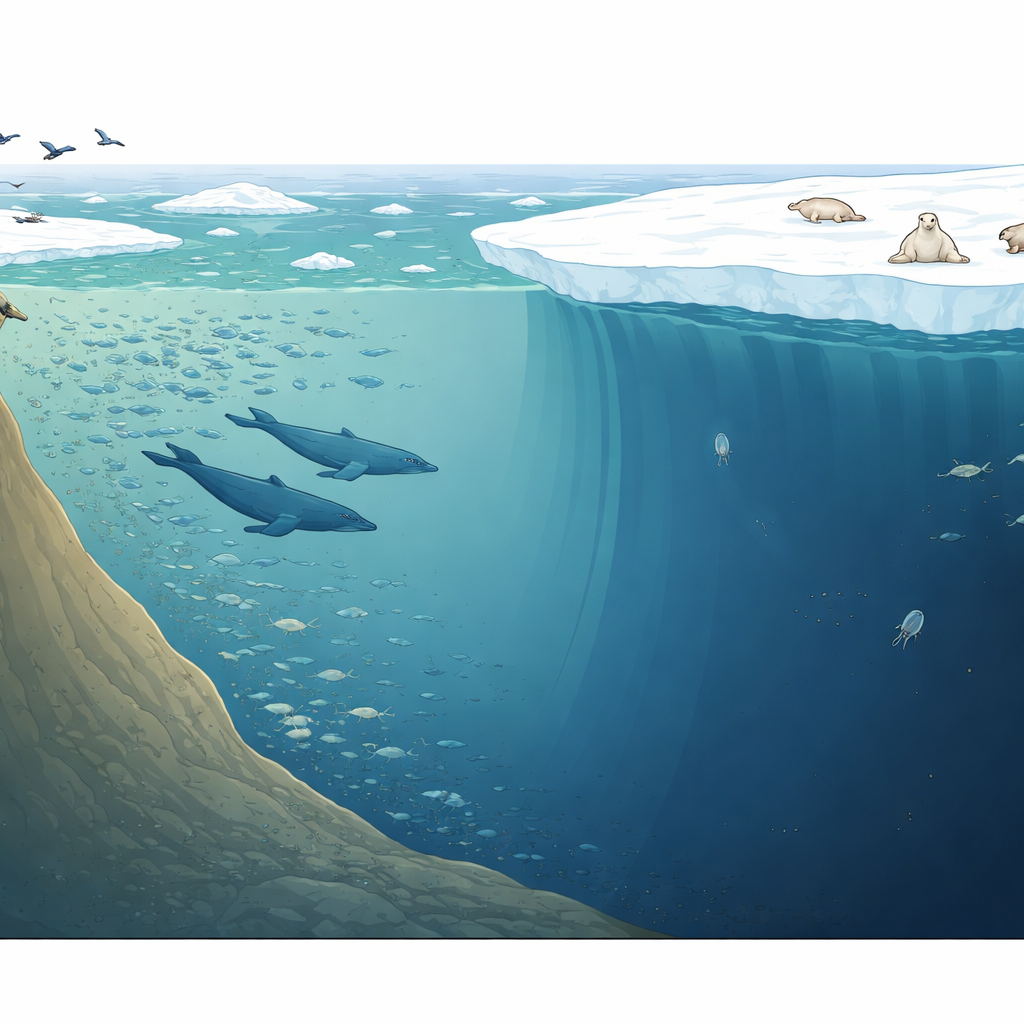
Busy Edges, Empty Middle
North of Svalbard, along the continental shelf and its steep slope, the team found a lively ocean. Warmer, saltier Atlantic water flowed into this region, carrying nutrients and tiny plantlike plankton that fuel the food web. Echo‑sounders showed dense layers of zooplankton and schooling fish between about 100 and 400 meters depth. Trawls there caught large numbers of capelin, some Atlantic cod, redfish, Greenland halibut and a few polar cod, along with krill, amphipods and squid. Many whales, dolphins, seals and seabirds were seen feeding in these waters, confirming that this boundary zone between the Atlantic and the Arctic is a productive hot spot.
Crossing into the Barren Basin
As the ship pushed north beyond about 82°N into deeper water and heavier ice, the scene changed dramatically. The echo‑sounders still showed a faint “mesopelagic layer” between roughly 300 and 500 meters, but trawls from this layer brought up almost no fish—only scattered lanternfish and small catches of gelatinous creatures such as comb jellies, arrow worms, jellyfish and a few squid. Net samples revealed that zooplankton biomass, especially the copepods, krill and amphipods that fish prefer, dropped by about an order of magnitude compared with the shelf and slope. Chlorophyll measurements, a stand‑in for plantlike plankton, also fell sharply north of the ice edge. In short, the deep Central Arctic Ocean appears to be a low‑food environment, offering little to sustain large shoals of pelagic fish.
How Top Predators Survive
Yet the surface did not feel lifeless. Even in these “barren” waters, observers frequently saw ringed and bearded seals resting on ice floes and polar bears hunting them. Underwater cameras and overturned floes revealed polar cod living right beneath the ice and small crustaceans clinging to it. Previous specialized under‑ice trawls in the region have shown that these ice‑associated communities can be patchy but locally dense enough to support seals. The new results suggest that, away from the shelf, polar bears and seals rely mainly on this thin, ice‑bound food web rather than on fish in the open water column. 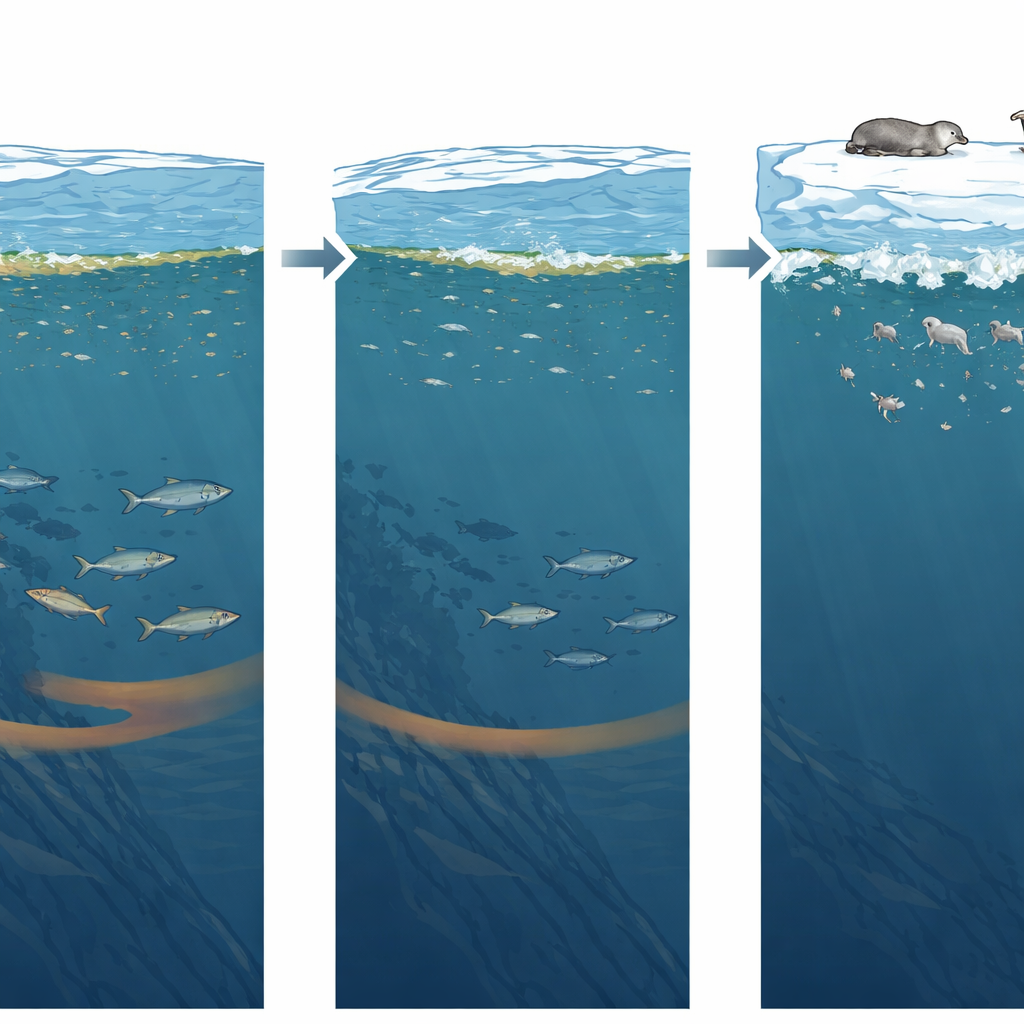
What This Means for Future Use
The authors conclude that the deep Central Arctic Ocean currently holds no fish stocks of commercial interest. Instead, it functions as a fragile, ice‑dependent ecosystem where a relatively small amount of under‑ice life supports iconic top predators. As summer sea ice retreats and human activity—shipping, tourism and possibly future fishing—moves farther north, these simple food chains could be easily disturbed. The researchers therefore argue that the existing international agreement that bans fishing in the Central Arctic Ocean should be considered as a foundation for a full marine protected area, to safeguard one of the planet’s most remote and least disturbed oceans while its future is still being decided.
Citation: Dodd, P.A., Hop, H., Nikolopoulos, A. et al. Barren depths from 82° N to the North Pole reveal scarcity of fish in the Central Arctic Ocean. Commun Earth Environ 7, 390 (2026). https://doi.org/10.1038/s43247-026-03381-7
Keywords: Central Arctic Ocean, pelagic fish, zooplankton, polar bears and seals, marine protected area