Clear Sky Science · en
Pathways to spatial equity: lessons from global patterns of urban infrastructure diversity
Why city services are not shared equally
As more people move into cities, a basic question matters to daily life: does every neighborhood have a fair mix of homes, schools, clinics, shops, and parks, or are these services clustered in a few lucky areas? This study looks at how the variety and spread of such building-based services differ around the world, and what that means for creating fairer, more livable cities.
Looking at cities through their buildings
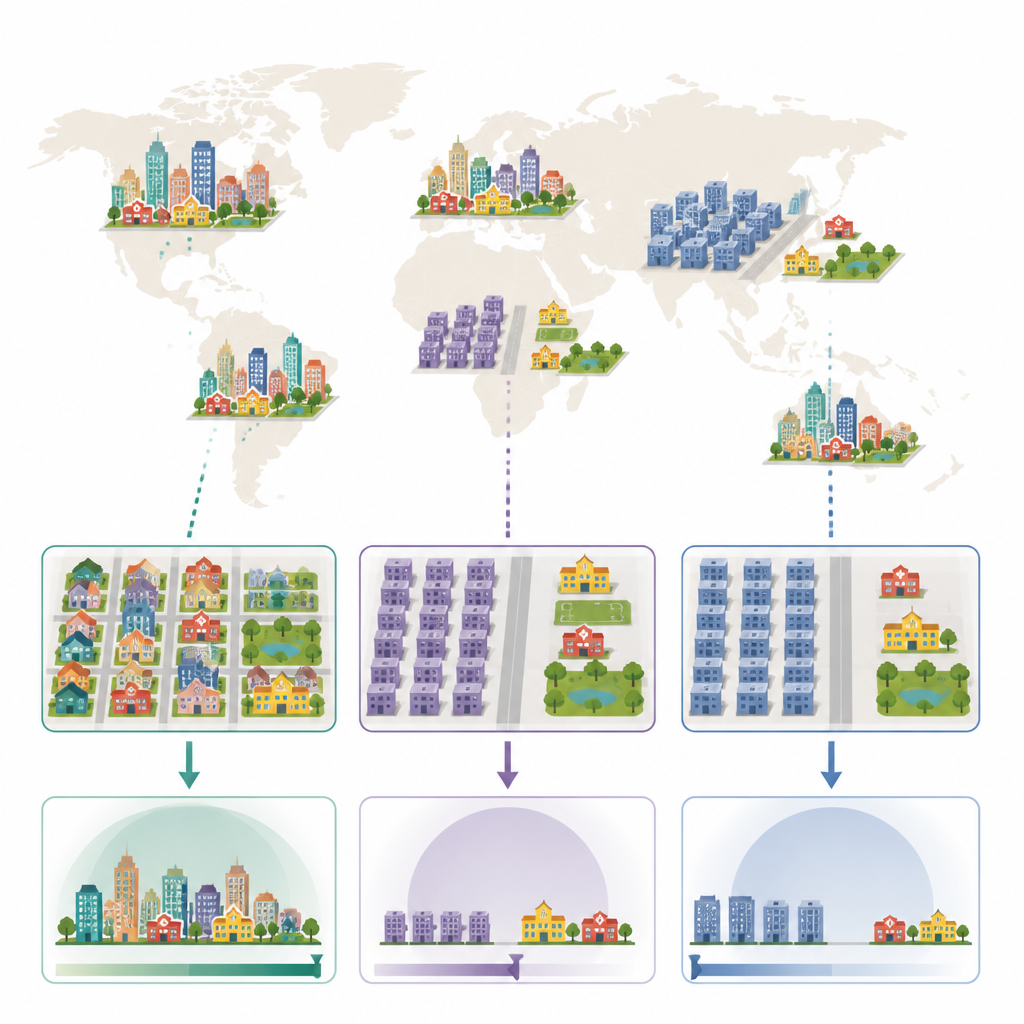
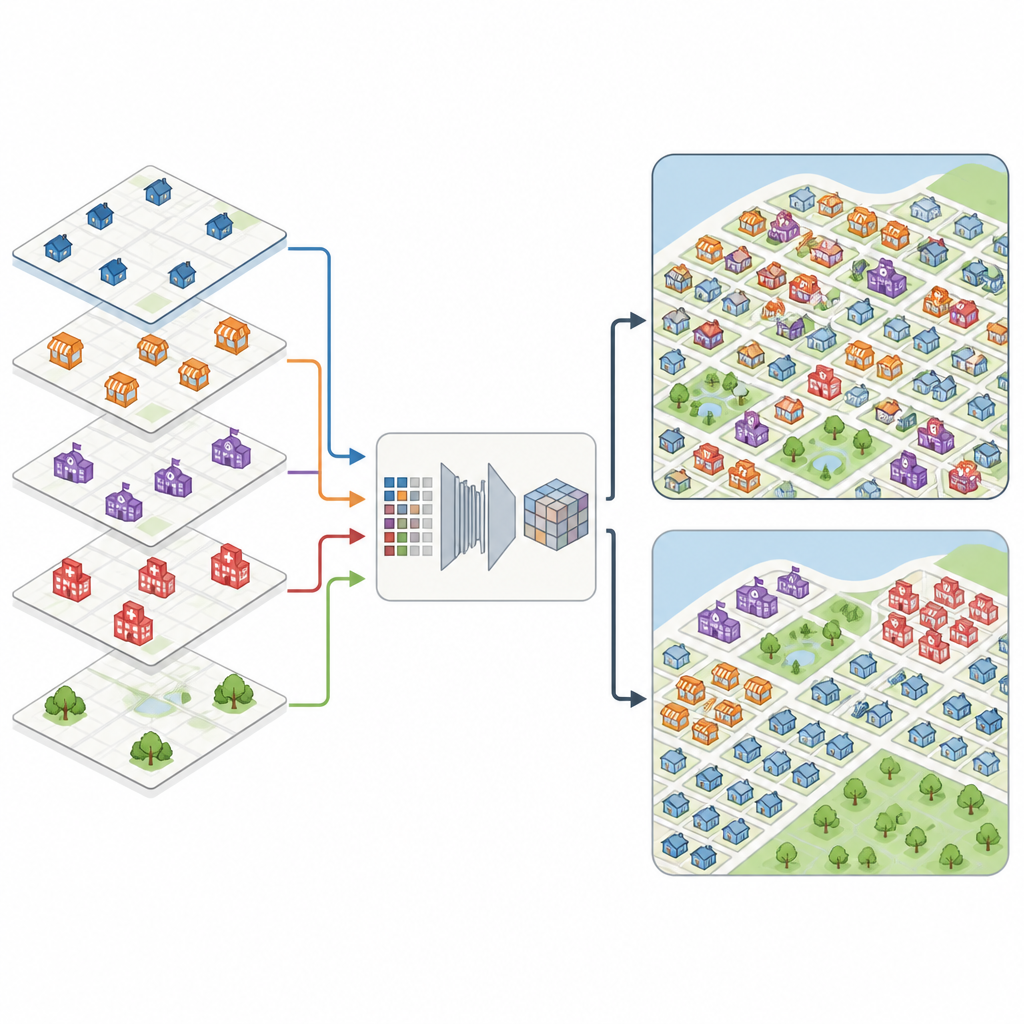
Instead of counting only how many buildings a city has, the researchers asked what those buildings are used for. They combined global building maps with volunteer-contributed data from OpenStreetMap and machine learning tools to classify buildings into everyday categories such as housing, commercial spaces, factories, schools, medical centers, public buildings, and others. By doing this for 482 cities worldwide between 2017 and 2025, they built a detailed picture of how different types of services are scattered across urban areas.
Measuring the mix within and across neighborhoods
To describe how varied city infrastructure is, the authors used a diversity index that captures both how many types of buildings exist and how evenly their floor areas are shared. They calculated this diversity at two scales. At the city scale, it shows how rich the overall mix of services is across the whole urban area. At the community scale, using a one-kilometer grid, it reflects how well that mix is shared among local neighborhoods. They then used a familiar inequality measure, the Gini coefficient, to see how uneven this community-level diversity is within each city.
Different stories in the Global North and Global South
The analysis found that cities in the Global North generally enjoy a higher mix of infrastructure types than those in the Global South, and this difference is most dramatic at the community level. In 2025, Global North cities had more diverse neighborhoods on average, even when Global South cities sometimes matched or exceeded them in overall city-scale diversity. Over time, both regions saw growth in diversity, but inequality moved in opposite directions: community-level gaps shrank slightly in the Global North while they widened notably in the Global South. This pattern suggests that many cities in developing regions are adding new services overall, but not spreading them evenly across neighborhoods.
When growth and fairness drift apart
The study introduces the idea of scale decoupling, which describes a gap between growth in citywide diversity and growth in neighborhood-level diversity. In much of the Global North, many cities showed stronger gains at the community scale than at the city scale, a sign that new infrastructure is being added in a way that better balances local access. In contrast, most cities in the Global South showed the reverse: city-scale diversity rose faster than neighborhood diversity, and this decoupling was closely tied to rising inequality. Statistical modeling confirmed that this mismatch between scales explained more of the change in inequality than shifts in income or population patterns.
What this means for building fairer cities
For a layperson, the message is that it is not enough for a city to build more roads, schools, hospitals, or parks overall. What matters just as much is where these services end up. The research shows that many cities, especially in the Global South, risk falling into a loop where new investments mainly benefit already well-served areas, leaving other neighborhoods behind. By tracking the diversity of building uses at both city and community scales, planners and policymakers can spot these hidden gaps and design policies that place new services in disadvantaged areas. Doing so can help tie together goals for better health, education, and housing, and move cities closer to a future where basic urban services are within reach for all residents.
Citation: Chen, Z., Weng, Q. Pathways to spatial equity: lessons from global patterns of urban infrastructure diversity. npj Urban Sustain 6, 80 (2026). https://doi.org/10.1038/s42949-026-00378-1
Keywords: urban infrastructure, spatial inequality, Global South, urban planning, sustainable cities