Clear Sky Science · en
Social hierarchy influences monkeys’ risky decisions
Why Monkey Choices Matter to Us
Every day, we all make gambles—whether to change jobs, invest money, or speak up in a meeting. This study asks a deceptively simple question: are our attitudes toward risk shaped only by who we are inside, or also by where we stand in the social pecking order? To explore this, scientists turned to a group of monkeys living together in a semi-wild setting and playing a kind of casino game for juice. Their behavior reveals how social rank can subtly bend the way brains, including ours, weigh possible gains and losses.
Monkeys at the Casino
The researchers studied a group of Tonkean macaques living in a wooded park, where the animals could freely visit automated touchscreen machines. At these stations, monkeys chose between two "lotteries" that could increase or decrease a set of tokens, which were then converted into juice rewards. Over three years, the team collected more than 1.3 million such choices, an unusually rich dataset that let them follow each monkey’s decision style over time. Because the animals lived together, the scientists could simultaneously track their social lives, noting who displaced whom at the machines to build a daily, numerical record of each monkey’s rank within the group.
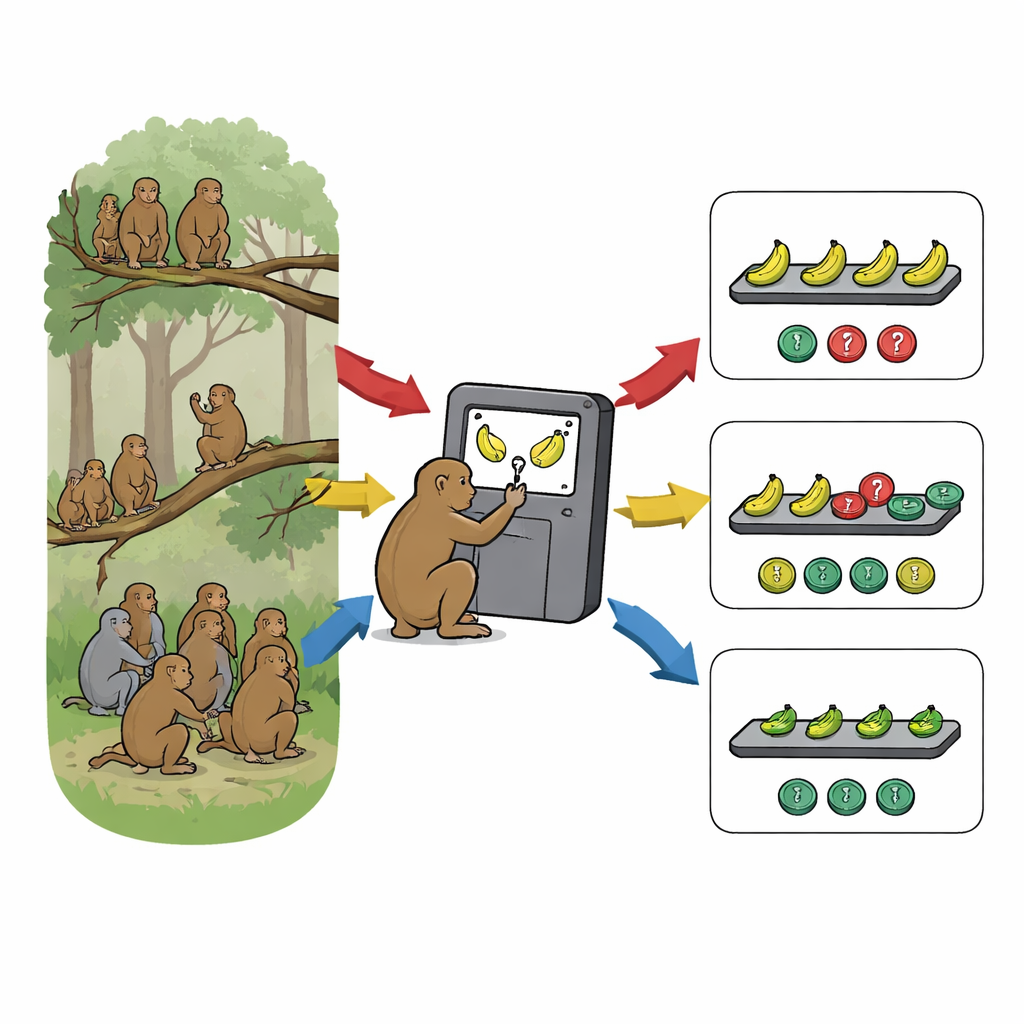
Gains, Losses, and Mental Shortcuts
The team analyzed the choices using a framework from behavioral economics called Prospect Theory, which describes how people tend to fear losses more than they value equal-sized gains and often misjudge probabilities. The monkeys showed similar quirks. On average, they were cautious when facing potential gains, preferring safer options, but became more willing to gamble when trying to avoid losses. They also exaggerated small chances in one direction and large chances in another—the same kind of probability distortion seen in humans. Overall, losses weighed more heavily than gains, indicating a form of loss aversion in these nonhuman primates.
Social Rank and the Taste for Risk
The most striking patterns emerged when the scientists overlaid decision profiles with social rank. Using a chess-style "Elo" score updated after each conflict around the machines, they showed that hierarchy in this group was not fixed but shifted over months and years. Monkeys at the very top and very bottom of the ladder tended to have more predictable outcomes in conflicts: dominant individuals usually won, subordinates usually lost. Those in the middle, however, faced more evenly matched opponents and more uncertain social encounters. This social uncertainty lined up with differences in risk attitudes for gains. Middle-ranking monkeys were less cautious about possible rewards than both high- and low-ranking animals, and at times even sought risk. Yet when it came to avoiding losses, all ranks behaved similarly—they were willing to gamble to escape negative outcomes, regardless of status.
Age, Experience, and Flexible Minds
Other factors also nudged decision styles. The researchers found no clear differences between males and females. Age, however, played a role: younger monkeys were less extreme in their loss-related risk-taking and showed weaker loss aversion than adults, hinting that attitudes toward bad outcomes may sharpen with maturity. Experience with the task mattered too. As monkeys accumulated more trials, they tended to become less cautious when pursuing gains, but slightly more restrained when facing losses. Together, these patterns suggest that risk preferences are not rigid personality traits. Instead, they respond to both social pressures and learning, with gains proving more behaviorally flexible than losses.
What This Means for Understanding Choice
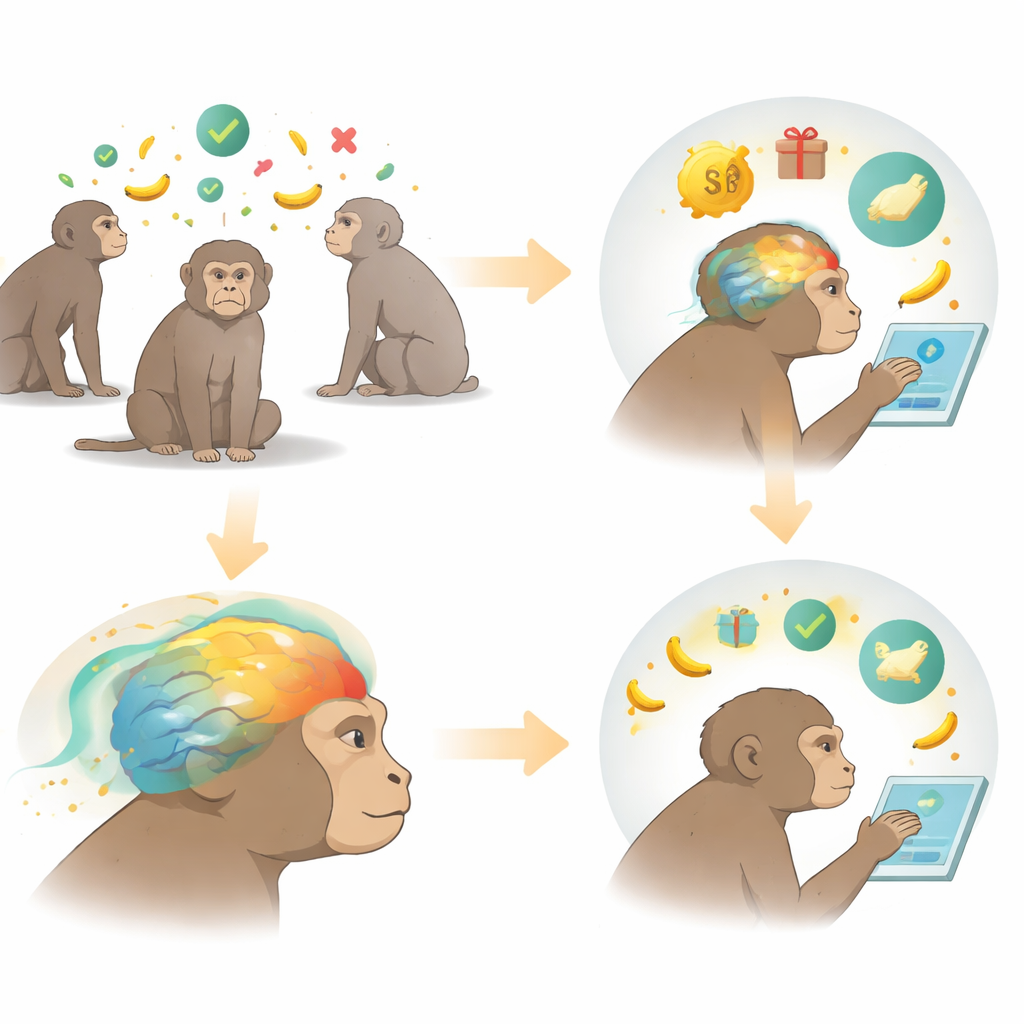
In plain terms, this study shows that where a monkey stands in its group can change how boldly it chases rewards, without altering how it reacts to potential setbacks. Middle-ranked animals, living with the greatest uncertainty about winning or losing social clashes, seem to accept more financial-style risk when there is something to gain—perhaps as a strategy for improving or defending their place. Because similar psychological rules appear in humans, these findings hint that our own appetite for risk may also ebb and flow with our social fortunes and the predictability of our daily contests, from the office to the marketplace.
Citation: Chaix-Eichel, N., Guerillon, A., Bourgeois-Gironde, S. et al. Social hierarchy influences monkeys’ risky decisions. Commun Biol 9, 578 (2026). https://doi.org/10.1038/s42003-026-09817-2
Keywords: social hierarchy, risk-taking, monkey decision-making, gains and losses, prospect theory