Clear Sky Science · en
The first sauropod dinosaur from the Lower Cretaceous Khok Kruat Formation of Thailand enriches the diversity of somphospondylan titanosauriforms in southeast Asia
A Giant from Thailand’s Ancient Rivers
Long before elephants and tigers roamed Southeast Asia, colossal plant-eating dinosaurs shaped the landscape. This study introduces Nagatitan chaiyaphumensis, a new long-necked sauropod discovered in Thailand’s Lower Cretaceous rocks. By carefully analyzing its bones, the authors show how this animal fits into the dinosaur family tree and what it reveals about climate, habitats, and giant body sizes in Asia about 115 million years ago. 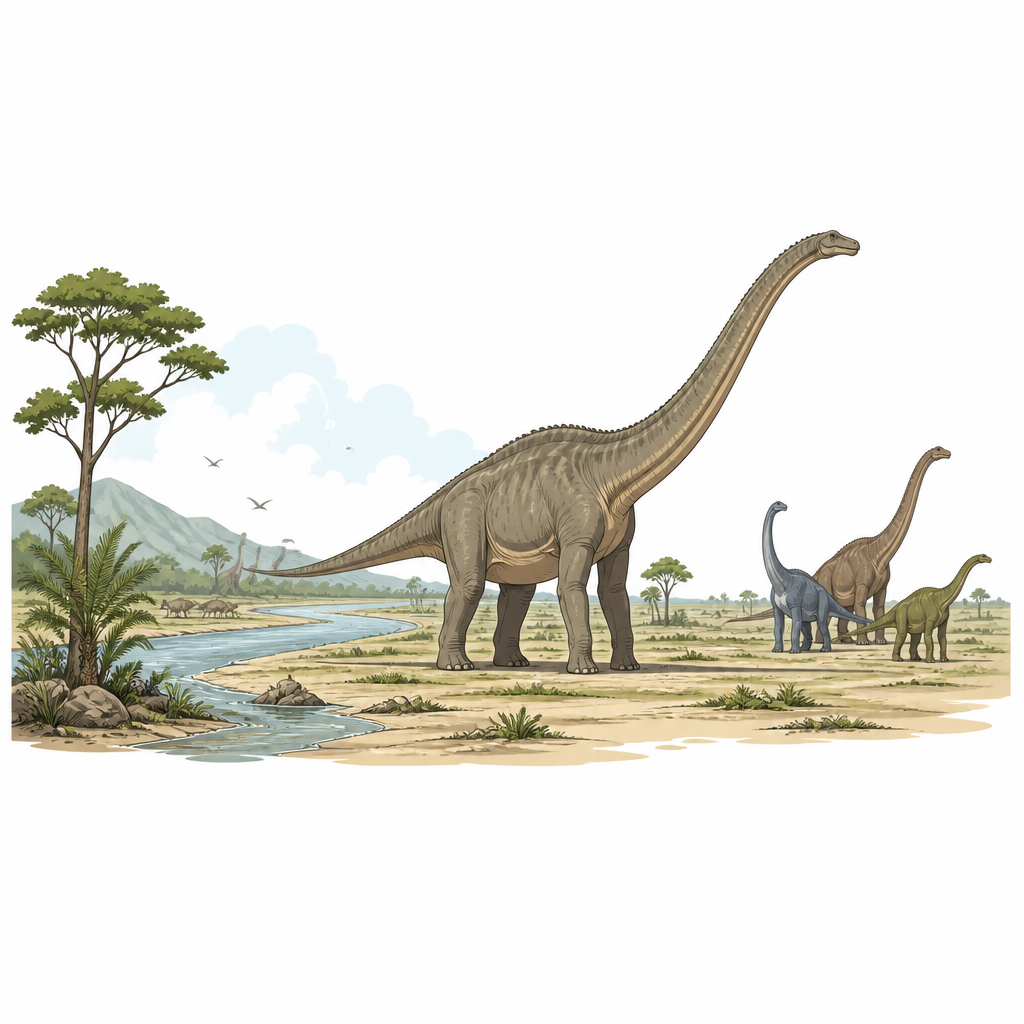
The Place Where the Bones Were Found
The fossils come from the Khok Kruat Formation in northeastern Thailand, the youngest dinosaur-bearing rock unit in the country. These sediments were laid down by a meandering river flowing across semi-arid floodplains, dotted with ponds and seasonal channels. The same rocks preserve a rich community of life, including freshwater sharks, turtles, crocodile-like reptiles, flying pterosaurs, and several kinds of meat-eating and plant-eating dinosaurs. In 2016 a local resident noticed bones eroding from the bank of a communal pond at Ban Pha Nang Sua, triggering excavations that continued for several years and ultimately produced a partial skeleton of a very large sauropod.
Piecing Together a New Long-Necked Giant
The skeleton of Nagatitan includes parts of the back and hip region: four dorsal vertebrae, four sacral vertebrae with ribs, several dorsal ribs, the right upper arm bone, both pubic bones of the pelvis, the right hip bone, and most of the right thigh bone. Using detailed measurements, 3D scans, and comparisons with dozens of other sauropods, the researchers identified traits that set Nagatitan apart. Its back vertebrae show an unusual mix of supportive ridges and cavities, including two distinct shapes of a bracing structure called the hyposphene, and triangular flaring plates at the top of some spines. The humerus has a distinctive rounded outer corner and a strong muscular bulge, while both the upper arm and thigh shafts are notably flattened side-to-side compared with most sauropods.
Family Ties across Asia and Beyond
To find Nagatitan’s closest relatives, the team added it to a large computer analysis that compares 570 skeletal features across 153 sauropod species. The results place Nagatitan within Euhelopodidae, a group of long-necked dinosaurs previously thought to be mostly restricted to East Asia. In this analysis Nagatitan clusters near European species under one method and with Asian forms under another, but it does not form a tight local subgroup with two roughly similar Southeast Asian sauropods, Phuwiangosaurus from Thailand and Tangvayosaurus from Laos. Detailed bone-by-bone comparisons show that all three can be told apart by the shapes and orientations of their back vertebrae, limb bones, and pelvic elements, suggesting that Southeast Asia hosted several distinct lineages rather than a single isolated clan. 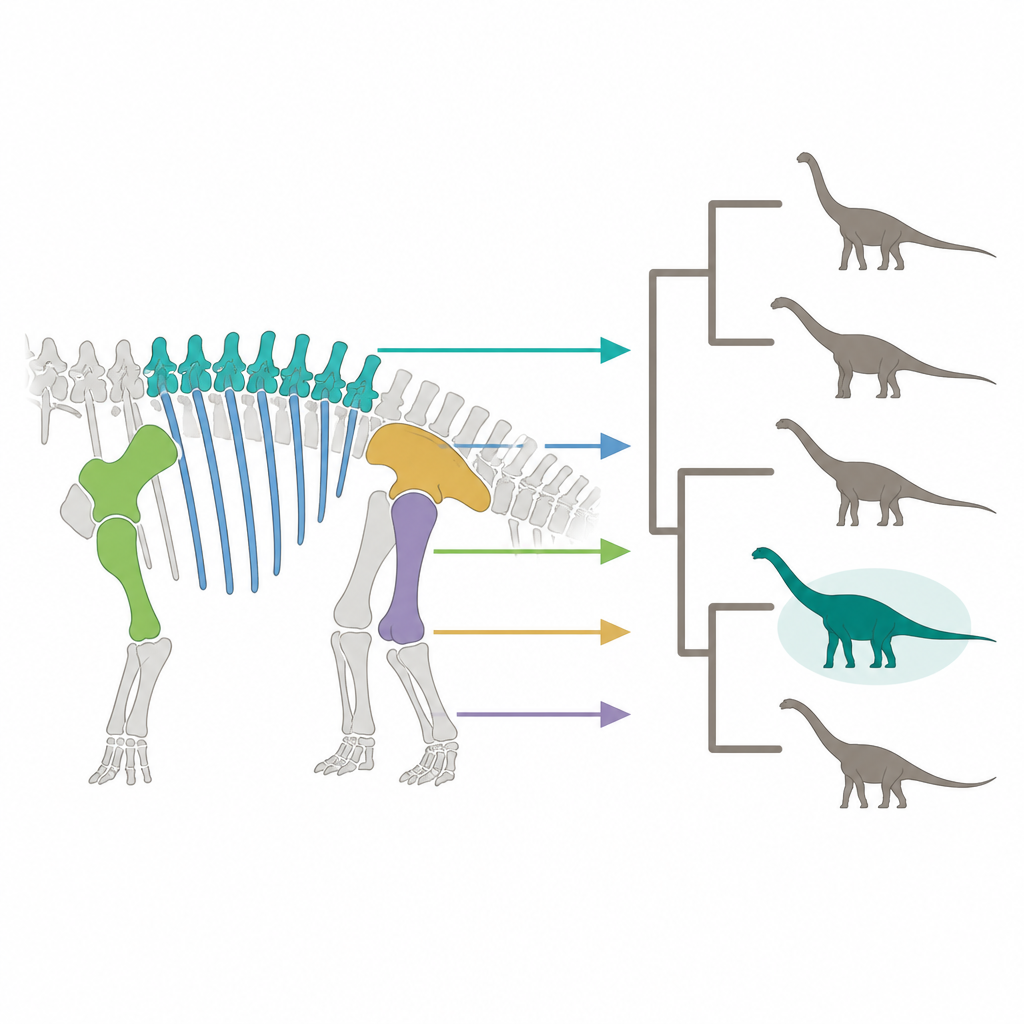
Big Bodies in a Warming World
From the thickness of the upper arm and thigh bones, the researchers estimate that Nagatitan weighed about 25 to 28 tonnes and stretched roughly 27 meters in length. That makes it heavier and longer than the earlier Thai sauropod Phuwiangosaurus, and similar in size to large mid-Cretaceous titanosauriforms from China and Laos. When these estimates are combined with data from other Asian species, a pattern appears: before the Aptian stage, most Asian titanosauriforms were under 20 tonnes, but during and after this interval many lineages trended larger. The authors link this shift to rising global temperatures and the spread of warm, open, savanna-like habitats that could support vast amounts of plant food for giant herbivores.
What This New Dinosaur Tells Us
Nagatitan chaiyaphumensis shows that the rivers of Early Cretaceous Thailand supported some of the largest animals ever to live in Southeast Asia. Its distinctive skeletal features expand the known variety of sauropod body plans and help clarify how different lineages of long-necked dinosaurs were distributed across Asia. By tying anatomy, age, and body size to changing climates and landscapes, the study suggests that warming conditions and expanding dry open habitats encouraged these gentle giants to evolve ever larger bodies while diversifying into several separate branches of the dinosaur family tree.
Citation: Sethapanichsakul, T., Khansubha, SO., Manitkoon, S. et al. The first sauropod dinosaur from the Lower Cretaceous Khok Kruat Formation of Thailand enriches the diversity of somphospondylan titanosauriforms in southeast Asia. Sci Rep 16, 12467 (2026). https://doi.org/10.1038/s41598-026-47482-x
Keywords: sauropod dinosaur, Cretaceous Thailand, titanosauriform, dinosaur evolution, paleoclimate