Clear Sky Science · en
Association between body roundness index and the prevalence of diffuse idiopathic skeletal hyperostosis in elderly patients: the Bunkyo health study
Why belly shape can matter for spinal health
As people age, many notice changes in weight and body shape, especially around the waist. This study asks a simple but important question: can the roundness of the body around the belly signal a higher chance of developing extra bone growth along the spine, a condition that can cause stiffness and pain? By looking at older adults living in Tokyo, the researchers explored how a new measure of body shape, called the body roundness index, relates to this little-known spinal condition.
The spine condition behind back stiffness
Diffuse idiopathic skeletal hyperostosis, or DISH, is a mouthful of a name for a condition in which extra bone forms as bridges along the front of the spine. These bony bridges can limit how easily the back moves and, in some cases, cause problems such as chronic back pain or difficulty swallowing if they affect the neck. DISH tends to appear in older adults and has been linked to other health issues such as diabetes, high blood pressure, and heart disease. Despite these links, doctors still do not fully understand why some people develop such heavy extra bone growth while others do not.
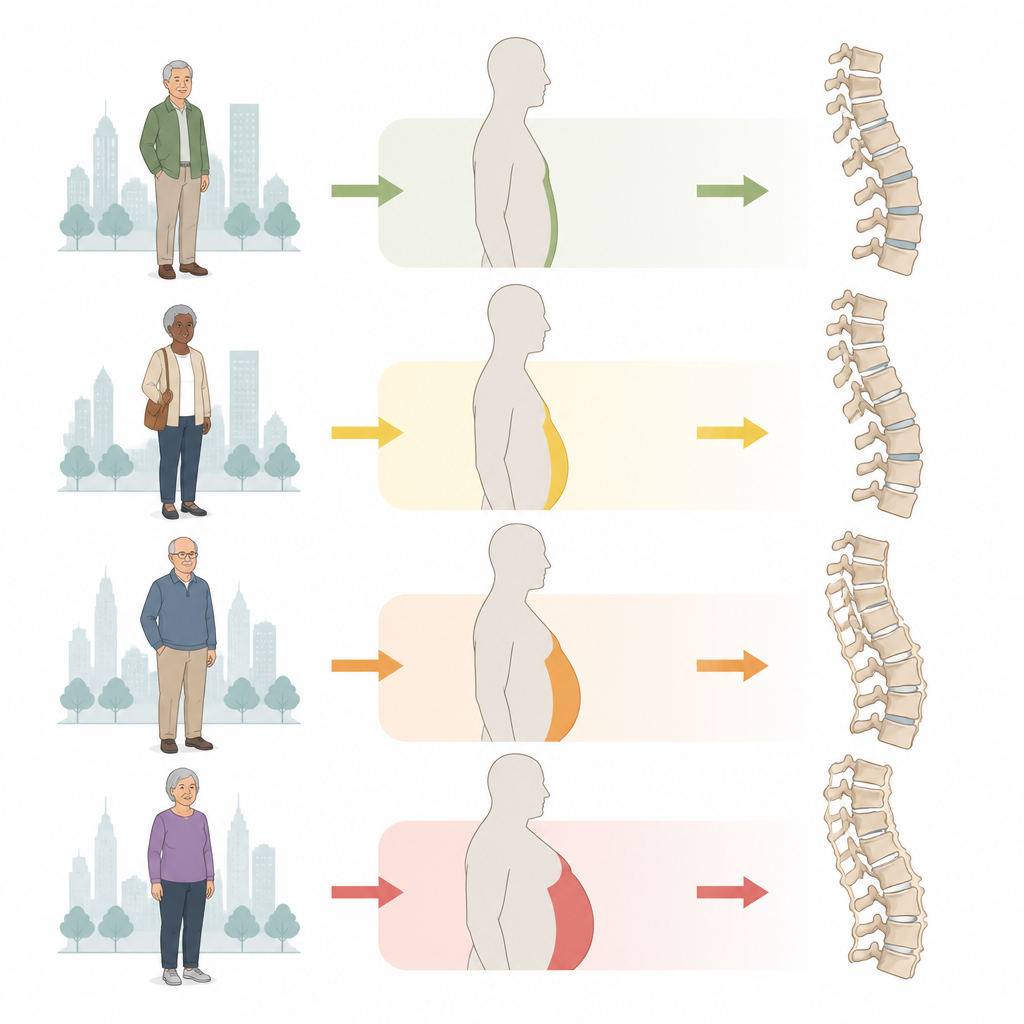
Looking at body shape in an older city population
The researchers drew on the Bunkyo Health Study, a long running project that follows older residents of one Tokyo district. They focused on 1,258 men and women aged 65 to 84 who had spine X rays, blood tests, body measurements, and scans of abdominal fat. To capture body shape, they calculated the body roundness index from each person’s height and waist size, which better reflects deep belly fat than the usual body mass index. Specialists examined side-view spine X rays to see who had DISH, defined by continuous bony bridges across at least three neighboring vertebrae. The team then compared people with and without DISH, taking into account age, sex, and use of medicines for diabetes and blood fats.
What the study found about fat and extra bone
About 15 percent of participants had DISH, and the condition was much more common in men than women. People with DISH tended to be older and to have higher body roundness index scores, larger waistlines, and more visceral fat around their organs. They were also more likely to have a history of smoking, high blood pressure, diabetes, and heart disease. When the researchers used statistical models to look for factors that were independently linked to DISH, both body roundness index and visceral fat volume stood out, even after adjusting for body mass index and other health measures. In contrast, standard blood markers of bone turnover did not differ much between the groups, suggesting that usual bone tests in the bloodstream may miss the local bone-forming activity along the spine.
Links with metabolism, muscle, and sex
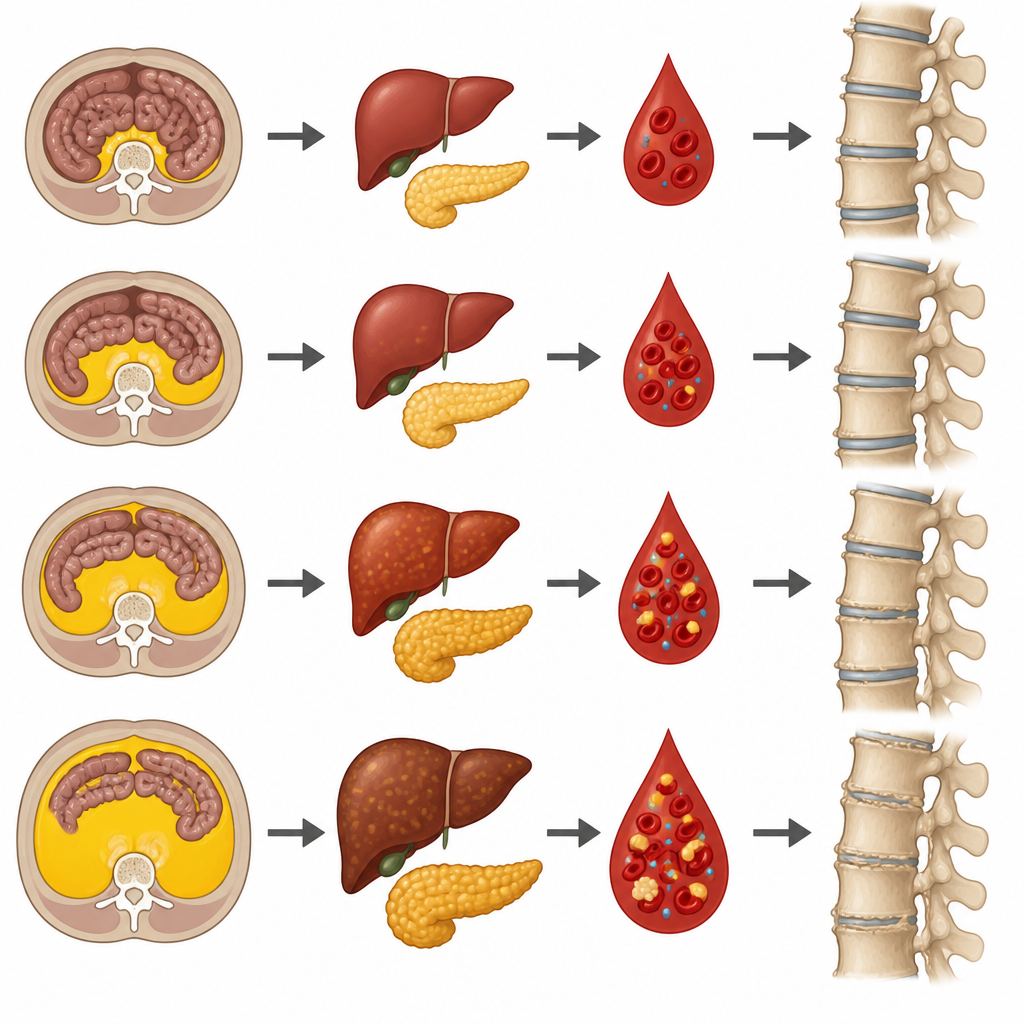
The study also explored how metabolism and body tissues might be tied to this spinal condition. Participants with DISH showed signs of reduced insulin sensitivity, such as higher fasting insulin and lower values on a widely used insulin sensitivity index. They had lower levels of adiponectin, a hormone released by fat tissue that usually helps improve insulin sensitivity and supports healthy bone balance. Hip bone density and skeletal muscle mass were higher in people with DISH, which may reflect the combined effects of body weight, mechanical forces on bone, and hormonal signals. When men and women were examined separately, body roundness index and visceral fat remained important in both groups, although some blood markers, such as a growth factor involved in bone formation, appeared to differ mainly in women.
What this means for everyday health
For a lay reader, the key takeaway is that how round the body is around the waist, a simple measure combining height and waist size, is closely tied to a spine condition that can reduce flexibility and quality of life in older age. The study suggests that deep belly fat and related metabolic changes, rather than overall weight alone, may quietly promote extra bone growth along the spine over many years. While this research cannot prove cause and effect, it highlights body roundness index as a practical tool that doctors could use to spot older adults who might be at higher risk of DISH and its complications, and it underscores the broader value of keeping visceral fat in check through lifestyle and medical care.
Citation: Sugawara, Y., Nojiri, H., Nagao, M. et al. Association between body roundness index and the prevalence of diffuse idiopathic skeletal hyperostosis in elderly patients: the Bunkyo health study. Sci Rep 16, 15922 (2026). https://doi.org/10.1038/s41598-026-47398-6
Keywords: body roundness index, visceral fat, spine stiffness, older adults, insulin resistance