Clear Sky Science · en
Evaluating coastal urban underground space for ecological and marine-pollution suitability using AHP–TOPSIS
Why building underground by the sea matters
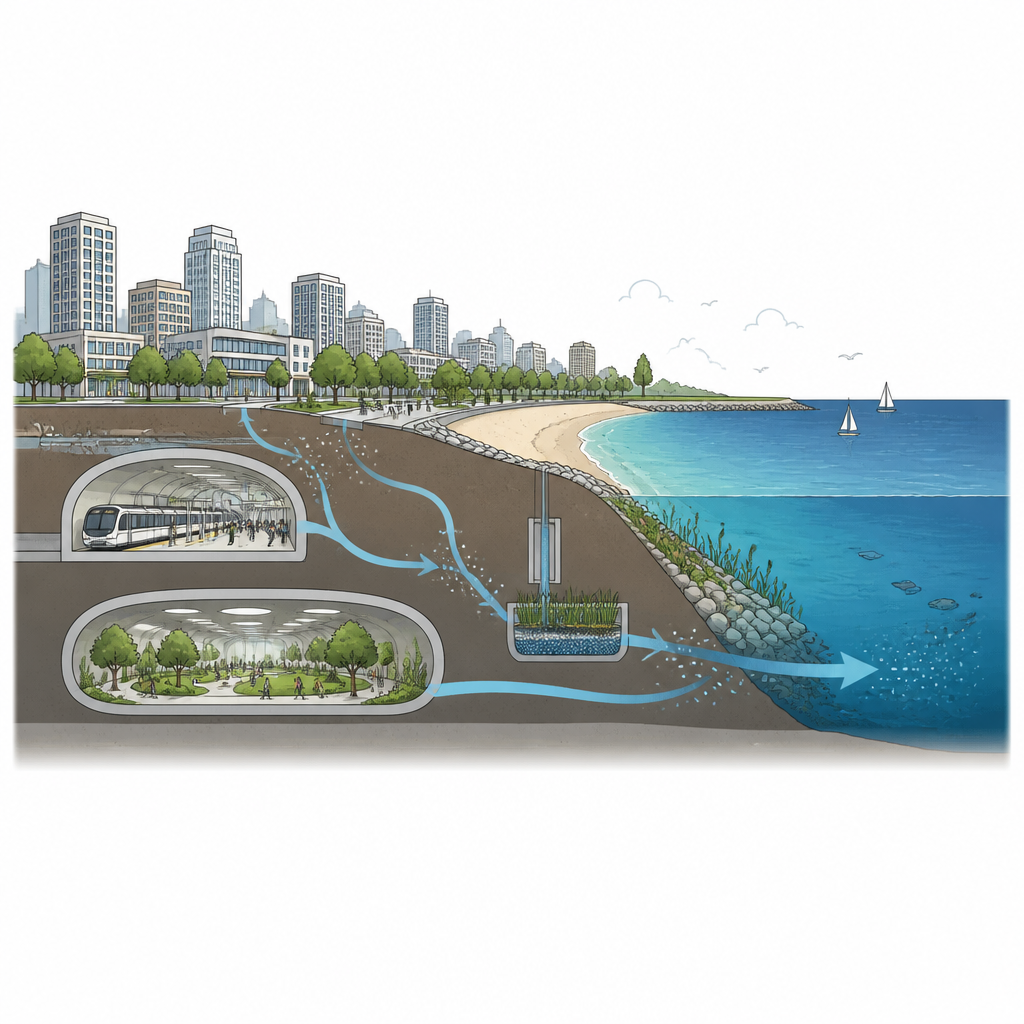
As coastal cities run out of space, more roads, shops, and public facilities are being built below ground. But what happens to coastal waters when drainage pipes, parking garages, and transit hubs disappear beneath our feet? This study asks a practical question for planners worldwide: which kinds of underground projects help protect marine life and which ones risk adding to pollution, flooding, and energy waste.
How experts weighed different kinds of impacts
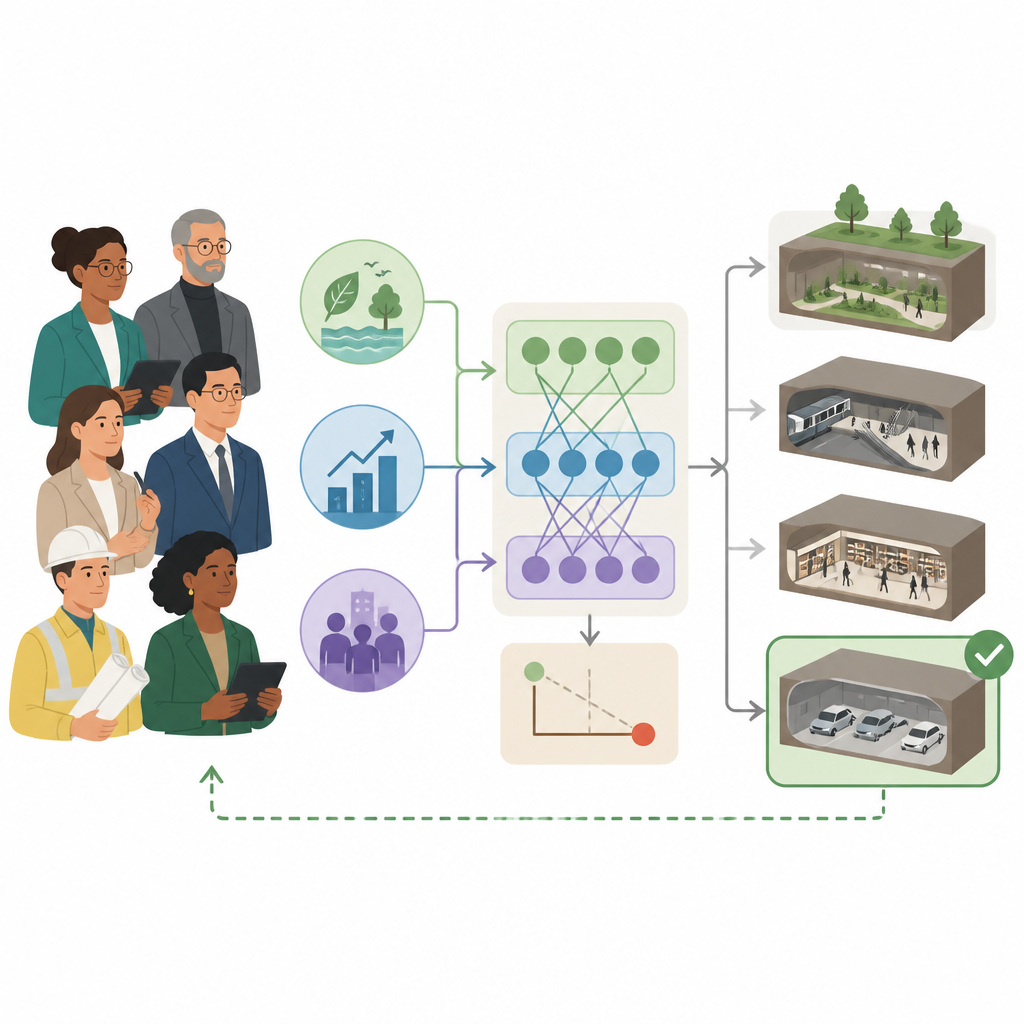
The researchers created a structured scoring system to judge underground projects in coastal cities. Instead of focusing only on cost or space savings, they brought together ten criteria grouped into three themes: environmental and marine health, economic and technical performance, and social and governance aspects such as safety and public acceptance. Fifty specialists in planning, engineering, marine science, transport, and finance from several coastal regions compared these criteria and rated five typical underground projects, including a transit hub, a retail center, a green park, a parking garage, and a mixed-use complex.
Turning expert judgement into clear rankings
To turn many opinions into a clear ranking, the study used a two-step decision method. First, experts compared the importance of each criterion in pairs. This allowed the team to calculate weights that show how much each factor should count in the final score. Environmental and marine concerns together received more than half of the total weight, with energy use, air quality, stormwater control, and direct impact on the sea standing out. Second, the team combined these weights with expert ratings of how well each project type performs, then measured how close each option came to an “ideal” project that scores highly on all criteria and far from a “worst case” project.
Which underground projects came out on top
The underground green park emerged as the most suitable option for coastal cities when marine pollution is a central concern. Experts judged that it can reduce sealed surfaces, soak up rainfall, slow polluted runoff before it reaches the sea, and maintain good air quality while using relatively little energy. An underground transit hub ranked second. Although expensive to build, it supports public transport, cuts traffic on the surface, and can be designed to manage stormwater more safely. A dense mixed-use complex placed in the middle: it makes good use of scarce land and can be well connected to the city, but tends to need more energy and offers fewer direct benefits for coastal water quality.
Why some popular projects fall short
In contrast, underground retail centers and multi-level parking garages consistently ranked lowest. They can be profitable and straightforward to construct, but experts saw them as energy hungry, less friendly to air quality, and less helpful for managing rainfall and runoff. Car-focused facilities in particular risk locking cities into high traffic and higher emissions while contributing little to coastal protection. Even when the researchers shifted the scoring system to favor economic or social goals more strongly, these two project types rarely moved out of the bottom positions.
What this means for coastal city planning
The study concludes that when coastal and marine protection is treated as a core goal rather than a bonus, the best underground projects are those that combine ecological functions with support for public transport and quality public space. The results suggest that city authorities should set firm minimum standards for energy use, air quality, and stormwater control before approving new underground schemes. Used this way, the evaluation framework can help planners screen proposals, invest in underground green parks and transit hubs, and avoid designs that quietly undermine long-term coastal health.
Citation: Zhao, Z., Tian, Z., Wang, G. et al. Evaluating coastal urban underground space for ecological and marine-pollution suitability using AHP–TOPSIS. Sci Rep 16, 15234 (2026). https://doi.org/10.1038/s41598-026-45750-4
Keywords: urban underground space, coastal cities, marine pollution, multi-criteria decision making, sustainable infrastructure