Clear Sky Science · en
Unexpected high subterranean biodiversity on rock glaciers threatened by global warming
Life hiding under the rocks
High mountain landscapes may look bare and lifeless, but beneath loose piles of cold stones there can be a bustling hidden world. This study reveals that rock glaciers in the Swiss Alps shelter a surprisingly rich community of fungi, plants and especially small animals living in the spaces between rocks. As the climate warms and mountain ice retreats, understanding these secret habitats helps us see what might be lost and where cold-adapted life might still hang on.
What rock glaciers are and why they matter
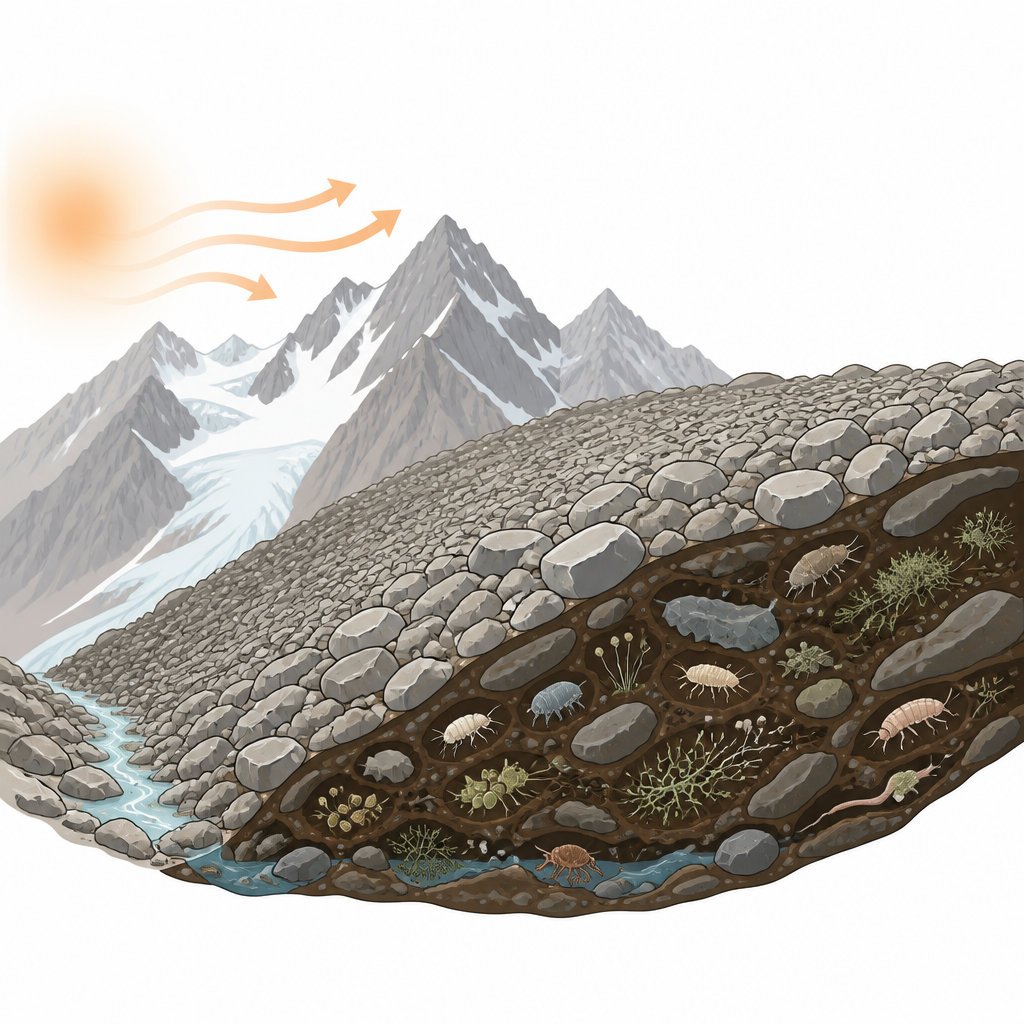
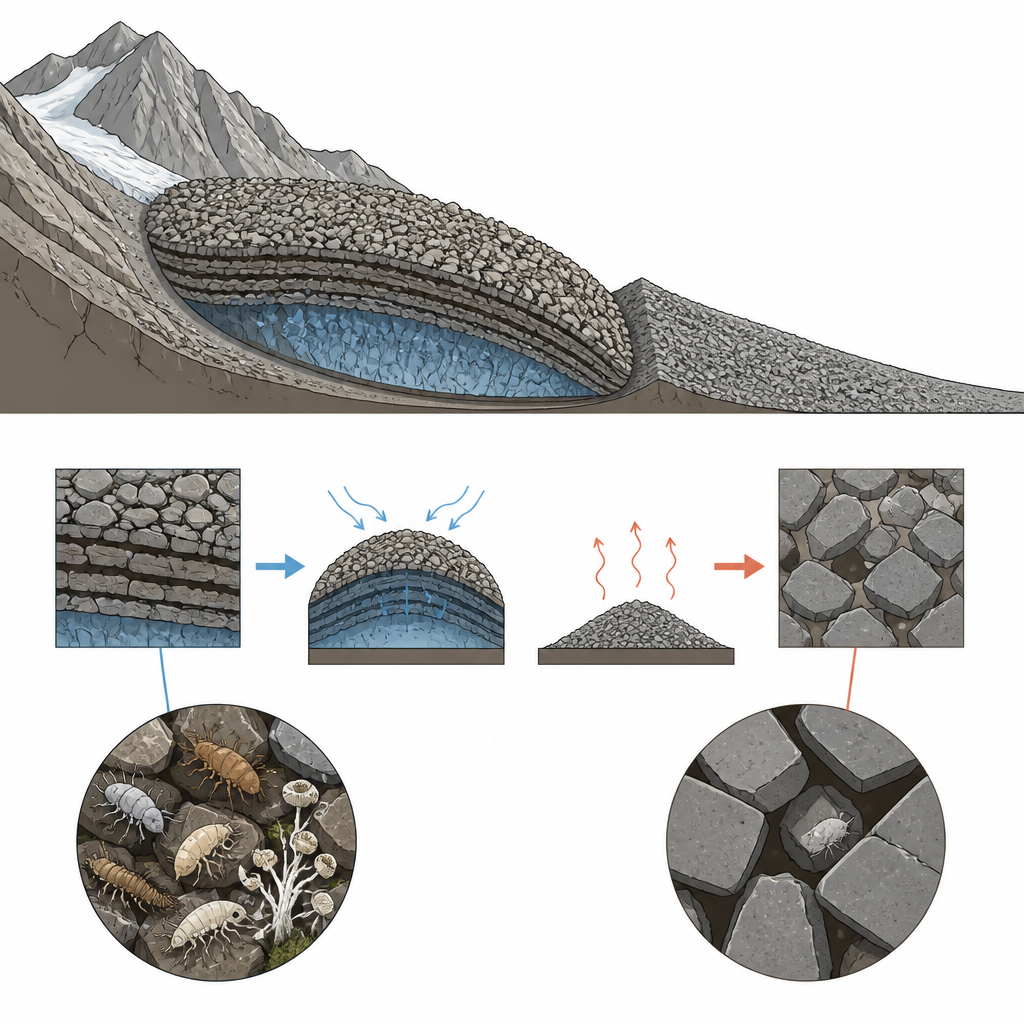
Rock glaciers look like slow frozen rivers of boulders. Inside their thick blanket of debris lies ice that creeps downhill over decades. The loose surface layer of stones, with finer material tucked between them, creates a cool but more stable environment than the exposed mountain surface. Scientists have suggested that such landforms could act as last refuges for plants and animals that depend on cold conditions when regular glaciers shrink. Yet almost nothing was known about the creatures living inside the upper rock layers of these features.
Exploring a hidden underground world
The researchers studied two active rock glaciers and their surroundings in the strictly protected Swiss National Park. They compared three nearby habitats made of the same rock: the rock glaciers themselves, the areas in front of them where glaciers once stood, and the steep scree slopes to the side. To reach the underground residents, they buried special tubes with side holes and small traps at the bottom. These devices stayed in place for up to three years, quietly collecting invertebrates moving through the spaces between rocks. At each site they also sampled fine debris to study fungi and mapped the small patches of vegetation that had taken root on the surface.
Surprising richness below the surface
The team found far more subterranean life than expected. In total they recorded 64 kinds of fungi, 36 species of vascular plants and 80 species of invertebrates, including snails, spiders, harvestmen, millipedes, springtails, beetles and more. The number of fungal types was similar in all three habitats, suggesting that spores spread widely through the landscape. Plant life told a different story: the glacier forelands had the densest and most diverse vegetation, rock glaciers held a modest but distinctive set of hardy pioneer plants, and the steep lateral scree slopes were almost bare.
Cold-loving animals in stable underground climates
The biggest surprise came from the animals living in the rock layers. The traps uncovered two species of snails, 48 insect species and 30 other arthropods, including some cave-adapted forms and even a beetle species new to science. Many were decomposers feeding on windblown organic particles and dead insects that settle on the rocks, with predators forming the second largest group. Measurements showed that at about 80 centimetres depth, temperatures stayed much more stable than at the surface and remained a little warmer in winter, thanks to snow cover and the insulating effect of the debris. Species that favour the cold tended to be more common where the yearly average temperature was lower, supporting the idea that these underground spaces act as cool refuges.
What climate change may mean for these refuges
Despite the rich life they contain, rock glaciers are not safe from climate change. As the air warms, their internal ice is shrinking and many will likely disappear from the Alps within decades. This study shows that each of the three habitats rock glacier, glacier foreland and lateral scree field holds a slightly different mix of species, and together they support a diverse alpine community. The authors conclude that while rock glaciers alone may not protect cold-adapted species in the long run, they could still play an important role when combined with other cool rocky slopes and shaded high-altitude landforms, helping at least some of this hidden mountain life to persist.
Citation: Gilgado, J.D., Rusterholz, HP. & Baur, B. Unexpected high subterranean biodiversity on rock glaciers threatened by global warming. Sci Rep 16, 14946 (2026). https://doi.org/10.1038/s41598-026-45647-2
Keywords: rock glaciers, subterranean biodiversity, alpine invertebrates, climate warming, mountain ecosystems