Clear Sky Science · en
Longitudinal prevalence and correlates of dynapenic abdominal obesity among community-dwelling ageing adults in rural South Africa from 2015 to 2022
Why weak muscles and belly fat matter as we age
As people grow older, extra weight around the waist and dwindling strength in the hands and arms may seem like separate annoyances. This study shows that when these two problems occur together, they can form a risky combination for middle-aged and older adults. Focusing on a rural community in South Africa, the researchers followed people over seven years to see how often this double condition appears, what everyday habits are linked to it, and which health problems travel alongside it.
A closer look at a risky body pattern
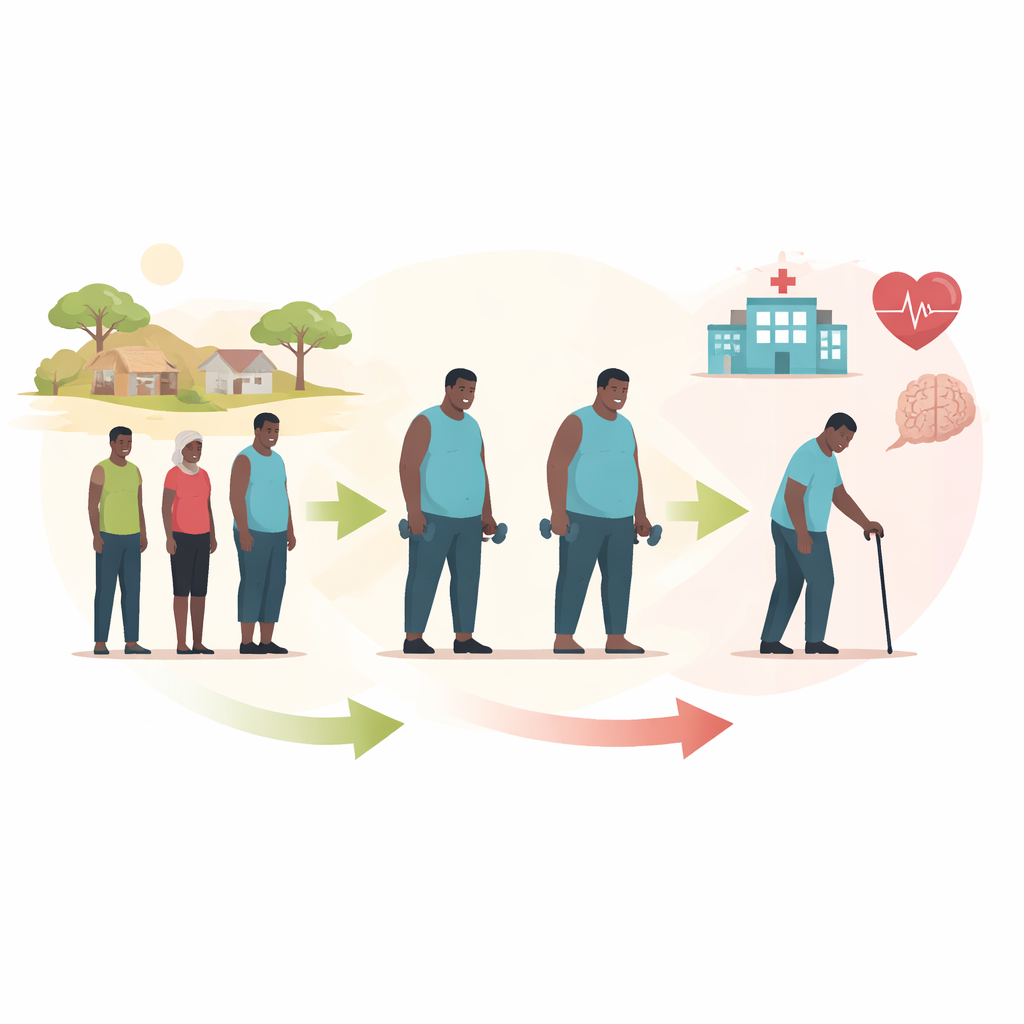
The paper examines a condition called dynapenic abdominal obesity, which simply means having both weak muscles and a large waistline at the same time. Earlier research in Europe, Asia, and Latin America suggested that this combination is more dangerous than either weak muscles or belly fat alone, being tied to falls, hospital stays, heart problems, and even earlier death. What had been missing, however, was long-term evidence from sub-Saharan Africa, where populations are ageing quickly and where many people now live with both undernutrition earlier in life and rising obesity later on. This study helps fill that gap using detailed, repeated measurements from a large rural population.
Following thousands of villagers over time
The researchers drew on the Health and Ageing in Africa: A Longitudinal Study of an INDEPTH Community (HAALSI), set in the Agincourt area of rural Mpumalanga Province. More than five thousand residents aged 40 and older were first interviewed and examined at home in 2014–2015, and those who survived were invited back in 2019 and 2022. At each visit, trained staff measured handgrip strength with a dynamometer and waist size with a tape measure, and collected information on diet, smoking, alcohol use, mood, pain, long-term illnesses, and hospital stays. People were grouped into four simple categories: neither problem, weak muscles only, big waist only, or the combination of both.
How common the problem is
Across all three survey waves combined, about 8 in every 100 participants had both weak grip strength and a large waist. Among those aged 60 and older, that figure rose to just over 9 in 100. Men showed a lower overall prevalence than women, but patterns shifted over time: the share of men with the combined condition grew from one wave to the next, while it declined among women. Compared to studies elsewhere, the level in this South African community was higher than in England and China, similar to some regions of Brazil, and lower than in Colombia and certain mixed-country samples. Differences in age structures, body build, lifestyles, and even the cut-off points used to define “weak” and “large” likely explain some of this variation.
Everyday habits and health conditions that track with risk
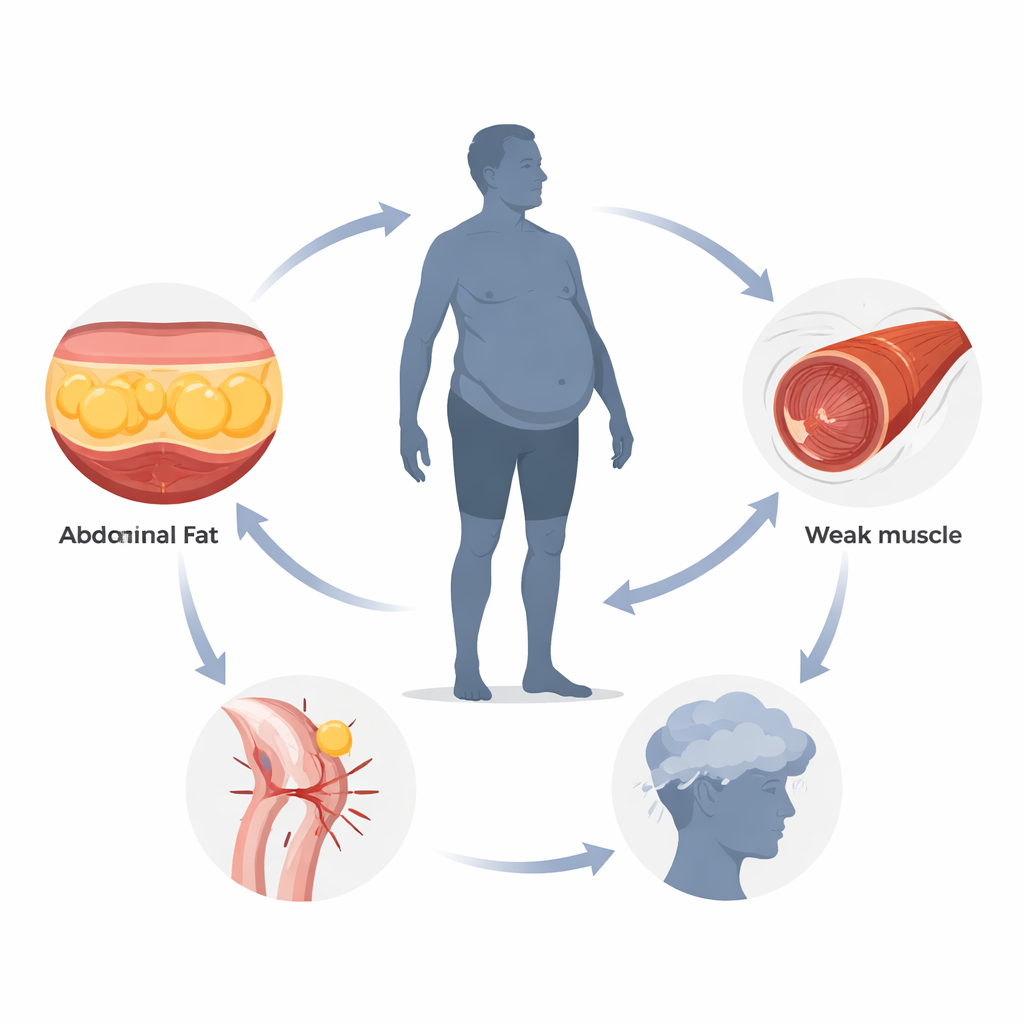
Using statistical methods that focus on how the same person changes over time, the authors searched for factors that move together with shifts into or out of the combined condition. They found that as men aged, they were more likely to develop the problem, while among women the picture was more complex, partly because frailer women were more likely to die or drop out of the study. Eating more fruits and vegetables was linked to a lower chance of entering the risky category, pointing toward the value of even modest improvements in diet. Developing high blood pressure was strongly tied to the onset of the combined condition in both the full group and especially in women. Among women, greater interference of pain with daily life and a shift from being a current tobacco user to a non-user also coincided with higher risk, possibly reflecting illness-driven quitting and weight gain. In separate time-to-event analyses, older age, high blood pressure, and, for women, symptoms of depression, all raised the likelihood of newly developing the combined problem.
What this means for older adults and health workers
The study suggests that in this rural South African setting, a notable minority of middle-aged and older adults live with both weak muscles and a thickened waist, a combination that clusters with high blood pressure, pain, and low mood. At the same time, some findings differ by sex or appear contradictory when different types of analysis are used, and no clear links were seen with conditions such as diabetes, heart disease, kidney disease, or HIV over the study period. Because the work is observational, it cannot prove cause and effect, and the authors caution against drawing firm conclusions. Still, simple checks of handgrip strength and waist size—along with attention to diet, blood pressure, pain, and mental health—could help primary care teams and community health workers identify older adults who might benefit from strength-building exercise and careful weight management before more serious problems arise.
Citation: Pengpid, S., Peltzer, K. & Hajek, A. Longitudinal prevalence and correlates of dynapenic abdominal obesity among community-dwelling ageing adults in rural South Africa from 2015 to 2022. Sci Rep 16, 13304 (2026). https://doi.org/10.1038/s41598-026-44336-4
Keywords: dynapenic abdominal obesity, ageing adults, rural South Africa, muscle weakness, abdominal obesity