Clear Sky Science · en
The role of cultural memory and place attachment in designing cultural heritage tourism
Why old towns matter to modern travelers
When people visit ancient streets and riverside towns, they are often looking for more than pretty photos. They want to feel a connection—to history, to local traditions, and to a shared sense of identity. This study explores how that kind of deep connection forms in a famous Chinese heritage site, Sanhe Ancient Town, and how memories, emotions, and social influences together shape what visitors do and how meaningful their trip feels.

How stories, symbols, and rituals shape memory
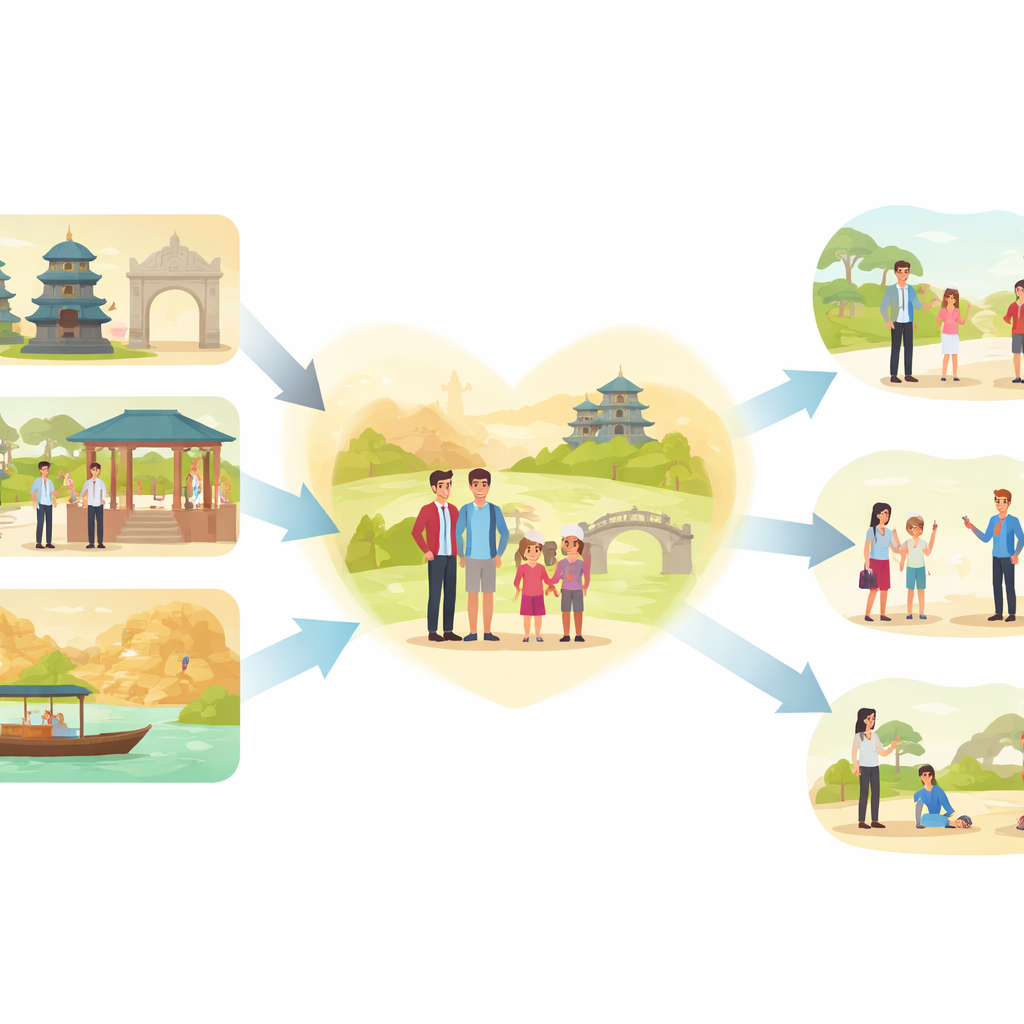
The researchers start from the idea of “cultural memory”: the shared pool of stories, symbols, and practices that help a society remember its past. In a place like Sanhe, cultural memory shows up in three main ways. First are symbolic cues, such as distinctive bridges, pavilions, and decorative motifs that instantly signal tradition. Second are rituals, including festivals, temple activities, and crafts that people enact together. Third are narratives, the stories and interpretations that tie individual buildings and scenes into a larger historical plot. The team proposes that these three pathways feed visitors’ emotional bonds with the town, which then influence how they think, what they feel able to do, and what they intend to do after leaving.
From feeling attached to planning future actions
To understand these processes, the authors combine cultural memory theory with two psychological ideas: place attachment and the Theory of Planned Behavior. Place attachment is the emotional tie people feel to a location—seeing it as meaningful, feeling reluctant to lose it, or wanting loved ones to appreciate it. The Theory of Planned Behavior explains how three factors shape our intentions: our attitude (do we see a behavior as positive?), our sense of social pressure (do important others approve?), and our perceived control (do we feel able to act?). The study suggests that cultural symbols, rituals, and stories first strengthen attachment to Sanhe, and that this attachment then colors visitors’ attitudes toward heritage travel, their sense of what others expect, and their confidence in returning or helping to protect the site.
What 420 visitors revealed about their experiences
The team surveyed 420 visitors on-site, asking about their reactions to symbols, rituals, and stories in Sanhe, their emotional attachment to the town, their attitudes and perceived social expectations, how much control they felt over future visits, and their intentions to revisit, recommend, or engage in similar cultural activities. They also rated their overall experience, including satisfaction, learning, and immersion. Using statistical models, the researchers found that symbolic cues and narrative elements were strongly linked to feeling attached to Sanhe. That attachment, in turn, was closely tied to more positive attitudes, stronger feelings that friends and family would support cultural visits, and a stronger sense of being able to revisit or contribute to the site. Those three factors together predicted visitors’ stated plans to come back, recommend Sanhe, and seek out similar places—and these intentions were strongly associated with richer, more satisfying experiences.
When rituals are quieter but still matter
One surprise was that ritual elements—such as festivals and on-site activities—did not show a straightforward, linear link to place attachment in the main model. The authors suggest several reasons. During the study period, there were no major festivals, so ritual experiences may have been low-key or easy to overlook. Some ritual-like events in Sanhe are also similar to those in many other Chinese towns, and may not clearly express what makes Sanhe itself unique. Yet when the researchers used a more flexible machine-learning approach, ritual cues still contributed to predicting visitors’ intentions and experiences, suggesting that rituals may matter in more subtle or non-linear ways, especially when designed to fit the site’s specific history.
Designing more meaningful and sustainable visits
The study’s results point to practical ways heritage destinations can create deeper, more sustainable forms of tourism. Carefully designed symbols and clearly told stories can strengthen visitors’ emotional bond to a place, which then encourages them to return, recommend the site, and behave in ways that support its preservation. The authors go a step further by sketching a virtual reality prototype for Sanhe that weaves together symbolic scenes, embodied ritual actions, and story-driven boat rides. While this prototype was not tested experimentally, it serves as a blueprint for using digital tools to activate cultural memory and place attachment. Overall, the work suggests that heritage tourism is most powerful when it helps visitors feel that they are not just passing through a picturesque backdrop, but becoming part of an ongoing cultural story.
Citation: Qian, Y., Peng, X. & Jung, E. The role of cultural memory and place attachment in designing cultural heritage tourism. Sci Rep 16, 14321 (2026). https://doi.org/10.1038/s41598-026-44178-0
Keywords: cultural heritage tourism, place attachment, cultural memory, visitor experience, virtual reality storytelling