Clear Sky Science · en
Comparative effects of surface and underwater lighting methods on coastal fishery resources in Terengganu
Why the Color of Night Lights at Sea Matters
Along the dark coastline of Terengganu in Malaysia, fishing boats turn night into day with powerful lamps that lure fish toward their nets. This study asks a deceptively simple question with big consequences: does it matter whether those lights shine above the water or glow from below the surface? The answer affects not only how many fish are caught, but whether enough young fish survive to keep future catches — and coastal livelihoods — afloat. 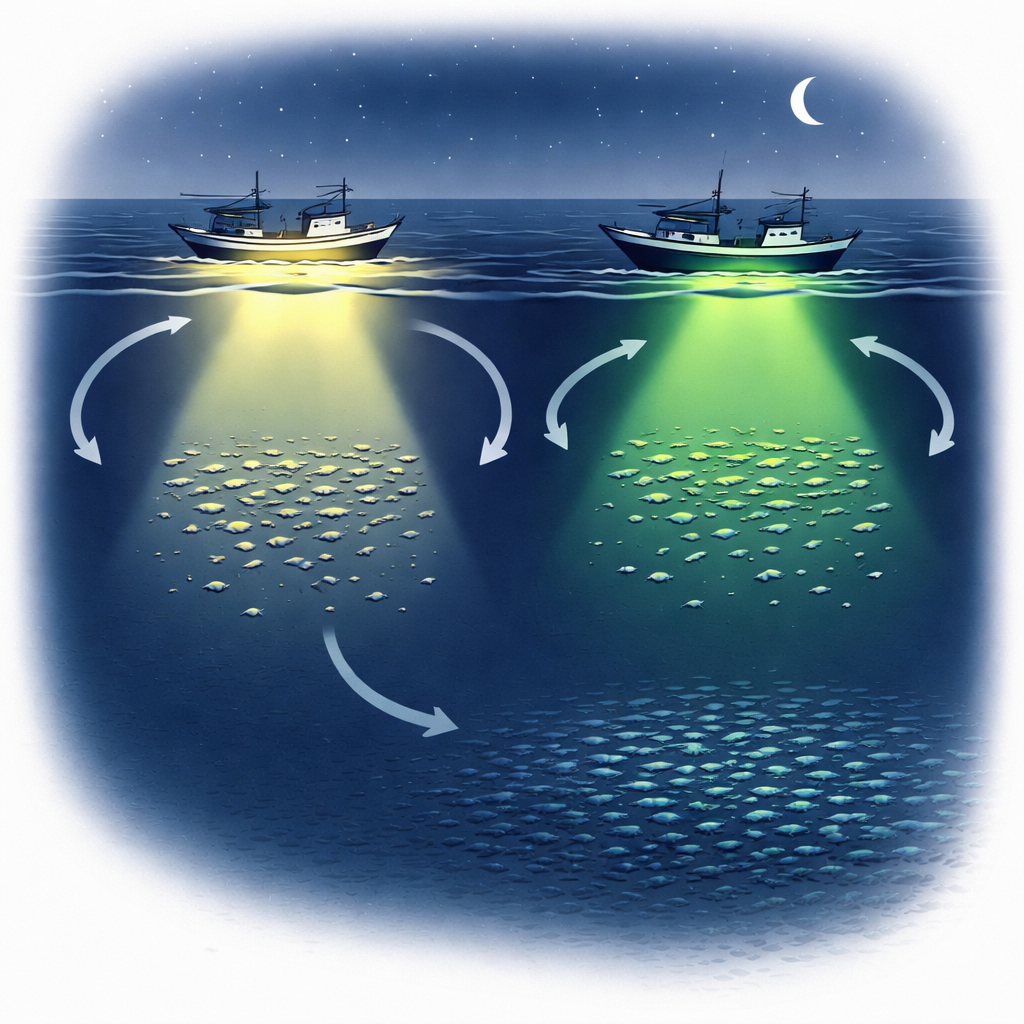
Bright Nights on a Busy Fishing Coast
Terengganu, on the east coast of Peninsular Malaysia, is one of the country’s most productive fishing areas. Many local fishers use purse seine nets — huge curtains of mesh that surround schooling fish — together with artificial light at night. The lights act like beacons, drawing in pelagic fish such as scads, mackerels, and sardines that swim near the surface. In recent years, traditional surface lamps mounted on the boat have been joined by underwater light-emitting diode (LED) units, which are cheaper to run and can shine deeper into the sea. This shift raises an urgent question: are these new underwater lights simply more efficient, or do they also increase pressure on already stressed fish populations?
Testing Two Ways to Light the Sea
To find out, the researchers joined six commercial fishing trips in offshore “Zone C” waters near Kuala Terengganu in September 2024. Two purse seine vessels worked side by side, one using a large array of mixed surface lamps, the other using green underwater LED units hung a couple of meters below the surface. Both operated at the same time, in the same waters and season, to avoid differences caused by weather or location. After each set of the net, the team thoroughly mixed the catch and took a 20‑kilogram subsample. Every fish and squid in these subsamples was identified, measured, and compared with known sizes at which the species first become capable of reproducing.
More Fish, but Younger Ones Too
Overall, the underwater LEDs brought in a slightly larger share of the total subsampled catch: about 54% of all individuals, compared with 46% for surface lights. The species caught were largely the same for both methods, dominated by Indian scad, Indian mackerel, and goldstripe sardine. Where the two methods differed was not so much in what was caught, but in the life stage of those animals. For both light types, more than half of the fish and squid measured were smaller than their known first-maturity length, meaning they were likely not yet able to spawn. This pattern was even stronger under underwater LEDs, where about 81% of individuals were immature, compared with about 81% under surface lights — a small numerical difference, but one that statistical tests showed to be more pronounced for the underwater system when looking at size structure within that catch. 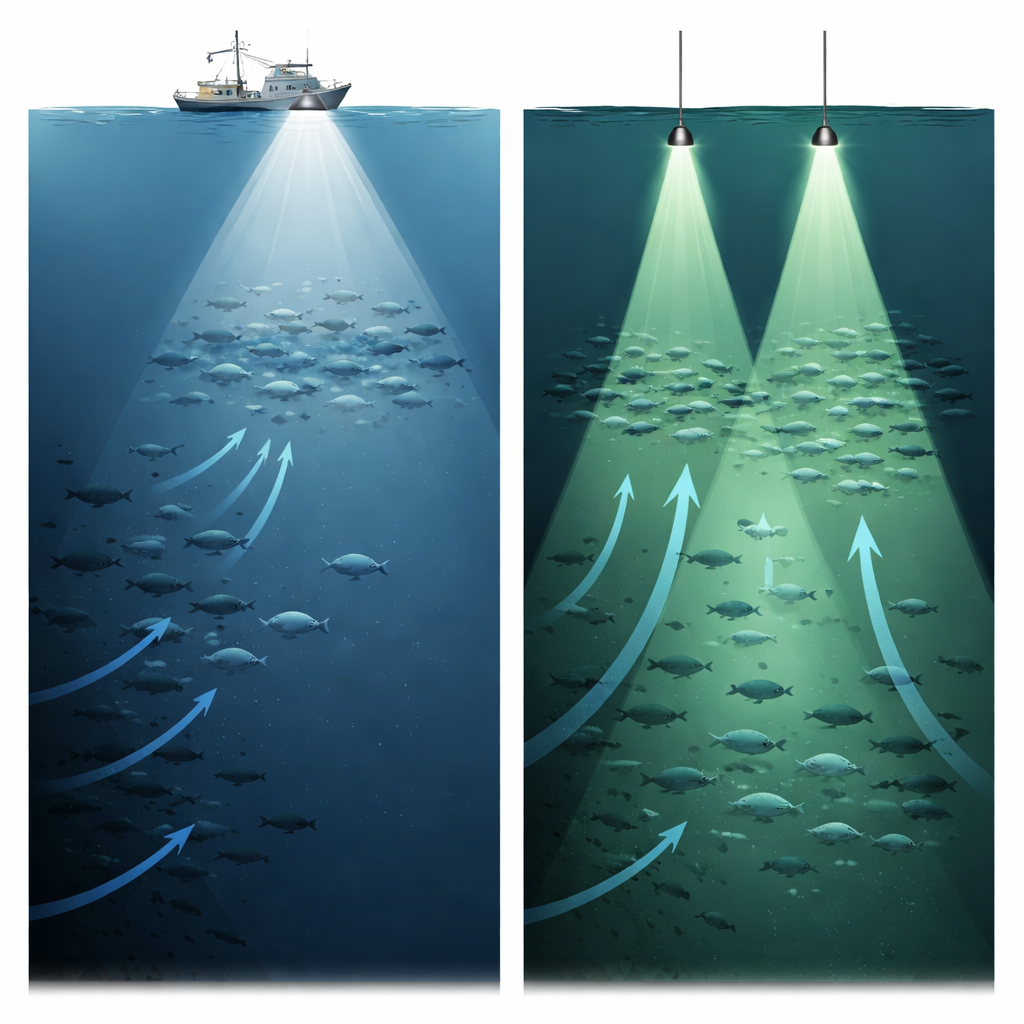
Hidden Risks Beneath the Surface Glow
Diving deeper into the data, the study found that for many species, especially under underwater LEDs, the catch was heavily skewed toward immature fish. Some species, such as certain herrings, barracudas, and small tuna, were taken almost entirely before they reached reproductive size. The authors suggest that underwater LEDs may illuminate a wider and deeper volume of water than traditional metal halide lamps, pulling in dense schools that include large numbers of young fish that would otherwise remain scattered and less vulnerable. Even though the measured effect size was statistically small, removing additional immature fish can, over time, weaken the breeding population, slow recovery, and increase the risk of long-term overfishing.
Keeping the Future Catch in Mind
In simple terms, this study shows that underwater LEDs help fishers catch more of the same kinds of fish, but they also tend to scoop up a bigger share of youngsters that have not yet had a chance to reproduce. If this practice expands without careful oversight, today’s glowing nets could dim tomorrow’s harvests. The authors argue that regulators should treat underwater lighting as a powerful tool that needs rules — for example, limiting its use during spawning seasons, enforcing size-based catch rules, or adjusting light intensity and color to reduce the attraction of juvenile fish. By balancing clever technology with cautious management, coastal communities can benefit from efficient fishing while still leaving enough fish in the sea to sustain the next generation.
Citation: Maidin, M.S.R., Mustapha, M. & Harun, N.A. Comparative effects of surface and underwater lighting methods on coastal fishery resources in Terengganu. Sci Rep 16, 13672 (2026). https://doi.org/10.1038/s41598-026-43944-4
Keywords: underwater fishing lights, purse seine fisheries, juvenile fish catch, Terengganu coast, sustainable fishing