Clear Sky Science · en
Multi-task interference during walking in children, adolescents and young adults
Why walking and doing two things at once matters
Walking while talking, texting, or carrying objects is so common that we hardly notice it—until something goes wrong. This study asks a simple but important question: how well can children, teenagers, and young adults walk when they have to do two or even three things at the same time, and how does that ability change as we grow up? The answer sheds light on everyday safety, like moving through busy school corridors, and on how the brain’s control systems mature over time.
How the study tested everyday multitasking
Researchers worked with thirty typically developing males divided into three groups: children (around 8 years old), adolescents (around 14), and young adults (around 19). Everyone completed a standard ten‑meter walking test on a flat indoor path. First, they walked at their usual pace with nothing else to do—this was the single‑task condition and served as a baseline for normal walking speed. Then, the team layered on common everyday challenges to see how adding mental and physical demands would change walking performance.
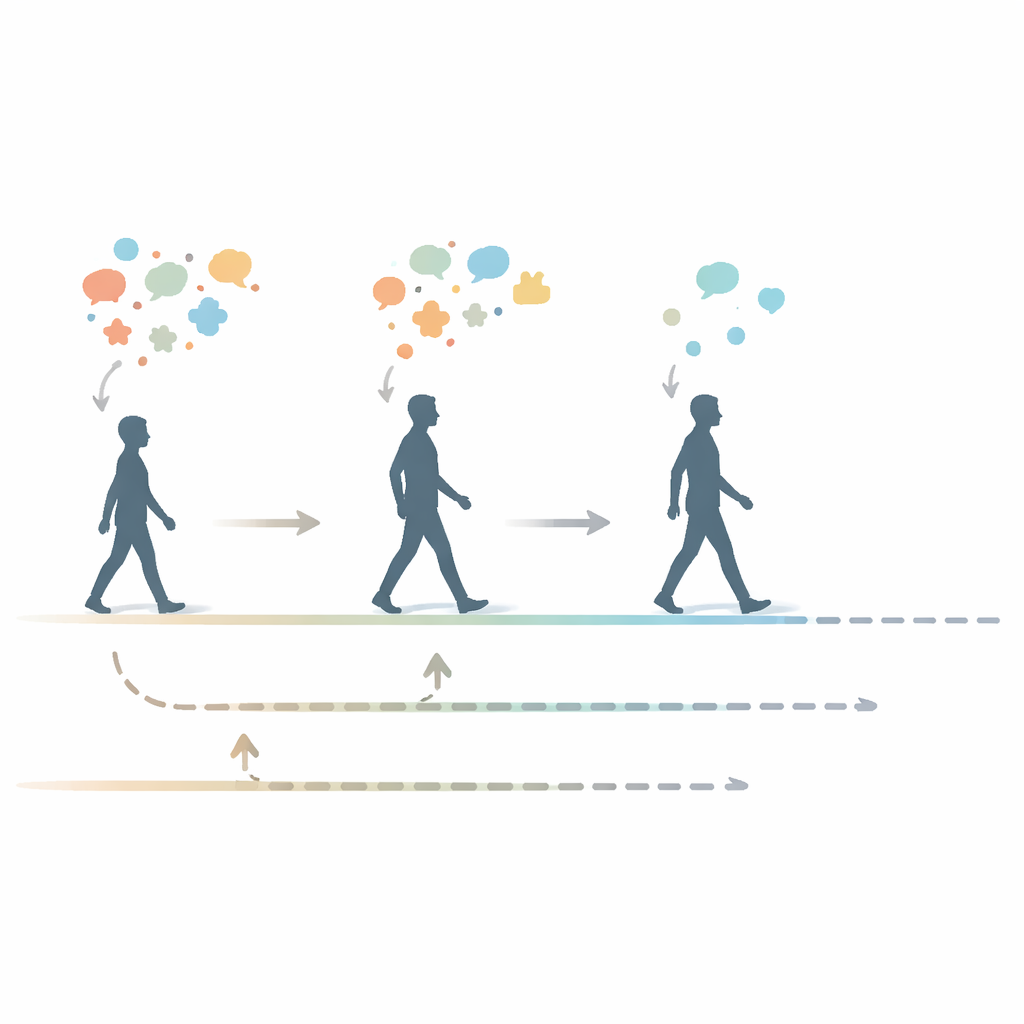
Adding thinking and carrying tasks while walking
Participants repeated the walk under three multitasking conditions. In the cognitive dual task, they walked while performing a verbal fluency exercise—saying as many words as they could from a category such as animals or colors. In the motor dual task, they walked while carrying a round tray with a ball, trying not to drop it. Finally, in the triple task, they walked while doing both the word‑generation and tray‑carrying tasks at the same time. The key measure was walking velocity—how fast they covered the middle ten meters—and how much it dropped compared with walking alone. This change in speed was treated as a sign of interference from multitasking.
What happened to walking speed at different ages
Across all ages, walking generally became slower when extra tasks were added, confirming that walking is not a fully automatic activity: it draws on attention and planning. For children and adolescents, walking speed dropped in every multitasking condition compared with walking alone, and it dropped the most during the triple task. In young adults, walking slowed clearly when a thinking task was added, both in dual and triple task conditions, but was much less affected by simply carrying the tray. When the researchers compared age groups, children always walked more slowly than teenagers and young adults under multitasking, and teenagers showed more slowdown than young adults, especially when mental effort was involved.
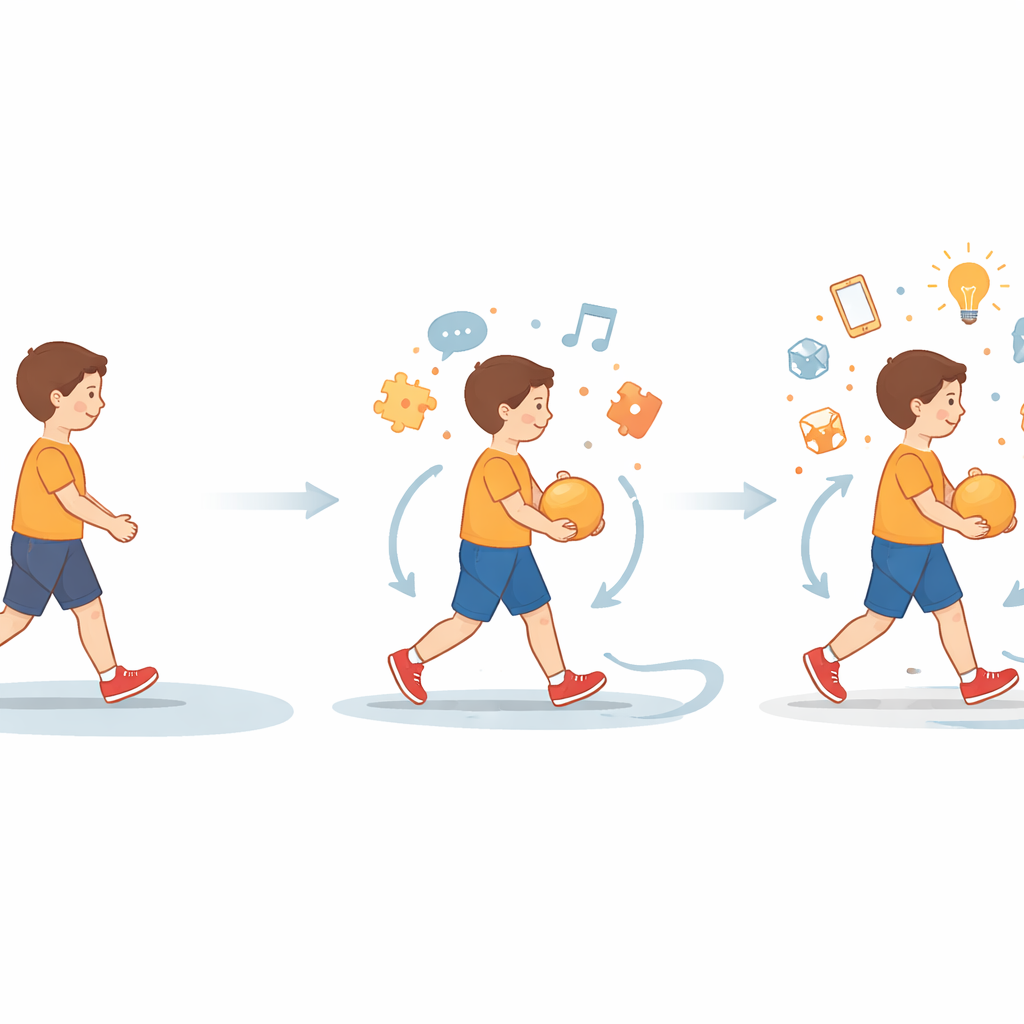
Why younger walkers struggle more
The pattern suggests that younger children have a smaller “pool” of attention and executive control to share between tasks. Brain regions that help juggle information, plan actions, and keep balance—especially the prefrontal cortex and cerebellum, along with connecting white‑matter pathways—are still developing throughout childhood and adolescence. When children must walk, think of words, and carefully carry an object at the same time, all these systems are heavily taxed. The study found that the triple task produced the largest drop in walking speed in children and adolescents, indicating that combining a mental and a motor challenge pushes their multitasking abilities close to their limits. Young adults, with more mature brain networks and better coordination skills, were able to cope with the added load more effectively.
What this means for everyday life
For a layperson, the takeaway is clear: children are much more likely than adults to have their walking disrupted when they are distracted or overloaded with tasks. Slower and less stable walking under heavy multitasking may raise the risk of stumbles, bumps, and falls, especially in crowded or complex environments like playgrounds and school hallways. The results support designing age‑appropriate activities that gradually build the ability to combine movement with thinking and object handling, rather than assuming that children can safely manage the same multitasking demands as adults. In short, our capacity to walk and do several things at once improves with age, and understanding this can help parents, teachers, and planners create safer, more supportive spaces for growing minds and bodies.
Citation: Laatar, R., Borji, R., Harrabi, M.A. et al. Multi-task interference during walking in children, adolescents and young adults. Sci Rep 16, 12097 (2026). https://doi.org/10.1038/s41598-026-42643-4
Keywords: multitasking, walking, child development, dual task, triple task